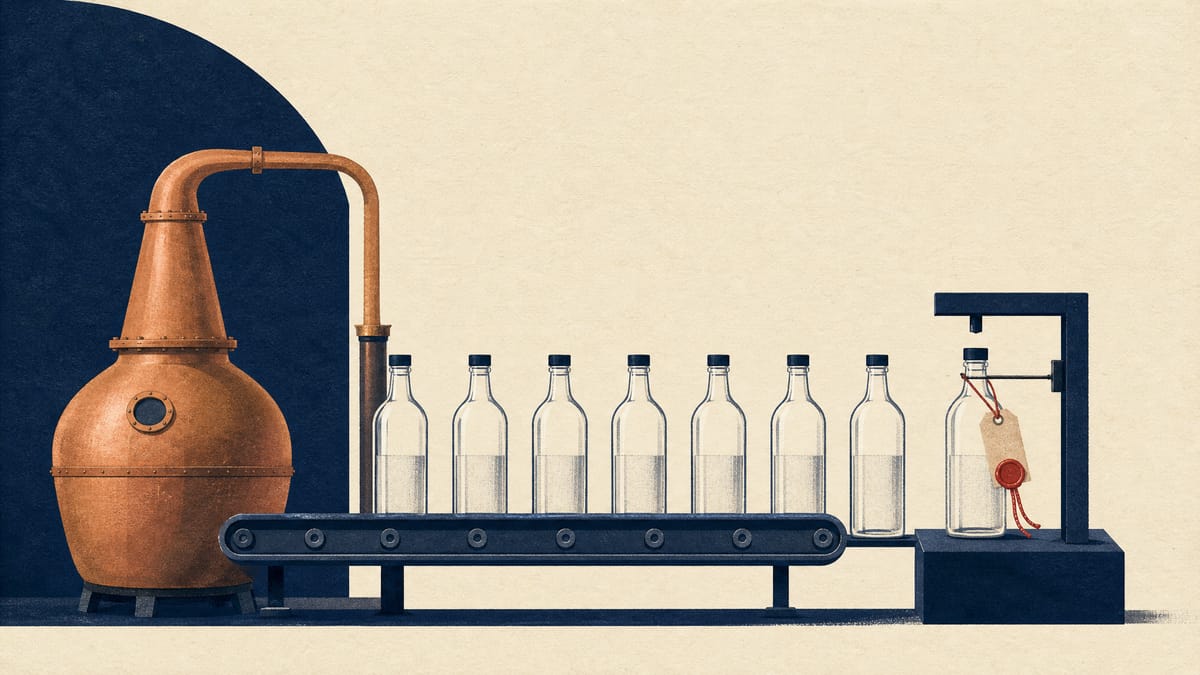
The Ministry of Finance and the National Tax Agency opened a public comment period on 21 October 2026 on a draft that would designate honkaku shochu as a geographical indication for distilled spirits, with the production area defined as all of Japan. Comments close on 20 November 2026, must be in Japanese, and will not be answered individually.
What the draft requires
The draft designation sets out the standards a producer would have to meet to use the name.
- Ingredients must be those of single-distilled shochu as defined in the Liquor Tax Act.
- Fermentation and distillation must both take place in Japan, and distillation must use a single-distillation still.
- Nothing may be mixed into the distillate afterwards other than water, items covered by the production-method provision above, or items permitted by the tax rules for preserving liquor.
- Any storage must be in Japan, and wooden-container storage needs approval under Article 50(1) of the Liquor Tax Act.
- The spirit must be filled in Japan into containers meant for consumers.
The draft also puts a checking body between producer and label. Before a product leaves the distillery (removals covered by Article 28(1) of the Liquor Tax Act are excluded), the Honkaku Shochu Management Committee must confirm, under its own operating guidelines, that it meets the standards. The committee has its main office in Kagoshima, inside the Kyushu Honkaku Shochu Council.
The draft describes the category as spirit of up to 45% alcohol, noting that bottles on the market are mostly diluted to 20%, 25% or 35%. It gives its own account of the name: used from around 1960 to distinguish the spirit from continuously distilled shochu, and permitted in 1971 as an exceptional product-type label under the ministry's enforcement rules.
The rule change behind it
A companion draft amends Article 11-5 of the enforcement rules for the law on liquor tax preservation and liquor industry associations. Today the entry for single-distilled shochu lets products of the types listed in the Liquor Tax Act use the name. Under the draft, the name would be available to shochu entitled to use the honkaku shochu indication that the NTA commissioner designates as a geographical indication. The amended ordinance would take effect on promulgation.
Transition for existing labels
Products already carrying the old wording when the ordinance takes effect would keep the existing rules. For five years from the effective date, a producer or licensed seller could also keep using the old wording on single-distilled shochu sold under the same trademark as products already shipped with it. The comment notice gives no date for the final designation to take effect.