Japan's land ministry has opened public comment on a package of draft rules to implement the law amending the Sewerage Act and other laws (Act No. 65 of 2026). The drafts introduce a five-tier condition grade for sewer assets, set inspection intervals as short as three years, and require operators to publish results. Comments are accepted from 16 October to 14 November 2026, and the drafts say the rules would apply from 12 January 2027.
Five grades, each with a duty
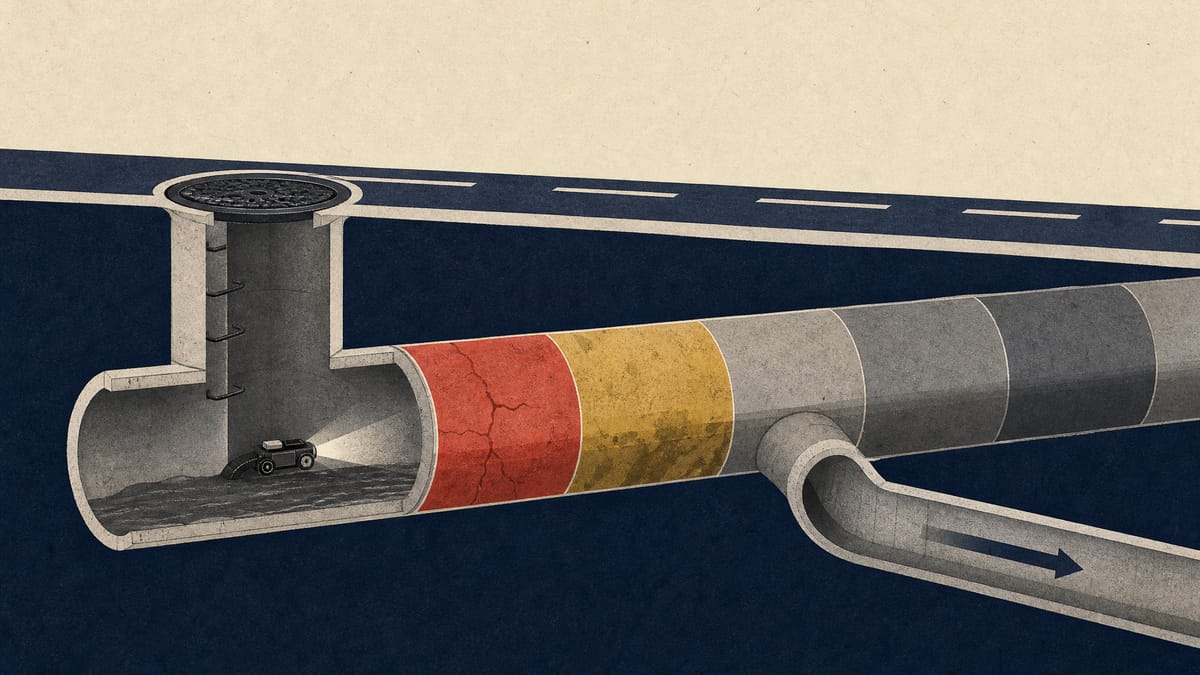
The draft ministerial notice sorts each assessed facility into one of five categories: diagnosis deferred, grade IV (emergency action), grade III (early action), grade II (watch) and grade I (sound). Grade IV means the structure's safety has fallen, or is very likely to fall, and urgent rebuilding is needed.
For the drainage facilities designated for particularly intensive inspection, the response scales with the grade. For grade IV, the operator must rebuild urgently to restore grade I. If that is difficult, it must carry out ground improvement or similar measures to prevent road collapse until rebuilding happens. For grade III, operators must apply emergency measures, increase the frequency of detailed inspections and plan the rebuild. Where a facility cannot be diagnosed, the draft calls for better inspection methods first, and for facilities that still cannot be assessed it calls for bypass pipes, upstream storage or weirs.
Which pipes face the tightest regime
A separate draft notice designates the facilities treated as critical. They include public sewer pipes with an inner diameter of at least two metres, pipes running from the most downstream confluence manhole to the treatment plant, pipes under emergency transport roads named in local disaster plans, pipes under railway or tramway land, pipes under rivers, and all pipes of basin-wide sewer systems.
For these facilities, the draft ministry ordinance makes using several inspection methods the basic approach. Intervals depend on location. Corrosion-prone concrete spots, pipe-manhole joints without damage protection, and spots on sandy ground where the last inspection found a risk of voids (excluding spots where ground improvement or other effective damage-prevention measures are in place) must be checked at least every five years. Other spots must be checked at least every ten years. Corrosion-prone concrete spots with markedly high hydrogen sulfide levels, and spots meeting all three of those first criteria, move to at least every three years.
The draft cabinet order adds design requirements: manholes built so that inspection equipment can be moved in and out easily, or otherwise built to allow safe and efficient rebuilding, repair or inspection, and, for critical facilities, measures to regulate sewage flow such as bypass pipes, upstream storage or weirs. At critical-facility spots at particular risk of damage, corrosion or deterioration, it calls for sensors or other measures that make anomaly detection more efficient. It also allows remote operation of equipment and similar information technology for inspections.
Disclosure and finances
For the critical facilities and the designated corrosion-prone facilities covered by the inspection rules, operators would have to publish each facility's location, assessment date, result and any planned rebuilding or repair. Publication is due by the end of the fiscal year after the assessment. Grade IV facilities must be published promptly. A draft notice sets map colours: black for deferred, red for grade IV, yellow for grade III, green for grades II and I, and grey for facilities not yet assessed.
The ministry ordinance also asks operators to model long-term income and spending over 30 years or more. It says they must endeavour to publish an outlook covering at least ten years and to review it roughly every three to five years. Usage fees would be set from a cost base that includes a reserve for future renewal work.
How to respond
Comments must be in Japanese, by email or post, with name, address and contact details. Telephone comments are not accepted, and the ministry says it will not reply to individuals. Submitters' names may be published with their comments.