Web View
Plenty of kerosene, Tokyo says, but please order like last year
Japan says there is no kerosene shortage, then asks sellers to order like last year and promises an import subsidy. Plus a record foreign-resident count, Rakuten's dollar-debt plan and a Shimane Bank balancing act.
MARKETS
Market pulse
Tokyo equities advanced while the 10Y JGB yield nudged lower.
Sourced from Nikkei, JPX, BOJ, MOF - values, not commentary.
TSE Prime investor flows
| Investor | Week ending |
|---|---|
| Foreign net flow | +¥1447.5bn |
| Individual net flow | +¥47.5bn |
| Trust-bank net flow | −¥32.7bn |
Japan Exchange Group, investor-type weekly trading value (TSE Prime)
lead
Japan Asks Buyers to Calm Down on Winter Kerosene
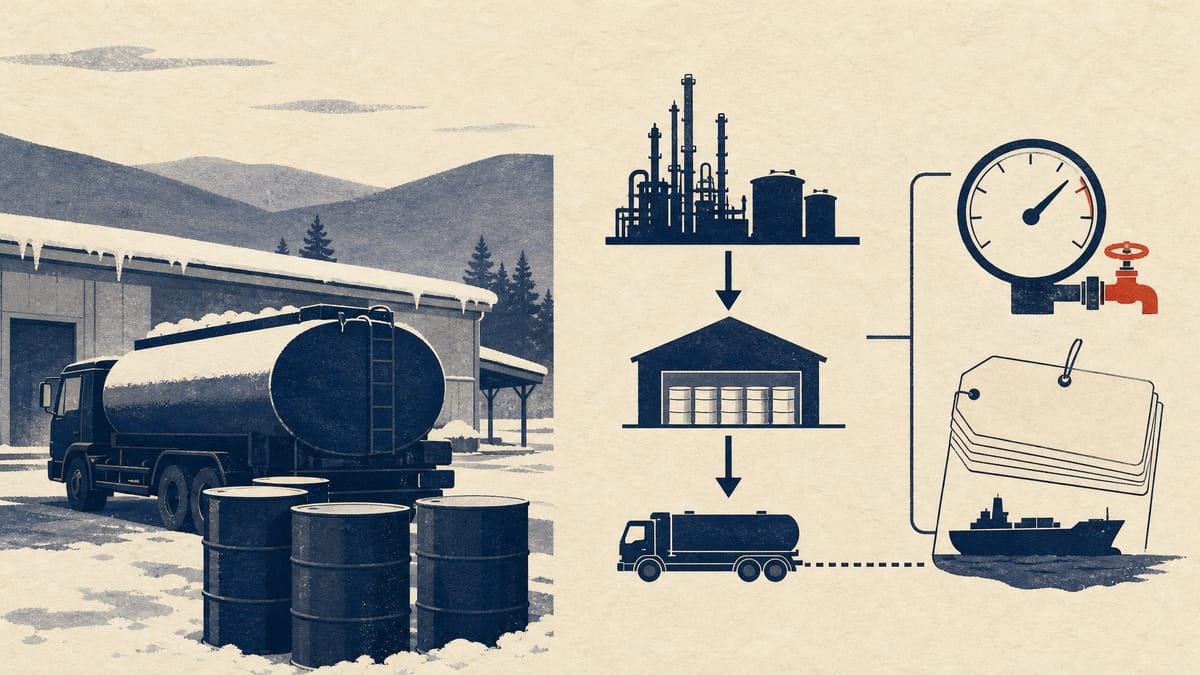
Japan asks fuel sellers to hold kerosene orders at last year's level and adds import-price subsidy
Economy minister Akazawa says Japan has no kerosene shortage, yet METI will ask sellers to match last year's volumes, let refiners sell directly and subsidise the import-price gap. At a post-cabinet press conference on 16 October, Akazawa said the ministry had decided to strengthen countermeasures against rising kerosene prices. He said petroleum products including kerosene are secured in the quantity Japan needs as a whole and that the country is not in a situation of supply shortage. That is the minister's assertion; the transcript gives no volume figures.
What changed: METI named three steps. Refiners, import trading houses and wholesalers are asked to sell and order the same volumes as in the same month a year earlier. A new kerosene direct sales scheme will let refiners sell directly when supply is lopsided or distribution is clogged. A new subsidy will cover the difference between the import price and the domestic wholesale price, under the name import kerosene adjustment unit price.
Why it matters: Akazawa said some wholesalers have placed orders far above normal annual demand, and some refiners have asked customers to order in line with expected demand so they can keep supplying steadily. He said anxiety about winter kerosene supply had spread among some of the public. Import kerosene prices remain high relative to crude oil because of reduced refining capacity internationally, he said, and domestic prices could be strongly affected by them.
What to watch: Asked about Hokkaido, where a reporter said prices have climbed to more than ¥10 above the national average, Akazawa gave no verdict on the level. He said that if the public understands direct sales will bring product to market, he expects prices to settle gradually, though Hokkaido can stay pricier. The transcript gives no subsidy size, per-litre rate, start date or budget source.
secondary
People, Borders and Audit Rules

Flat first-half foreign entries in Japan mask a 57% fall in new arrivals from China
New foreign entrants fell just 0.1% in the first half of 2026, but the mix underneath moved sharply: China down, South Korea and Taiwan up about a fifth each. Japan's Immigration Services Agency counted 19,706,953 new foreign entrants from January to June, down 21,452 on a year earlier. Including re-entrants, foreign entrants rose 0.3% to 21,447,220.
The number: China's new entrants fell 57.3% to 1,598,470, or 8.1% of the total. South Korea, the largest source, rose 19.0% to 5,553,483 and Taiwan rose 21.2% to 3,769,254. The release does not give reasons for any of the nationality-level shifts.
The catch: Foreigners granted special landing permission, which is not a residence-status entry, fell 32.2% to 1,370,546. Cruise-ship sightseeing landing permission fell 64.1% to 281,792. The figures end in June 2026 and say nothing about conditions since.

Foreign residents hit record 4.28mn as specified skilled worker status leads six-month rise
Specified skilled worker status added 53,960 residents in six months to end-June, the biggest gain among the five most common statuses. Japan had 4,281,026 foreign residents at the end of June 2026, a record, up 155,631 or 3.8% from 4,125,395 at the end of 2025, the Immigration Services Agency said. The 3.8% is a six-month change, not an annual one.
By the numbers: Specified skilled worker status rose to 444,256. Engineer/humanities/international services status added 40,394 to reach 516,184. Technical intern numbers barely moved, up 891 to 457,509. The business manager status fell from 46,781 to 42,747, and the release gives no reason.
Reader takeaway: The figures count people by residence status at a point in time, so permanent residents, students and family members in the total should not be read as a workforce count. For employers, the useful signal is the mix: the fastest-growing statuses are tied to skilled and professional work.
FSA panel proposes longer going-concern look-ahead for auditors
A draft would require auditors to assess going concern for at least a year after financial statements are approved, and to report on it even without material uncertainty. The audit subcommittee of the Business Accounting Council published the draft revision of Japan's auditing standards on 16 October and opened it to public comment. Current practice has auditors test management's going-concern assessment over a reasonable period of at least one year from the closing date. The draft would instead require a review of at least one year after the approval date for publication of the financial statements.
What changed: Today the audit report carries a separate going-concern section only when a material uncertainty exists. The draft adds a separate section where none is found. For listed-company audits, the auditor would also have to explain how it examined management's assessment when the report notes an uncertainty, or says none exists and management made significant judgments. On fraud, the subcommittee concluded the standards need no revision.
What to watch: Comments are due by 17:00 on 16 November 2026. If adopted, the revised standards would apply to audits of financial statements for fiscal years ending March 2028. These are consultation proposals, and nothing is final until the council adopts a revised text.
secondary
Company Filings Worth a Minute
Rakuten earmarks ¥265.6bn of its ¥360bn bond for February dollar-debt repayment
Rakuten Group plans to use ¥265.6bn of the Series 26 bond's net proceeds to repay a dollar bond due February 2027, while the ¥40bn Series 27 is earmarked wholly for cash spent on its fintech restructuring. Rakuten Group filed two shelf registration supplements on 16 October for unsecured yen bonds with the same 4.370% annual coupon. Series 26 is ¥360bn and matures on 28 April 2032; Series 27 is ¥40bn and matures on 22 April 2032. Neither has been funded: payment is due on 29 October for Series 26 and 22 October for Series 27.
The move: Series 26 nets about ¥354.6bn after ¥5.4bn of estimated issue costs. Rakuten plans ¥265.6bn of that for redeeming dollar-denominated unsecured bonds maturing on 15 February 2027, and ¥10bn for Series 9 bonds maturing on 25 June 2027. The remainder is meant to replace cash already spent on preparatory steps for restructuring its fintech business on 30 September, and the supplement does not say how it is split.
Details: Series 27 nets about ¥39.8bn, all earmarked for the same restructuring-related cash. Both supplements sit under a shelf registration valid to 29 September 2028 with a ¥600bn ceiling, and Japan Credit Rating Agency assigned a single-A-minus rating on 16 October. The 4.370% is a coupon on bonds issued at par, not a yield, and the use-of-proceeds statements are plans, not completed repayments.

Shimane Bank pairs ¥60bn securities sale with ¥10bn preferred issue to SBI Shinsei
Shimane Bank forecasts a ¥5.98bn net loss for the year to March 2027 on a planned securities sale, and has proposed ¥10bn of non-voting preferred shares for SBI Shinsei Bank that need shareholder approval on December 24. Shimane Bank said on 16 October it plans to sell about ¥60bn of securities between January and March 2027, booking a loss of about ¥6.5bn, and proposed the Class C preferred issue.
What changed: The consolidated forecast turns from a profit (ordinary income ¥330mn, net profit ¥270mn) to an ordinary loss of ¥5.96bn and a net loss of ¥5.98bn. The bank calls the loss one-off, expects its capital ratio to rise to about 8.5% by the end of March 2027, and keeps the forecast dividend at ¥10 per common share. The chairman and the president will each take a 30% pay cut for January to March 2027.
The catch: If every Class C share converted at the ¥407 floor, the bank would issue common shares carrying 245,700 voting rights against 83,559 existing, about 294% of existing voting rights. That is a ratio to the current voting base, not an ownership stake. The filing says conversion would be expected to change the controlling shareholder, and SBI Shinsei already holds 20.90% of voting rights.
What to watch: Payment is due on 25 December 2026, with net proceeds of about ¥9.91bn earmarked for lending to local businesses. The bank will seek a special resolution at an extraordinary shareholders' meeting on 24 December, and class meetings of other holders must also approve. Issuance depends on all of those approvals.
Tokyo Steel now guides to a ¥1bn operating profit after forecasting a ¥4bn loss
Tokyo Steel now forecasts a ¥1bn operating profit for the year to March 2027, from a ¥4bn loss, on higher shipment prices and cheaper scrap, while asset sales help lift its interim net income guide. In a revision dated 16 October, the steelmaker also raised its net income forecast to ¥7.0bn from ¥1.0bn. All figures are non-consolidated forecasts for the year ending March 2027, not reported results.
What changed: The company says product shipment prices rose as it had assumed and the purchase price of iron scrap came in below its assumption. The notice gives no figure for either effect. The interim operating loss forecast narrows to ¥3.5bn from ¥4.0bn, so the second half has to carry the full-year profit. Full-year sales are now forecast at ¥326.0bn, up from ¥315.0bn.
The catch: The net income lift comes from a different source: the company says asset sales have progressed, lifting its interim net income forecast to ¥2.25bn from ¥1.0bn. The notice names no assets and gives no proceeds. The ¥7.0bn full-year figure is below last year's ¥11.557bn, and the company warns that actual results could vary significantly with iron scrap prices and steel market conditions.
Tokyo Century's aircraft lessor signs for 75 Airbus jets, delivering 2032 to 2035
Aviation Capital Group, the US lessor Tokyo Century is selling half of to Itochu, has signed for 75 A320neo-family jets with a catalog value of about ¥1.856tn; the actual price is undisclosed. Aviation Capital Group (ACG), which Tokyo Century consolidates, signed the contract on 15 October US time, 16 October in Japan. Tokyo Century converted the catalog value at ¥157.33 to the dollar as of 30 September, and says a confidentiality agreement stops it disclosing what ACG will actually pay.
Details: Delivery is expected from 2032, with the last aircraft due in 2035, so Tokyo Century expects only a slight effect on consolidated results for the year to March 2027. At the end of June 2026 ACG owned 286 aircraft and managed 25. Including aircraft on order, the figure is 504. Narrowbodies make up 94% of the fleet by aircraft count.
The catch: Tokyo Century has agreed to sell 50.0% of TC Skyward Aviation U.S., the parent of ACG, to Itochu. After the sale closes, ACG will leave Tokyo Century's consolidated group and become an equity-method affiliate. The order notice does not say how the commitment will be shared or financed after that change.
Kirin says hackers took data on 785,000 Fancl and Attenir members
Unauthorised access to the Fancl and Attenir online shops between 3 and 10 October exposed member data, Kirin said; card details were excluded, and the earnings effect is under review. Kirin Holdings said on 16 October that a third party broke into the online shops of its subsidiary Fancl and Fancl's consolidated subsidiary Attenir. It said it has seen no misuse or secondary damage attributable to the incident as of that day.
What changed: The leak covers 393,785 records for 368,184 Fancl members and 441,162 records for 417,312 Attenir members. The data includes email address, name, address, phone number, date of birth, sex and customer number. Credit card and other payment information was not part of the affected data. The notice does not say whether any individual is a member of both sites.
Details: An internal investigation on 15 October found that the two shops were accessed without authorisation between 3 and 10 October. The companies shut down the attacked function, reported the incident to the Personal Information Protection Commission and consulted the police.
What to watch: Kirin is still examining the effect on consolidated results and says it will disclose promptly if a material impact on future earnings emerges. The notice gives no cost estimate.
quick hits
Quick Hits
Japan pledges $40mn to child health fund and presses G20 on debt data
Read moreJapan pledged $40mn to the Global Financing Facility and urged every G20 member to join a World Bank debt-data exercise, in a statement delivered as it took the Development Committee chair.
Nidec receives officer-liability report and will weigh damages claims next
Read moreNidec has the committee report on whether current and former officers are legally liable for its accounting misconduct; the notice gives no findings, promises a redacted version later, and says damages claims will be deliberated next.
Japan proposes ending fixed airline audit schedule for risk-based plans
Read moreJapan's Civil Aviation Bureau proposes dropping standard audit frequencies for large carriers in favour of plans built on an 11-item risk profile and mandatory corrective-action plans; comments close November 13.
METI proposes extending sash efficiency rules to non-wooden apartments, with a 2.97 target
Read moreA draft METI notice would set a 2.97 W/m²K heat-loss target for sashes used in non-wooden apartments, applying to makers and importers with about 1% of output; public comment runs to 16 November 2026.
TradeWorks says a setup flaw exposed up to 4,611 Iwai Cosmo customers' data
Read moreTradeWorks says it will bear all costs after a misconfigured admin function in the trading system it supplies to Iwai Cosmo Securities may have exposed names and email addresses of 4,611 customers, and it is checking its other financial-institution clients.
Tokio Marine & Nichido prices ¥200bn of bonds, with coupons from 2.221% to 3.468%
Read moreTokio Marine & Nichido fixed coupons of 2.221% to 3.468% on four bond tranches totalling ¥200bn, up from ¥150bn expected earlier, and plans to allocate all net proceeds to green and nature finance projects by September 2029.
Japan Prime Realty agrees ¥32.8bn purchase of Otemachi tower stakes from its sponsor
Read moreJapan Prime Realty has contracted to buy 22.5% of the building portion of two Otemachi towers from its sponsor for ¥32.8bn at a 3.3% NOI yield, betting on rent resets as fixed-term leases are renewed.
Santen's Chinese venture seeks bankruptcy, with the parent's ¥2bn loan already fully provisioned
Read moreSanten Pharmaceutical's Chongqing joint venture, in liquidation since 2024, will apply for bankruptcy with about ¥3.3bn of liabilities, but the company says a fully provisioned ¥2bn loan means no new loss.