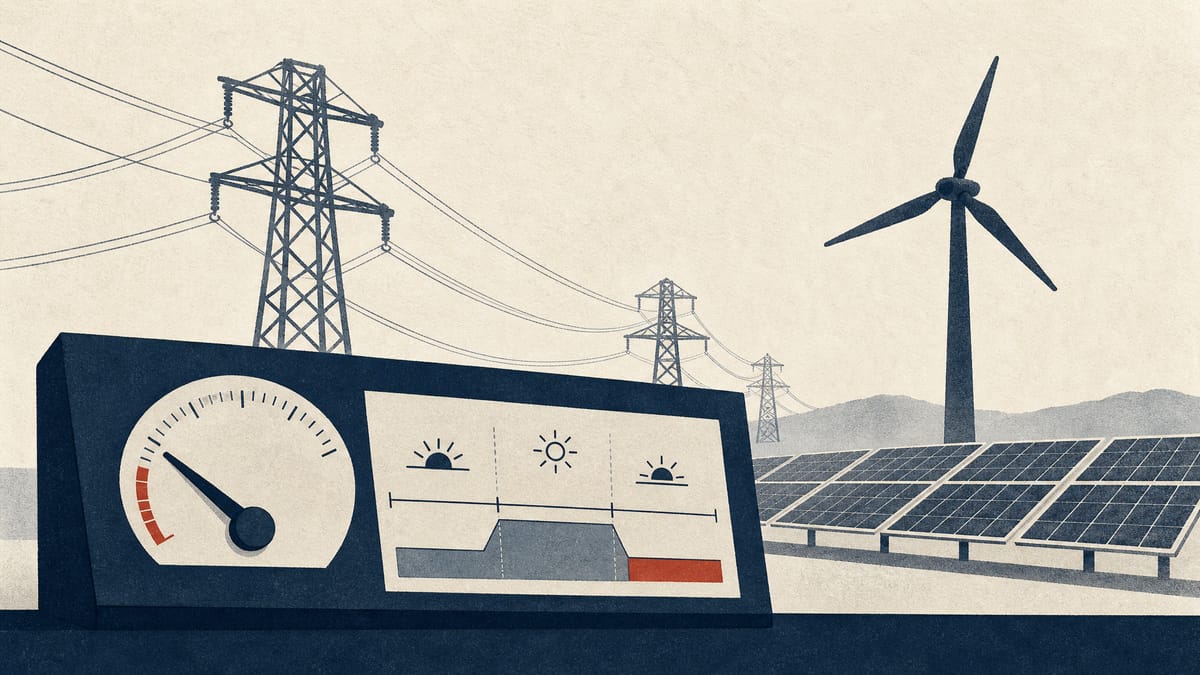
Japan's transmission oversight body has signed off on a small but telling curtailment order in Hokkaido, confirming that grid operator Hokkaido Electric Power Network had no other option but to throttle back solar and wind generators on a single congested line over five July holidays.
The Organization for Cross-regional Coordination of Transmission Operators (OCCTO) published its verification on September 9, cataloguing curtailment on the 66kV Tomikawa line during four hours a day, 10:00 to 14:00, on July 5, 12, 19, 20 and 26. Under the interim measures now governing local grid congestion in Hokkaido, output cuts are calculated separately for weekdays, Saturdays and holidays each month, and the July holiday cut topped out at 1,400 kW.
| Item | Detail |
|---|---|
| Congested line | 66kV Tomikawa line, Hokkaido Electric Power Network |
| Curtailment dates | July 5, 12, 19, 20 and 26, 2026 (Sundays and public holidays) |
| Curtailment hours | 10:00 to 14:00 daily |
| Maximum curtailment | 1,400 kW (0.14万kW) |
| Legal basis for review | Article 180, Paragraph 2, OCCTO business regulations |
| OCCTO's verdict | Both tested conditions judged valid |
OCCTO's review, conducted under Article 180, Paragraph 2 of its business regulations, tested two things: whether any adjustable generation or storage on the line, such as pumped-hydro pumping or battery charging, should have absorbed the strain before renewables took the hit, and whether the line's forecast power flow genuinely exceeded its operating capacity at the moment of maximum curtailment. OCCTO found no adjustable resources on the Tomikawa line to draw on first, and confirmed forecast flow did exceed capacity at the peak-curtailment hours on each of the five days. It judged the curtailment orders valid on both counts.
The review matters less for its verdict, which was a clean pass, than for what it says about how Hokkaido manages grid congestion while it waits for a permanent fix. The region's proper congestion management system is not due to launch until the end of the fiscal year running through March 2027, so local grid bottlenecks are handled under stopgap interim measures that calculate curtailment volumes month by month and apply them uniformly across all holidays in a given month, rather than tailoring cuts to daily conditions. OCCTO's own reference material notes that this differs from the methodology used in other regions: in a March 2025 case for Chubu Electric Power Grid, curtailment volumes were instead scaled to each connected generator's peak intake rather than applied as a flat cut.
For renewable developers connected to constrained lines under non-firm terms, the case is a reminder that a single line with no dispatchable backup can force output cuts on any day forecasters expect congestion, holiday or not, and that the region's curtailment math will keep running on this temporary formula until the permanent system launches by the end of the fiscal year running through March 2027.