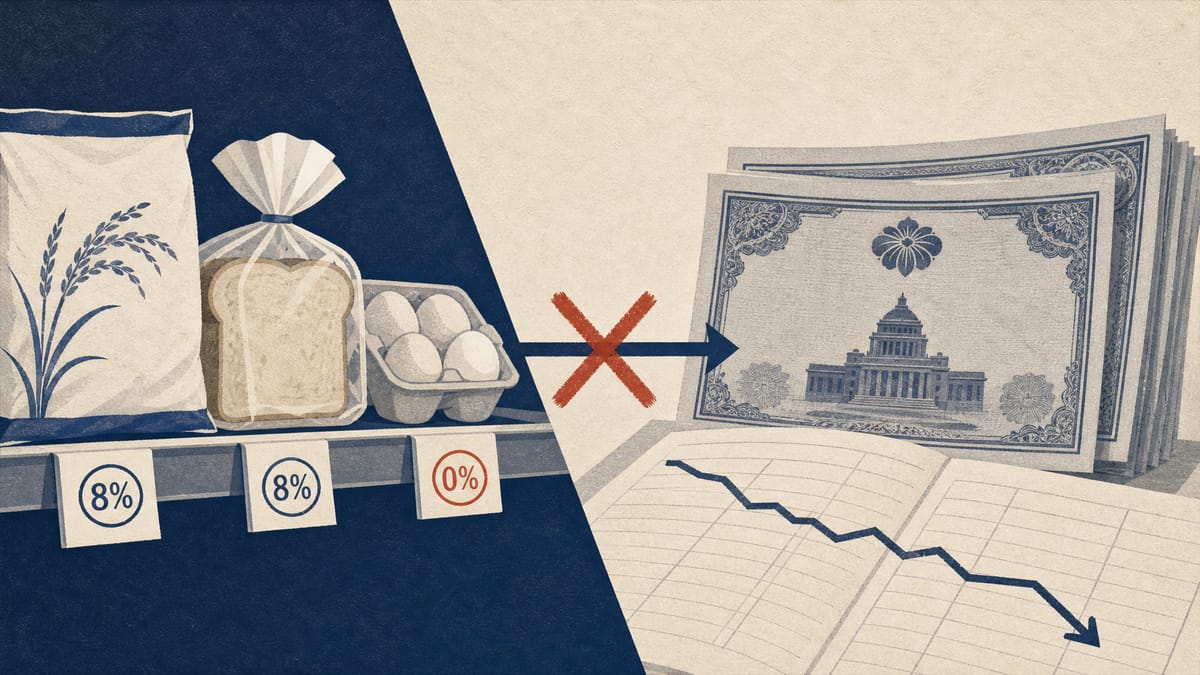
Finance Minister Katayama, who also oversees the Takaichi cabinet's budget-formation overhaul, told reporters on September 8 that funding for a two-year cut in the consumption tax on food and drink will come from that reform process, not new deficit bonds. Reporters had pressed him on how the administration would pay for a measure whose annual cost, including accompanying benefits, they put at roughly ¥5tn.
Katayama said the position has been consistent since an August 5 Cabinet decision set out the basic policy: secure the money "without relying on special government bonds" as the Takaichi administration's budget-formation reforms are turned into specifics. Concretely, that means a zero-based review of tax expenditures, subsidies and non-tax revenue sources, run alongside a review of both spending and revenue, while working to keep the debt-to-GDP ratio on a stable downward path. Only once that spending and revenue math is worked through will the ministry set the size of full-year Japanese government bond issuance needed to secure market confidence, he said.
He also used the briefing to draw a line under what he called years of supplementary-budget-dependent fiscal management. Going forward, supplementary budgets will be limited to measures of genuine urgency. That commitment reaches into the food-tax debate directly: the roughly ¥3tn Tokyo has recently parked in supplementary budgets for inflation relief is now up for review, because income-linked benefits and the tax cut itself are meant to take over that role as a bridge measure against high prices.
On the ministry's parallel effort to trim tax breaks and subsidies through Japan's version of the US DOGE spending review, Katayama sounded unimpressed with the opening results. Ministries' own requests so far propose abolishing only a small number of tax breaks and little in the way of subsidy or fund changes, and Katayama said the items ministries did offer to cut typically involve very small revenue effects or programs with no track record of ever being used. He said the finance ministry will not simply accept the self-inspections as final, calling the request-stage review only the first step before the tax reform process reprioritizes spending.
Katayama did not put a number on future bond issuance, nor detail how much revenue the tax-expenditure and subsidy review will raise. He said those specifics, along with the full financing picture for the food-tax cut, will be laid out later in the budget-formation process, and that the government intends to explain the plan carefully to financial markets and the public to secure their confidence.