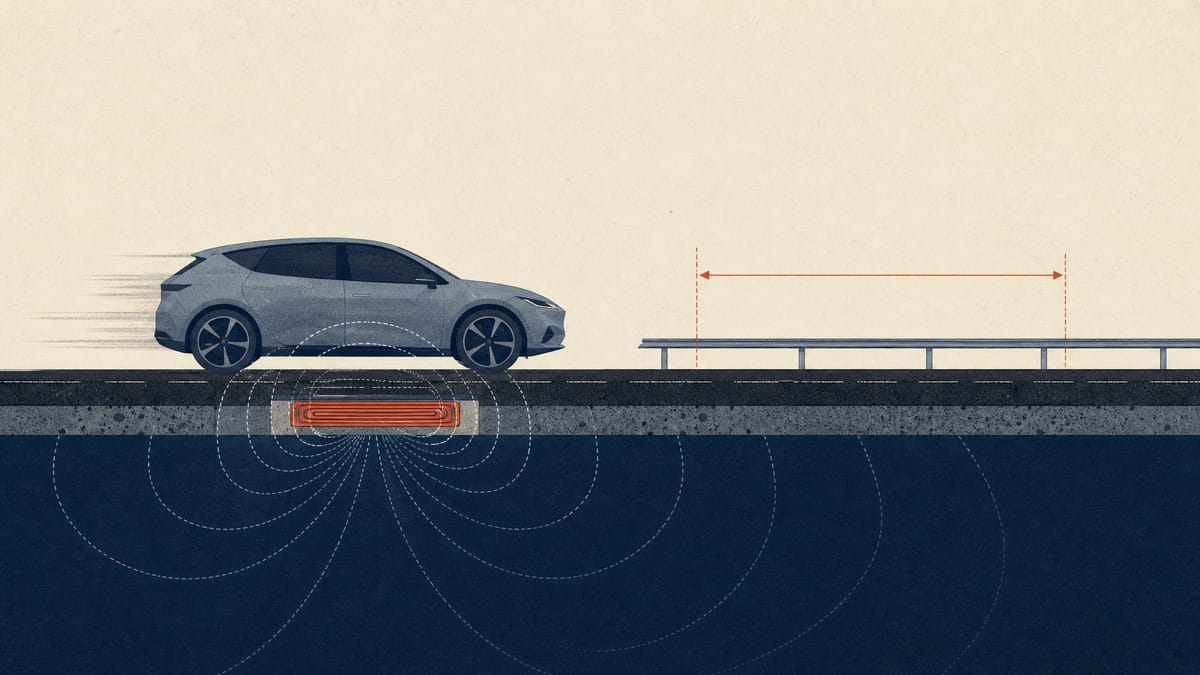
Japan's Ministry of Internal Affairs and Communications has opened public comment on a temporary exemption that would let wireless chargers for electric vehicles emit a much stronger magnetic field, so that in-motion charging can be tested on public roads. The draft would amend Notice No. 394 of 2026, which sets special conditions for high-frequency equipment.
What the draft would change
In-motion wireless charging supplies power to a vehicle from equipment laid in the road. The ministry says the exemption is meant to accommodate public-road trials on the Tateyama Expressway, including its main carriageway.
The current notice covers experimental wireless power transfer devices that use frequencies up to 450kHz. It caps their magnetic field strength (quasi-peak value) at 68.5 decibels at 10 metres from the equipment. The draft adds a separate allowance for EV wireless chargers using 79kHz to 90kHz. For those, the cap would be 102.8 decibels at 10 metres, with 1 microampere defined as 0 decibels.
The ministry ties the figure to the international standard being discussed at CISPR, the international special committee on radio interference. That standard is expected to set 102.8 decibels at 10 metres for 85kHz-band EV chargers. The standard is still under discussion, so the exemption anticipates a rule that has not been finalised.
Limited by place and time
The exemption would not apply nationwide. It would cover only designated trial zones, and the draft's annex lists them by address in seven prefectures: Hokkaido, Fukushima, Tochigi, Saitama, Chiba, Shizuoka and Aichi. The zones are defined by administrative boundaries as of 24 November 2026.
The allowance would run from enforcement until 31 March 2031. The ministry plans to promulgate and enforce the amendment in February 2027, after the comment period. The press release gives no trial dates or participants.
How to comment
Comments are open from 25 November to 24 December 2026. Submissions can be made through the e-Gov portal, by email or by post; postal entries count if postmarked by the deadline. The ministry bases the notice on Article 65, paragraph 1 of the Radio Equipment Regulations.
Submissions must be in Japanese. Comments longer than 1,000 characters need a summary attached. The ministry says it may publish the names of organisations and their representatives, and that it will not reply to individual comments.