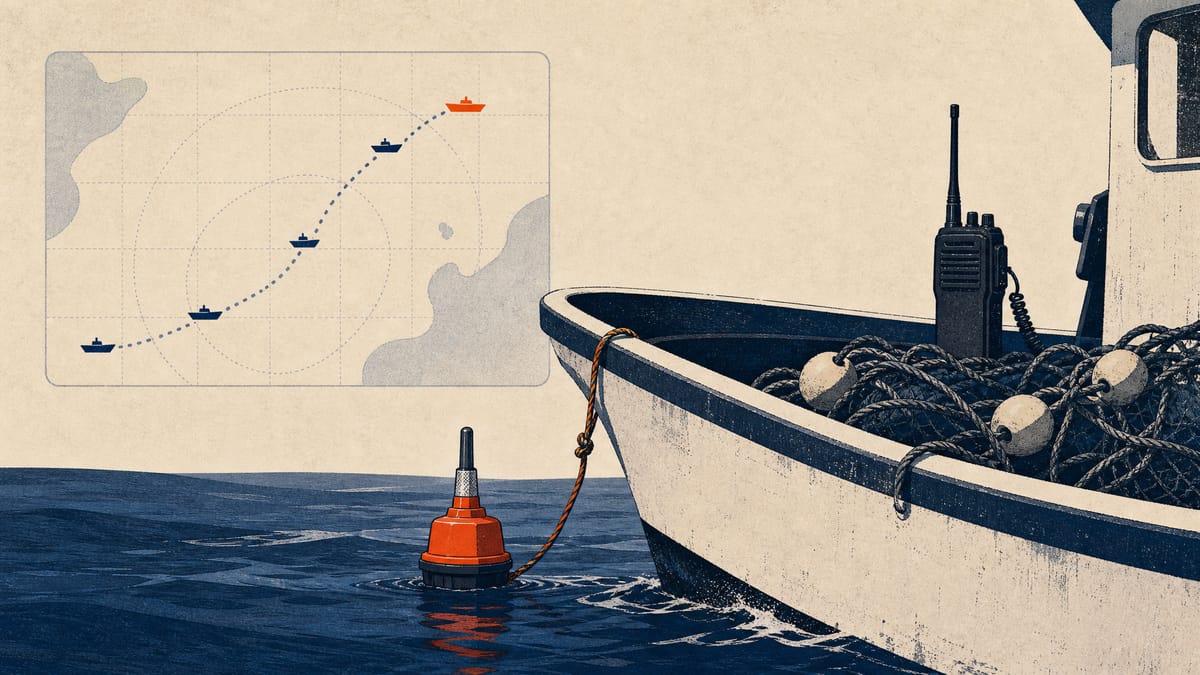
Japan's Ministry of Internal Affairs and Communications has opened a public comment period on draft ordinances that would write autonomous maritime radio devices (AMRD) into the country's radio rules. Comments run from 21 November to 21 December 2026, and must be in Japanese.
The ministry describes AMRD as devices that use AIS technology to help rescue people who fall overboard, and to let vessels locate and avoid fishing gear. It is acting after receiving a partial report on the devices' technical conditions from the Information and Communications Council.
Two device classes, one licence exemption
The draft ordinance comparison defines two kinds of AMRD. The first is distress auto-notification equipment with digital selective calling that sends information so its position shows on AIS or simplified AIS displays. The second is radio equipment independent of ship and coast stations that automatically sends information not directly related to navigation safety.
The technical standards differ. The first kind would use 161.975 MHz and 162.025 MHz, transmit at 9,600 bits a second with an equivalent isotropic radiated power of 1 W, float on the sea surface with a buoyant cord, and carry an independent battery able to run at least 12 hours continuously. The second kind would use 160.9 MHz at 100 milliwatts, with an antenna no higher than one metre above the sea surface.
Stations of the second kind that use F1D emissions on 160.9 MHz would be added to the list of radio stations that need no licence. The draft frequency allocation plan also splits the 160.6 to 160.975 MHz maritime mobile band into three segments, adding a low-power service category to the middle one, 160.8875 to 160.9125 MHz.
Fishing vessels and VHF channels
The second item responds to the 2012 Cape Town Agreement on fishing vessel safety, which implements the 1993 Torremolinos Protocol. The agreement is due to enter into force on 24 February 2027. It sets new numbers of radio equipment for qualifying fishing vessels, which the ministry will write into radio regulations.
In the draft, vessels covered by the agreement with an international gross tonnage of 950 or more join the categories that carry two search-and-rescue radar transponders or locating devices, and three two-way radios. The release does not say how many vessels this would reach. The amendment to the equipment rule in the radio law enforcement regulations and two notes in the licence-application forms take effect on 24 February 2027; the rest of the ordinance takes effect on promulgation.
The third item concerns international VHF channels. Frequencies for port operations and ship movement can already be used as single-frequency, four-digit channels instead of paired two-digit ones, a change made earlier because of congestion at busy ports and the Kanmon Strait. An International Maritime Organization circular requires four-digit channel support by the first radio station inspection on or after 1 January 2028, and the ministry is amending the relevant notices to meet that date.
| Date | What happens |
|---|---|
| 21 November 2026 | Public comment opens |
| 21 December 2026 | Public comment closes (postal submissions by postmark) |
| 24 February 2027 | Cape Town Agreement scheduled to enter into force |
| 1 January 2028 | Four-digit VHF channel support due by the first radio station inspection on or after this date |
What happens next
After the comment period, the ministry will consult the Radio Regulatory Council. If the council reports back, it plans to move quickly on the amendments. Comments of more than 1,000 characters must carry a summary, and the ministry says it cannot reply to individual submissions.
The ministry's list has ten entries: one ordinance amending seven existing rules, a change to the frequency allocation plan, and eight notices, including a newly created technical-conditions notice for AMRD.