Japan's transport ministry has put out for comment a draft that would let mobile mechanics do statutory inspection maintenance and drum-brake work away from their workshops, with tighter conditions for bigger vehicles. The Ministry of Land, Infrastructure, Transport and Tourism opened the consultation on 25 November 2026, and comments are due by 25 December.
What would be allowed
The off-site scheme, called visit specified maintenance, started in June 2025. Its limited category has so far excluded statutory inspection maintenance. The draft follows a regulatory reform implementation plan the cabinet approved on 21 July 2026. The plan called for allowing that work, and drum-brake replacement, on the premise of mechanic and vehicle safety.
Under the draft notification, statutory inspection maintenance would be possible for vehicles up to medium ordinary vehicles. Large ordinary vehicles stay as before. A medium ordinary vehicle has a maximum load above 2 tonnes or seats for 11 or more, excluding vehicles that count as large. A large one has a gross weight of 8 tonnes or more, a maximum load of 5 tonnes or more, or seats for 30 or more.
On brakes, pad replacement that involves removing the brake caliper, on ordinary vehicles other than large ones and on small and kei vehicles, would no longer be limited to pads worn or damaged by accident, failure or similar causes. Replacement of drum-brake linings that involves removing the brake drum would be added for the same classes, with centre brake drums excluded. For large vehicles, pad replacement involving brake-caliper removal stays limited to pads worn or damaged by accident, failure or similar causes, and excludes statutory inspection maintenance.
Conditions attached
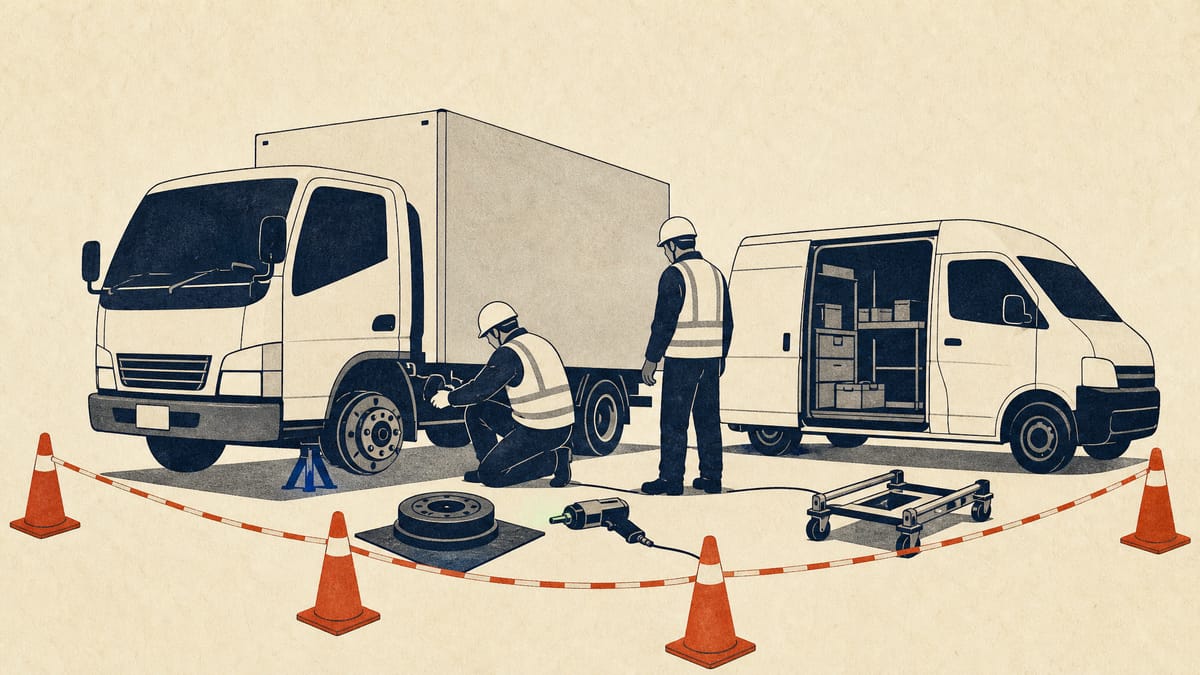
For the specified limited brake work on medium and large vehicles, operators must put at least two mechanics on the job and take safety measures. The draft circular names a wheel dolly and an impact wrench for tyre and wheel removal.
Statutory inspection maintenance done off-site would need a site that meets the ministry's size table (5 metres by 9 metres or more for medium vehicles) and lies outside low-rise and mid-to-high-rise exclusive residential zones. Crews would need a safety manual, helmets, safety shoes, fluorescent vests and a rest area nearby, and would have to mark the work area clearly for passersby, for example with cones or rope.
Failing to field two mechanics, or to take the safety measures, would each carry 15 violation points under the draft penalty standards.
Timing
Promulgation is planned for late January 2027, taking effect the same day. Operators that have already filed the required notification when the rule takes effect would be exempt from the two-worker and safety-measure requirement until 31 March 2027, but only for pad replacement that already counts as limited off-site work under the current rules.