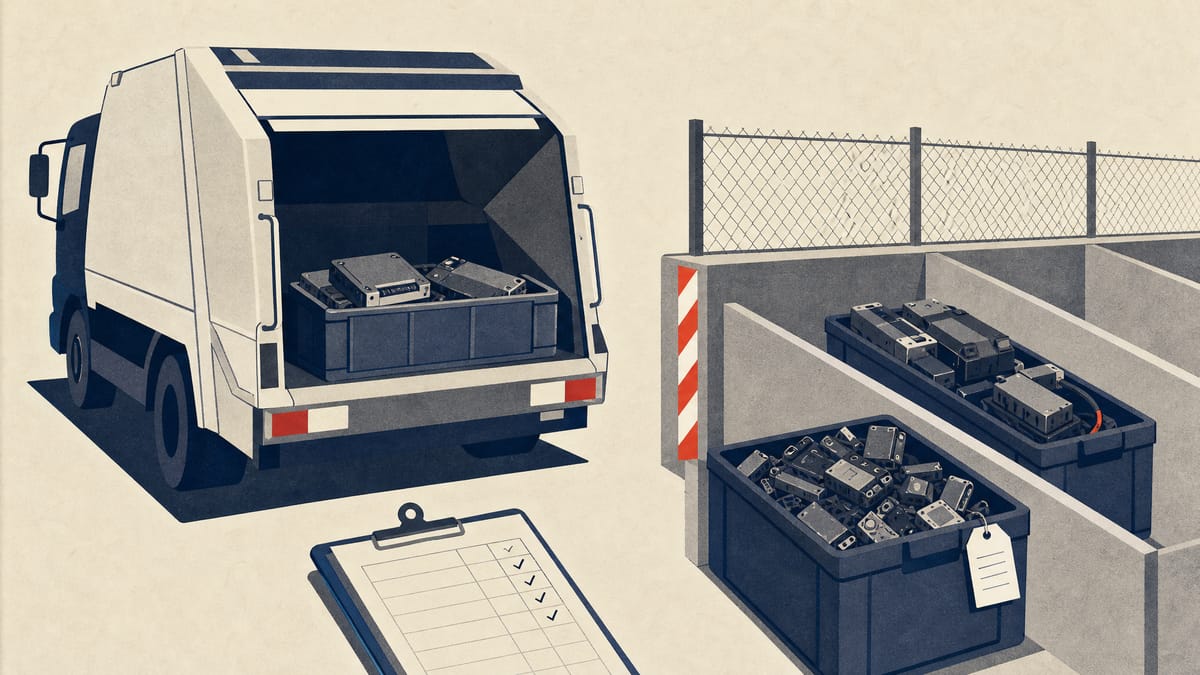
The Environment Ministry has put out a draft amendment to the enforcement regulations of Japan's Waste Management and Public Cleansing Act that would write lithium battery waste into the paperwork of the waste trade. The stated aim is to prevent fires, which the ministry says break out frequently in waste collection vehicles and treatment facilities.
This is a consultation on a draft, not an enacted rule. The ministry says it is also considering a change to the underlying cabinet order that would set waste-handling standards for lithium battery waste and for waste products that use lithium batteries as parts. The regulatory changes follow that order.
What the draft would require
The ministry says it would treat these wastes much as it already treats asbestos-containing and mercury-containing waste. The draft lists changes across the handling chain:
- Storage: signs at transshipment storage sites for general waste, and at industrial-waste storage sites, would have to say that lithium battery waste is stored there.
- Ledgers: general-waste handlers, some industrial-waste generators and industrial-waste handlers would record lithium battery waste in their ledgers when it is part of what they process.
- Industrial-waste storage standards: storage areas would need partitions or other fire-prevention measures. The draft also bars rough handling such as dropping, striking or dragging, and requires keeping the waste away from flames, sparks and heat.
- Contracts and manifests: consignment contracts would have to say when the consigned industrial waste includes lithium battery waste. Generators would record quantities on the industrial waste manifest and confirm the inclusion and quantity when handing the waste over.
- Electronic registration and permits: the electronic-manifest registration items, permit applications and change notifications would carry the same disclosure. Written consent documents and contracts for subcontracted treatment would too.
- Certified operators: a disclosure requirement would be added to the criteria for certified excellent operators, who must publish information on the waste they process.
- Cross-border shipments: export confirmation and import permit applications, and their reports, would state that the waste is included, with quantities on the export side.
The draft also extends storage rules for hazardous used equipment containing lithium batteries, with the same bans on rough handling and on proximity to flames or heat. It would cut the permit number shown on industrial-waste collection ships to the last six digits.
The general-waste and industrial-waste duties are written separately. Facilities that hold industrial-waste permits and handle similar general waste by prior notification would also have to state lithium battery waste in that notification. The ministry says such waste may fall under an existing category of plastic-integrated products.
Old permit forms would be treated as the amended forms, so documents already filed or issued would not need replacing.
Dates and how to comment
The comment period opened on November 4, 2026, and the ministry's notice sets the close at December 3. The e-Gov listing gives the cutoff as 0:00 on December 4. Comments must be in Japanese and go through the e-Gov form. The ministry will not take phone submissions and will not answer individual comments. It plans to publish a summary of comments with its responses after the period closes.
| Step | Date |
|---|---|
| Public comment opens | November 4, 2026 |
| Public comment closes | December 3, 2026 per the notice (e-Gov listing: 0:00 on December 4) |
| Planned promulgation | Late December 2026 |
| Planned effective date | April 1, 2027 |
The ministry labels the schedule as subject to change. Only the wording clean-up provisions would take effect on promulgation.