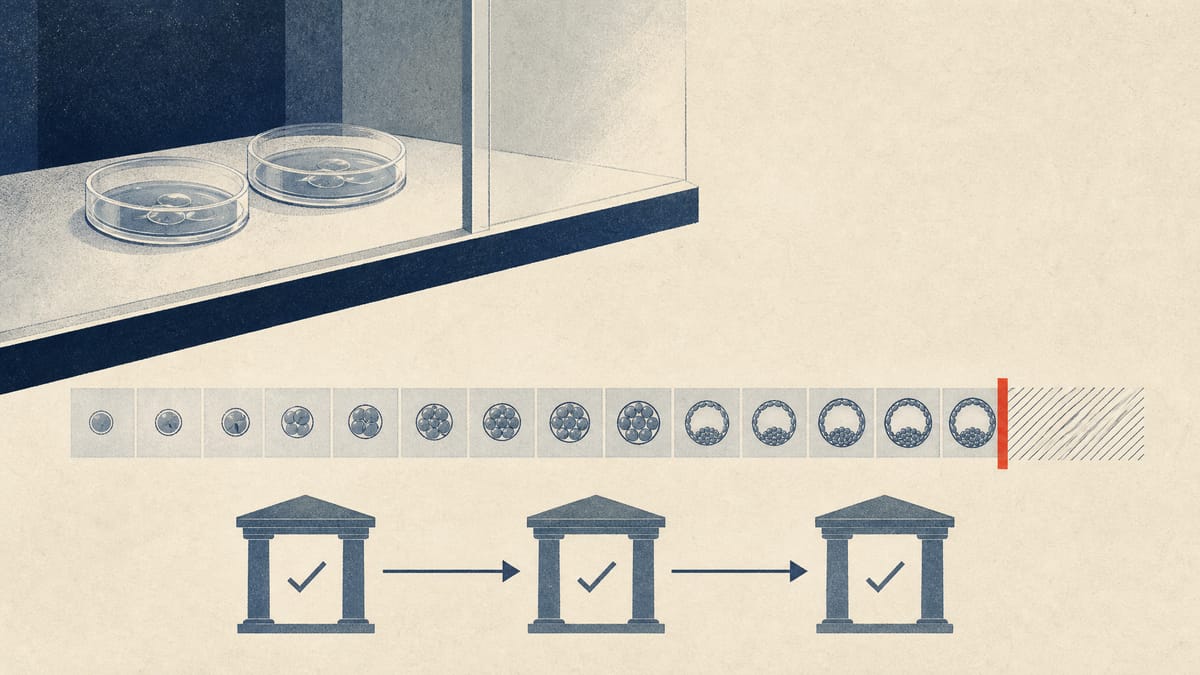
The Children and Families Agency, the education ministry (MEXT) and the health ministry opened public consultation on 30 October 2026 on draft guidelines for handling human genome-edited embryos and related materials. Comments on the guidelines are due by 28 November 2026. The draft is issued under Article 4 of the Human Genome-Edited Embryo Handling Regulation Act (Law No. 70 of 2026). The government's outline says the act was promulgated on 24 July 2026 and takes effect a year later, on 24 July 2027. Nothing here is in force yet.
Four permitted research uses
The draft allows work on genome-edited embryos and germ cells only where the research has scientific rationale and significance in one of four areas:
- fertilisation, embryo development and implantation, and preservation of germ cells and embryos, among other work to improve assisted reproduction;
- hereditary or congenital disease research, including mitochondrial disease, that uses nuclear transfer between eggs when creating embryos;
- checking whether fertilisation by stem-cell-derived germ cells is normal, or whether the resulting embryo develops like an ordinary one;
- research that makes genome-edited germ cells and handles them without fertilising them, to understand development or to develop diagnostics, preventives, therapies or drugs.
Embryo limits and consent
Donated embryos must be ones the donors have confirmed may be destroyed. They must be frozen, unless a morphological abnormality rules out reproductive use, and must be within 14 days of fertilisation, excluding frozen time. Donors may receive no payment for donating, other than reimbursement of communication, travel and similar costs of collection or donation.
Handling of an edited embryo runs from creation until the primitive streak appears. If none has appeared by the 14th day from creation, handling must stop, and frozen time is not counted. The number of embryos must be the necessary minimum.
Consent is written by default, with electronic consent allowed if identity is verified and donors can ask questions. Donors of embryos must be told the embryos will be kept for at least 30 days after consent, and either spouse may withdraw. Minors and people lacking capacity may not be asked to donate embryos or germ cells.
The draft does not open a clinical route. Donors must be told that edited embryos will not be transplanted into a person or an animal. Researchers may not handle them in rooms equipped for transfer into a womb. A narrow exception covers edited germ cells that an approved plan sends into animals, in rooms that cannot be used for human transfer.
Oversight and cross-border handling
Every plan goes to an ethics review committee of at least five members. They include a biologist, a reproductive-medicine specialist (a medical specialist where no embryos are handled), a bioethics expert, a legal expert or other humanities or social-sciences scholar, and a lay member. Embryo work also needs a genome-editing specialist. At least two members must be outside the researcher's or donor institution, and at least two must be men and two women. Minutes are public unless intellectual property or personal data is at risk. At least one physician must join any embryo project. Researchers file annual progress reports with the committee and the competent minister, and must discard embryos immediately once research ends or the handling period lapses.
Transfers between researchers and imports must be free apart from transport and other necessary costs. Importers must confirm the material was handled properly under the originating country's rules. Exporters must secure a contract or similar measure that bars onward transfer, requires disposal after use and applies rules equivalent to the draft's use conditions.
Companion instruments and dates
A draft decree would define the scope of genome-editing techniques, set the conditions for animal transplantation where no placenta could begin to form, and define basic-research uses. Its promulgation is planned for March 2027. A draft ordinance would add nine technique categories and fix reporting contents. It would also require records to be kept for five years after transfer, export, disposal or loss. For edited eggs placed in animals, it sets fertilisable windows of 14 days for sperm and 10 days for eggs.
MEXT is consulting separately on six notices revising or abolishing older embryo, ES cell and iPS cell guidelines. That consultation runs to 30 November 2026. The guidelines' draft transition clause disapplies three articles (19 to 21, covering responsibilities of the institution head, ethics review and plan preparation) when research already notified under the old guidelines makes the transitional notification to the competent minister under the act's supplementary provisions.
| Instrument | Comments due | Planned issue | Start |
|---|---|---|---|
| Draft guidelines on handling genome-edited embryos | 28 Nov 2026 | 2027, date left blank in the draft | 24 Jul 2027 (date the act takes effect) |
| Draft enforcement decree | 28 Nov 2026 | March 2027 (planned) | 24 Jul 2027 |
| Draft enforcement ordinance | 28 Nov 2026 | Late March 2027 (planned) | 24 Jul 2027 |
| MEXT guideline amendments (six notices) | 30 Nov 2026 | Not stated in the listing | Not stated in the listing |