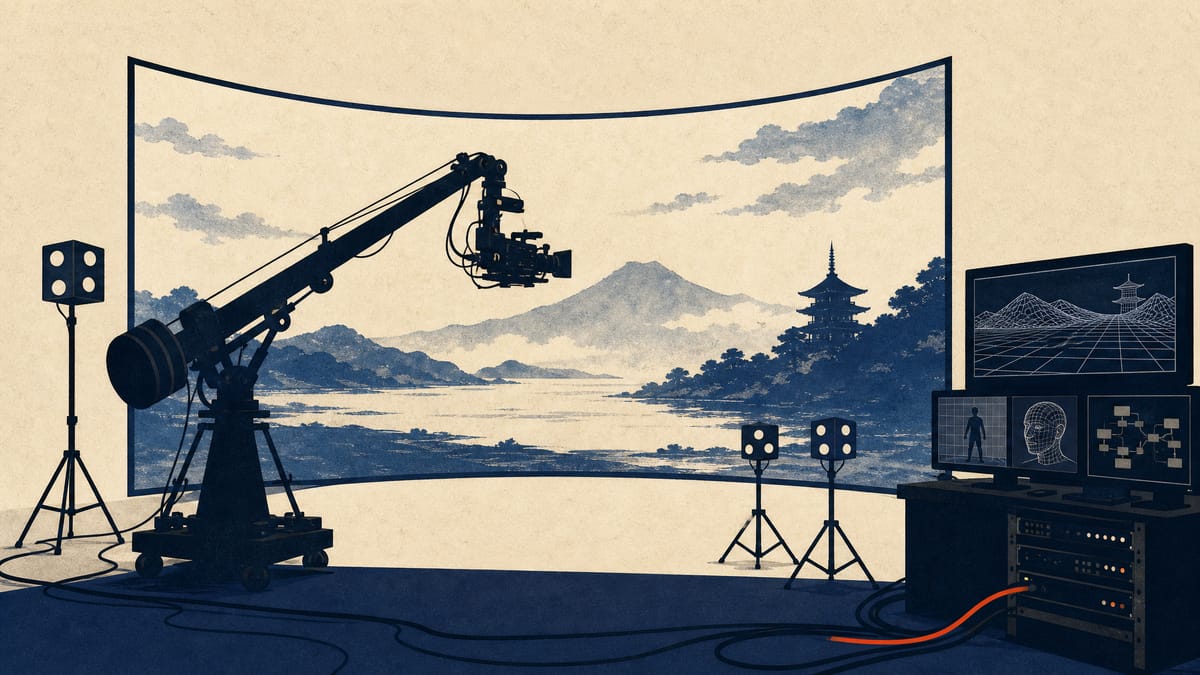
Japan's Ministry of Internal Affairs and Communications is taking applications for a third round of production subsidies meant to get more Japanese-made television content in front of foreign audiences, with advertising group Dentsu running the sub-grant program as secretariat. The fund pays up to half of eligible production costs on live-action shows built for overseas broadcast or streaming, with the richest support, up to ¥150mn, reserved for productions using at least one of the program's listed advanced effects techniques, such as virtual production, LED-wall shooting or motion capture.
The program splits into two tracks. Type A backs 4K live-action shoots, with the subsidy capped at ¥30mn, or ¥20mn if the applicant does not purchase or lease 4K equipment or systems. Type B covers advanced effects work, including virtual production, LED-wall shooting, volumetric capture, animatronics and AI-assisted compositing, capped at ¥150mn, and 4K-only costs are not eligible for Type B funding at all.
| Track | Focus | Subsidy rate | Cap |
|---|---|---|---|
| Type A | 4K live-action content | Up to half of eligible costs | ¥30mn (¥20mn if no 4K equipment or systems are purchased or leased) |
| Type B | At least one listed advanced effects technique (e.g. virtual production, LED-wall shooting, motion capture) | Up to half of eligible costs | ¥150mn (4K-only costs not eligible) |
The rules narrow what counts as eligible AI use. Generative AI tools qualify only when composited with live-action footage; content built entirely from AI-generated backgrounds or objects, with no filmed component, does not qualify, and AI used purely to speed up production workflow rather than improve image or sound quality is excluded too. Applicants must also clear copyright on any third-party material used in the content, a requirement the guidelines flag specifically for generative-AI systems.
To apply, a company needs its head office in Japan, a substantial controller (holding, directly or indirectly, more than a quarter of its voting rights) who is based in Japan or holds Japanese nationality, and it, or for a consortium the combined Japanese member companies, must hold the content's principal copyright, while the lead applicant company alone must hold the channel through which the finished show will be sold abroad. Individuals and NHK, the public broadcaster, cannot apply. The content itself faces limits too: material screened as a theatrical film before or at the same time as its broadcast or streaming release, short-form clips, anime (unless used only partially), music videos, news programs, commercials and adult content are all excluded, along with shows that are merely re-edits of material already aired.
Winners face conditions that stretch years past the funding itself. The subsidized production must be finished within three years of the funded project's completion, and the recipient must start overseas sales activity in that same three-year window. Starting from the fiscal year in which the project is completed and running five years, recipients must file annual reports on overseas broadcast deals and revenue, due within 60 days of each fiscal year-end, and the secretariat can order money returned if the content or the equipment it funded earns more than the subsidy amount.
Applications close at noon on October 5, 2026, with adoption decisions expected in late October and funded projects required to wrap by January 31, 2027. Questions about the application are accepted only until noon on October 1; queries submitted after that deadline may go unanswered.