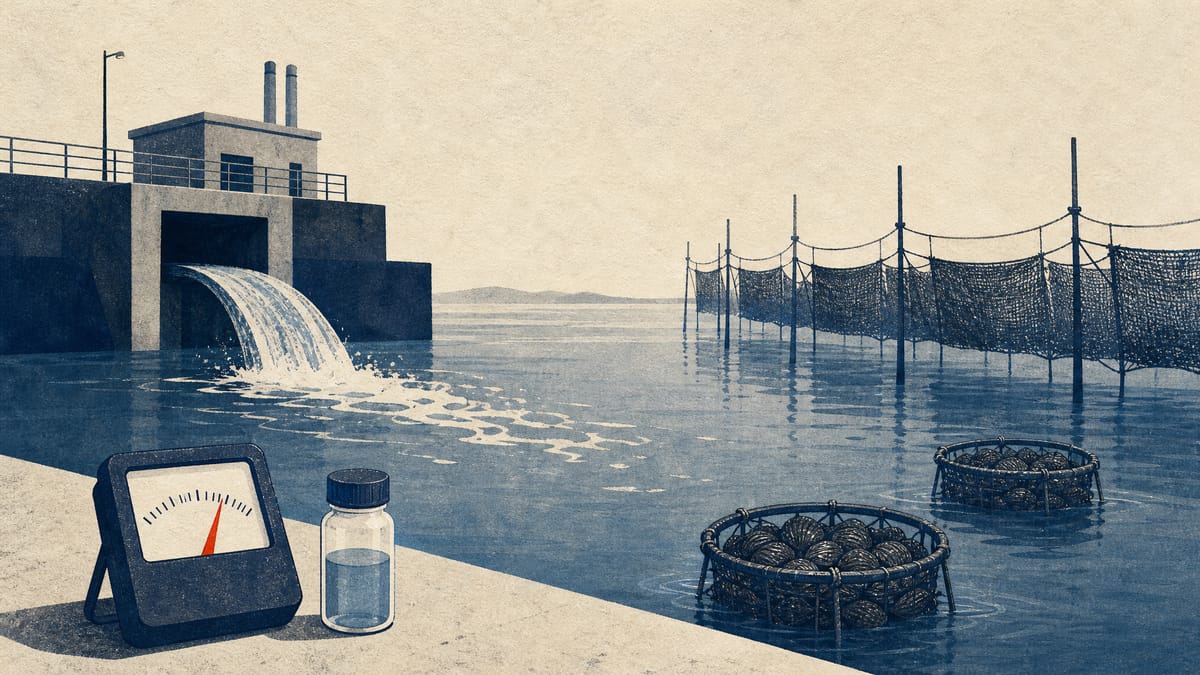
Japan's Environment Ministry wants sewage plants that discharge into a defined area of Ise Bay to be allowed to release more nitrogen than the current rule for advanced-treatment plants permits. A draft amendment to the nitrogen total-load control notification adds a separate Ise Bay category for sewerage operators, with a figure of 30 mg per litre.
What the draft changes
The notification amends the table covering the sewerage industry. Under the current text, a figure of 20 mg per litre applies to plants that remove nitrogen to a higher standard than conventional activated-sludge treatment, other than plants that accept and treat large volumes of high-nitrogen wastewater. The draft adds a new item for discharges into a defined sea area of Ise Bay, bounded by lines between named capes and the shore. It also covers discharges into the rivers flowing into that area, downstream of each river's most downstream water-quality monitoring point, and into similar waters. Plants that accept and treat large volumes of high-nitrogen wastewater are excluded. For the new item, one column's figure is set at 30 mg per litre, and the draft takes these dischargers out of the 20 mg per litre category. The ministry's table layout is dense, and the final wording could change after comment.
The notification matters because of how total-load control works. Under the Water Pollution Prevention Act, Tokyo Bay, Ise Bay and the Seto Inland Sea are designated enclosed waters where effluent standards alone have not been enough to meet water quality targets. Prefectural governors cap each plant's pollutant load, calculated as concentration multiplied by discharge volume. The environment minister sets the permitted concentration range by notification, and governors choose values within it.
Why Ise Bay
The ministry says water quality in the designated seas has improved overall, though some areas still suffer from expanding oxygen-poor water masses. In some waters, shortages of nutrients have been linked to effects on fisheries. In Ise Bay, falling output of nori seaweed and clams has created demand for more nutrient supply, the ministry says. Prefectures around the bay have been managing nutrients at sewage plants and testing the effects, and have built up a degree of knowledge.
The draft follows a 7 May 2026 report from the Central Environment Council, titled on moving from total load reduction to total load management, for the tenth round of the water quality programme. The report would let nutrient levels be managed according to local needs. The ministry says that round keeps the ninth round's period, sector and water-area classifications.
Formal adoption of the nutrient management system is a separate matter. It depends on discussion in the council's water environment subcommittee. The ministry presents the Ise Bay amendment as an interim step within the current framework, to be made only to the extent it causes no problem for water environment protection.
Timetable and how to respond
Comment opened on 11 November 2026. The ministry's notice gives 11 December as the closing date, while the e-Gov listing shows a cut-off of 0:00 on 12 December. Postal comments must arrive by the deadline. Comments must be in Japanese and go through the e-Gov form or by post to the ministry's Marine Environment Division. The ministry will not reply to individual comments.
The ministry plans promulgation around January 2027, with the amendment taking effect on the day of promulgation. The draft does not say how many plants fall in the new category or how prefectures will set values within it.