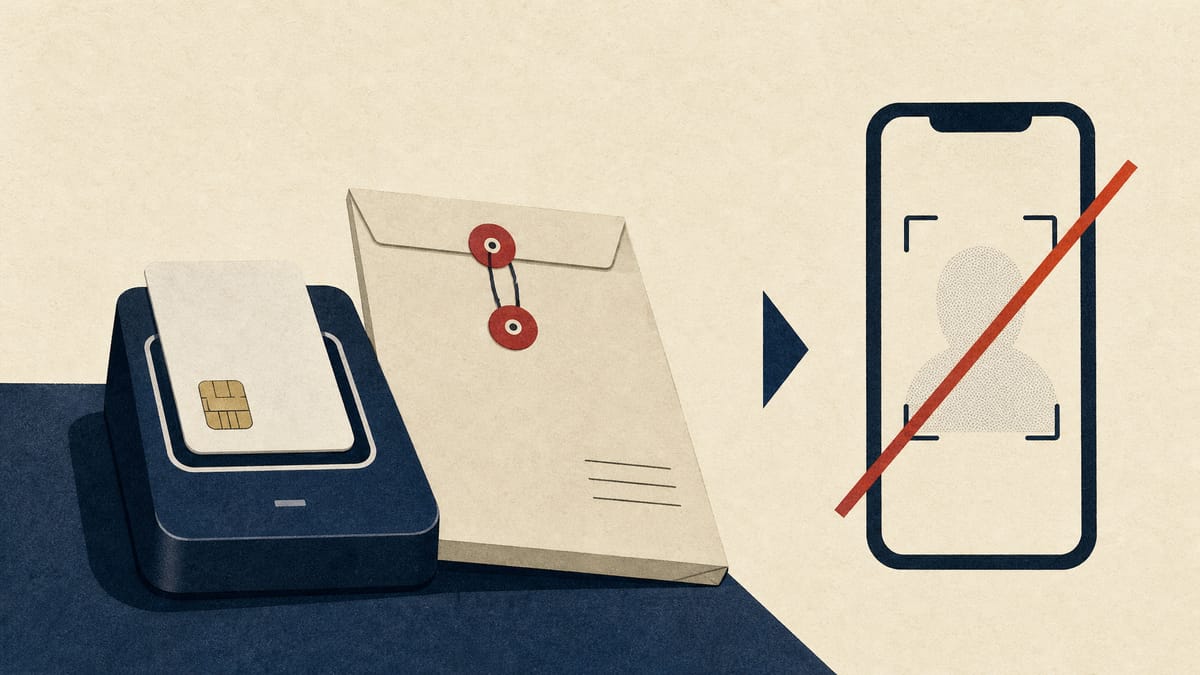
The Digital Agency has proposed abolishing two remote ways of verifying a depositor's identity under the rules for registering bank accounts to receive public benefits. The draft order would take effect on 1 April 2027, and public comment runs from 12 November to 11 December 2026.
What would go
The draft amends the enforcement rules of the Act on Registration of Deposit Accounts for Prompt and Reliable Payment of Public Benefits (Act No. 38 of 2021), under Article 18 of the Act. It targets methods the agency calls high-risk because forged or altered ID documents enable impersonation.
Two non-face-to-face methods would be abolished: receiving images of a depositor's ID taken with software provided by the financial institution, and receiving a copy of the ID.
What would stay
Remote verification would not disappear. For depositors without an ID document carrying an IC chip, the draft keeps a remote route but limits it to documents with anti-forgery measures, with the original sent to the institution. Depositors who have moved overseas would keep a method equivalent to the existing one, so that remote verification does not effectively disappear for them.
In person, the draft sets four tiers by document type.
| Channel | Method or document | Draft treatment |
|---|---|---|
| In person | Photo ID with IC chip | Present the ID and read the chip data |
| In person | Photo ID without chip (such as a disability certificate) | Present the ID and send application-related documents by non-forwardable mail |
| In person | Chip ID without photo (such as a residence card for under-16s) | Present the ID, read the chip and send documents by non-forwardable mail |
| In person | No chip and no photo | Only anti-forgery documents (such as a certified copy of the resident record), plus non-forwardable mail |
| Remote | ID images taken with the institution's software | Abolished |
| Remote | Copy of ID sent by the depositor | Abolished |
| Remote | Depositors with no chip-bearing ID | Kept, limited to anti-forgery documents, with the original sent |
| Remote | Depositors who moved overseas | Equivalent method kept |
The draft's comparison table also reorganises the numbered verification methods in the rules. It adds matching changes to record-keeping provisions and to the rules for agents acting for depositors.
Process
Comments must be submitted in Japanese through the e-Gov form with name, address and contact details. Late submissions are generally not accepted. The agency says it will not reply to individual comments. It may publish the names of organisations and their representatives, but not the names of individual commenters, and organisations can ask for anonymity. Inquiries go to the Digital Agency's Digital Society Common Functions Group.
The notice does not say how many accounts or institutions the change would affect. The draft is a proposal, and the final text could differ after comments.