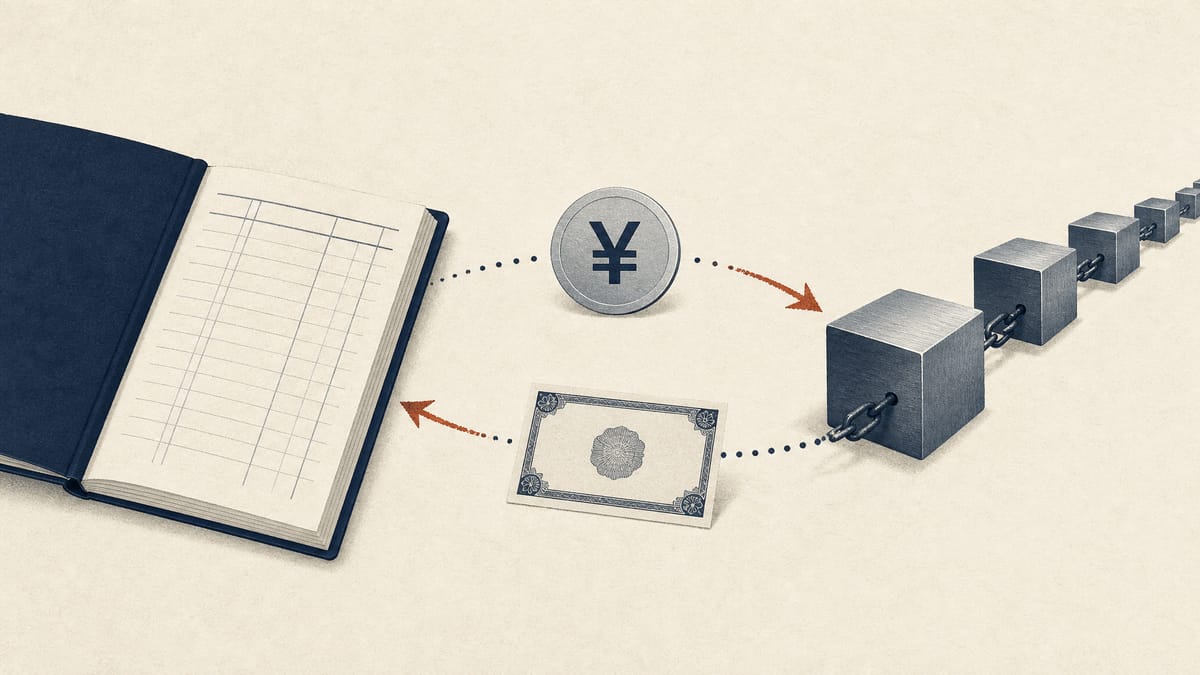
The Financial Services Agency's study group on responding to digital and decentralised finance was scheduled to hold its first session of the agency's 2026 administrative year on 20 October, with hearings from Nomura Holdings and Securitize Japan followed by discussion. The secretariat's paper says a second meeting in early 2027 will compile an interim summary and a public-private roadmap.
What the group is asked to decide
The secretariat set out five topics: stablecoins and tokenised deposits, security tokens, decentralised exchanges and DeFi, the book-entry transfer system, and shorter securities settlement. Members were asked which areas of law should be examined first, judged by innovation and investor protection. This group handles the legal environment. A separate group covers the healthy use of AI.
The parent body is the on-chain finance forum, chaired by Financial Services Minister Katayama, which met for the first time on 30 September. Katayama said an interim summary and a roadmap for that point in time would be drawn up early next year.
Trials, not approvals
The secretariat lists four pilots under the FSA's Payment Innovation Project:
- No. 1: a trial of a yen stablecoin to be jointly issued by the three megabanks, with bank deposits as the intended backing. Support was decided on 7 November 2025, and real transactions are planned within the current fiscal year.
- No. 2: on-chain securities settlement by Nomura Securities, Daiwa Securities and the three megabank groups, backed on 13 February 2026. Mizuho FG began a related JGB collateral trial in April and MUFG in August.
- No. 3: moving tokenised deposits between banks, backed on 3 April 2026. In August, 43 regional banks and others said they would take part.
- No. 4: a trade-document pilot linked to the megabanks' planned stablecoin, backed on 29 September 2026.
The paper says on-chain trading of book-entry securities such as government bonds, corporate bonds, funds and shares has not yet been achieved in Japan. The rules already in force are narrower: a Payment Services Act change effective June 2026 lets trust-type stablecoin reserves hold up to 50% of issuance in short-dated JGBs and certain time deposits. Separately, a law moving crypto-asset regulation from the Payment Services Act into the Financial Instruments and Exchange Act was promulgated in July 2026, and the paper still describes crypto-assets as currently regulated under the Payment Services Act.
What industry and other ministries want
Nomura's presentation calls Japan's position one step behind the US, at a demonstration stage, and lists ten practical and legal issues. They include moving government bonds and listed securities on-chain under the existing transfer law and putting the Bank of Japan's current accounts and bank deposits on-chain. Securitize Japan's presentation proposes legislation designed for distributed tokenisation on public blockchains, interoperability with overseas markets and rules that do not favour incumbents.
The 30 September forum minutes record other workstreams. The Ministry of Finance starts a study group on putting government bonds on-chain in October, the Digital Agency will examine stablecoins and tokenised deposits for public benefit payments, and the FSA plans an Asia Day conference in February 2027.