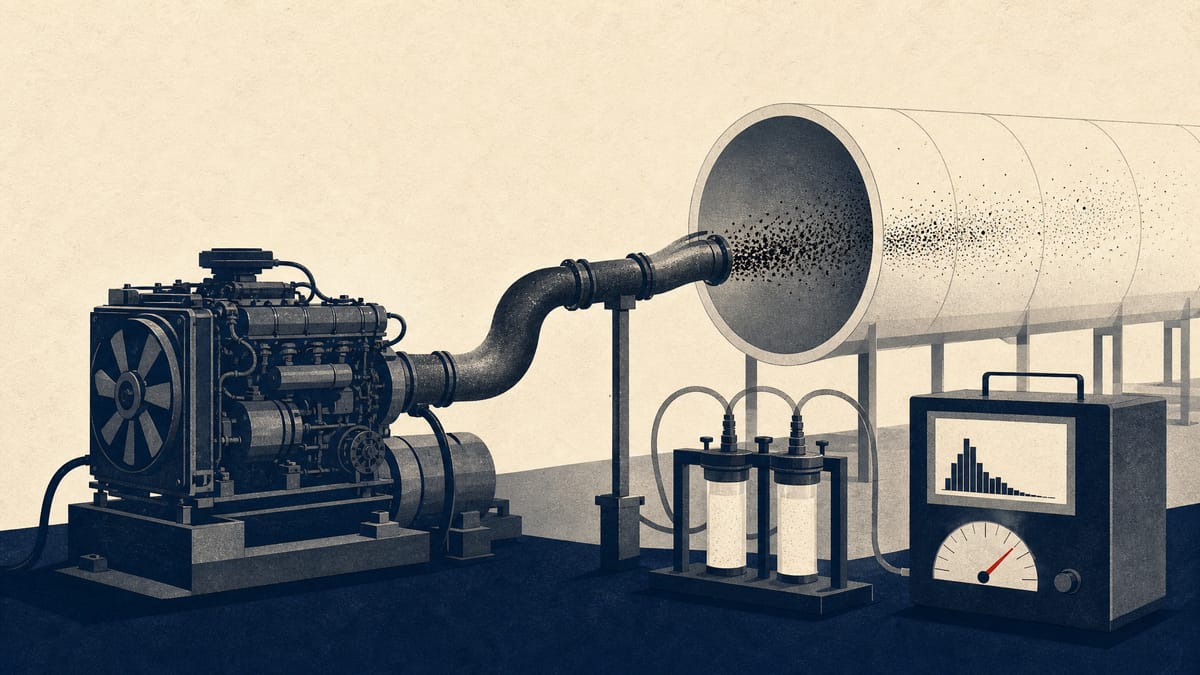
The Ministry of Land, Infrastructure, Transport and Tourism has put out for comment a draft notice that would cut permitted particulate emissions from diesel special vehicles and, for the first time, cap how many particles they emit. It covers diesel-fuelled special vehicles with engines rated at 19kW or more but under 560kW.
Two dates, one comment window
The draft sets different start dates by production status: December 1, 2027 for new models and December 1, 2030 for continuing-production vehicles. The ministry's schedule is promulgation in December 2026, with the rules taking effect on the day of promulgation. Public comment runs from October 5 to 14:00 on November 5, 2026.
The ministry ties the draft to a September 2024 report from the Central Environment Council, an advisory body to the Environment Ministry. The report judged it appropriate to tighten particulate-mass (PM) limits and to extend to diesel special vehicles the particle-number (PN) rules already applied to other vehicles, with a start by the end of 2027.
What the tables propose
The draft notice amends the detailed technical standards in two places: one for type-designated large special vehicles and type-approved small special vehicles, and one for other large special vehicles inspected at new registration. PM limits fall in every output band, but not by the same amount. For the type-designated group, the 19kW to under 37kW limit goes from 0.03 to 0.015 g/kWh, and the 37kW to under 56kW limit from 0.025 to 0.015. The three bands from 56kW up to 560kW move from 0.02 to 0.015.
| Rated output | Type-designated: current | Type-designated: proposed | Other large: current | Other large: proposed |
|---|---|---|---|---|
| 19kW to under 37kW | 0.03 | 0.015 | 0.04 | 0.02 |
| 37kW to under 56kW | 0.025 | 0.015 | 0.033 | 0.02 |
| 56kW to under 75kW | 0.02 | 0.015 | 0.03 | 0.02 |
| 75kW to under 130kW | 0.02 | 0.015 | 0.03 | 0.02 |
| 130kW to under 560kW | 0.02 | 0.015 | 0.03 | 0.02 |
The new PN limit is 1×10^12 particles per kWh for the type-designated group and 1.33×10^12 for the other large vehicles, in each case applied across all five output bands. The draft counts solid particles above 23nm in electric-mobility diameter.
The transitional carve-out
A companion amendment to the notice that sorts out how the safety standards apply would let vehicles built through November 30, 2030 keep meeting the existing test method and the current limits. The exceptions are non-imported vehicles whose type designation or approval dates from December 1, 2027, and models designated earlier against the new standard.
For machinery suppliers, the draft therefore turns on three facts per model: whether the vehicle is type-designated or inspected individually, which rated-output band it falls in, and when its designation or approval was granted. The notice is a proposal, not an enacted rule, and the limits and dates can change before promulgation.