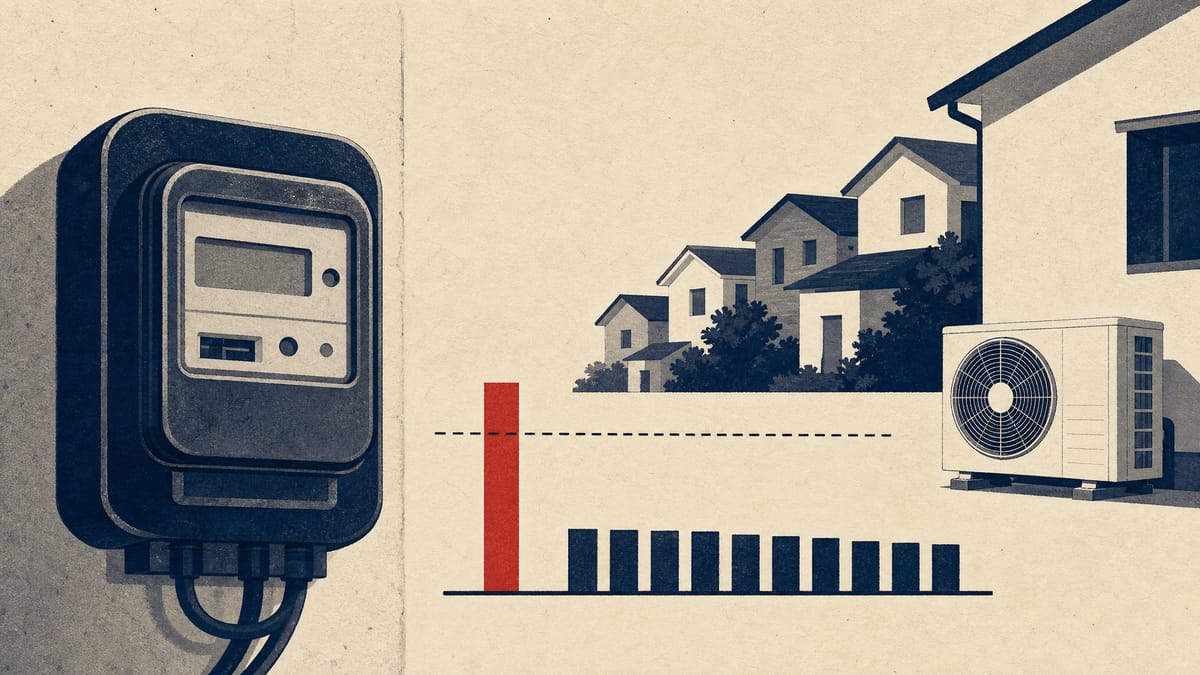
Kansai Electric Power has fixed the new prices for its low-voltage plans in the Kanto region, and the change falls mainly on the fixed part of the bill. From November 1, 2026, the basic charge on its household menu Hapi e Plus rises to ¥1,071.65 a month from ¥830.72 for contracts of 6kW or less, while usage rates move only in the second decimal place.
The company decided the revisions on October 5. It had said on September 29 that Kanto low-voltage menus would be announced separately once ready. Tokyo Brief's September 29 article on modeled bills is here.
Why the prices are moving
Kansai Electric says the revisions follow changes to the wheeling terms of the general transmission and distribution operators, covered in a METI news release dated September 11, 2026. Wheeling charges are the fees for using grid equipment. They cover both the demand-side fee for delivering power to customers and the generation-side fee paid by generators connected to the grid. The company is reflecting the revised charges in both its regulated and liberalized menus.
The covered area is Tochigi, Gunma, Ibaraki, Saitama, Chiba, Tokyo (excluding the islands), Kanagawa, Yamanashi, and Shizuoka east of the Fuji River.
Two menus, two shapes of increase
Hapi e Plus is aimed at homes using lighting and small appliances. Power Otoku Plus is for offices, restaurants and factories running three-phase 200-volt air conditioners, commercial refrigerators or pumps. Prices below include tax.
| Charge | Unit | Before | After |
|---|---|---|---|
| Hapi e Plus basic, contract up to 6kW | Per contract | 830.72 | 1,071.65 |
| Hapi e Plus basic, first 6kW (above 6kW) | Per contract | 1,716.44 | 2,198.30 |
| Hapi e Plus basic, each kW above 6kW | Per kW | 295.24 | 375.55 |
| Hapi e Plus usage, first 120kWh | Per kWh | 29.99 | 30.04 |
| Hapi e Plus usage, 120 to 300kWh | Per kWh | 36.43 | 36.48 |
| Hapi e Plus usage, above 300kWh | Per kWh | 40.47 | 40.52 |
| Power Otoku Plus basic | Per kW | 1,076.22 | 1,169.00 |
| Power Otoku Plus usage, summer | Per kWh | 27.48 | 27.53 |
| Power Otoku Plus usage, other seasons | Per kWh | 25.91 | 25.96 |
| Power Otoku Plus discount | Per kW | 148.28 | 148.28 |
On Hapi e Plus, the basic charge for contracts above 6kW also rises, as does the charge per kW above the first 6kW. Power Otoku Plus basic charges rise to ¥1,169.00 per kW from ¥1,076.22. The discount for customers at or below the base usage level is unchanged at ¥148.28 per kW.
The notice gives no modeled bills or percentage changes in total charges. A higher basic charge does not translate into the same percentage rise in a customer's bill, because usage charges barely move and the effect depends on how much power a household or business uses. The notice also does not state the wheeling charges themselves.
Terms beyond price
Other supply conditions change too. From November 1, 2026, customers applying for disaster special measures, such as deferred payment dates or waived basic charges for months without use, will be asked for a disaster certificate only when needed, rather than as a general rule.
Two changes follow on April 1, 2027. Invoice-issuance fees may also be billed with the following month's charges. This applies only to Hapi e Plus, and only when a direct debit from a bank account or a credit-card payment fails and Kansai Electric issues a payment slip. The company will also add lawyer corporations to the debt-collection companies it can use to collect unpaid bills.