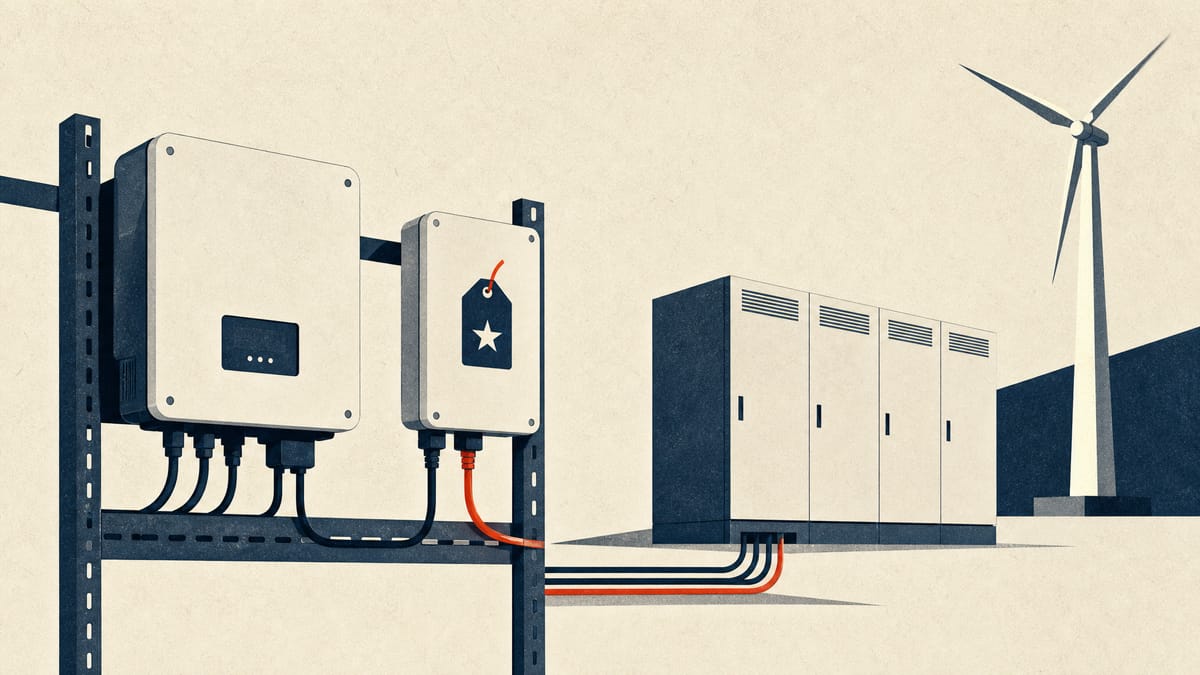
The Agency for Natural Resources and Energy (ANRE) has proposed that internet-capable equipment in new solar, battery, wind and fuel cell projects carry a JC-STAR Level 1 (★1) label or better. The proposal sits in a draft revision of its grid interconnection technical guideline, opened for comment on 6 October 2026. Everything below is a proposal, not effective rule.
What the draft requires
The draft says equipment with IP communication functions that distributed generators use must have a JC-STAR ★1 or higher conformity label. The labels come from the security requirement conformity assessment and labelling scheme run by the independent administrative agency IPA. ANRE's consultation notice says a grid code study group at the transmission-coordination body OCCTO has been working towards making JC-STAR ★1 equipment a requirement for solar, wind, batteries and fuel cells.
The requirement would apply to projects whose generation-facility contract applications are accepted on or after set dates. A project already accepted is not caught retroactively, even if its equipment is not yet installed.
| Technology | Proposed scope | Proposed start |
|---|---|---|
| Solar and storage, extra-high and high voltage | IP-capable gateways, generation-side devices and devices with direct IP links to main system components | 1 April 2027 |
| Solar and storage, low voltage | Same scope as above | 1 October 2027 |
| Wind | Gateway firewall functions or equivalent devices | 1 April 2027 |
| Fuel cells (inverter-connected) | IP-capable gateways, generation-side devices and devices with direct IP links to main system components | 1 April 2028 |
For solar and storage, the scope includes gateways, devices on the generation side of the gateway, and devices that talk IP to main system components without a gateway. The draft excludes routing devices used for internet connections at general-use electrical installations if they have no control function over the generating equipment.
Existing sites: additions and replacements only
The draft does not order a retrofit of installed equipment. After the start dates, the requirement would apply to a target device that is added or replaced at an existing site if the device is IP-capable. It would also apply when a new project switches a planned device to an IP-capable one.
There is a deferral. If a replacement triggers a connection study or a check on whether one is needed, and the local general transmission and distribution operator accepts that the requirement would impose an excessive burden, such as a major effect on continuing the generation business, the owner can seek a deferral. It must consult the operator individually, on the operator's form, and win its approval.
The owner has to supply three things: why a compliant replacement is hard and what the burden is; a concrete plan, with timing, to replace or switch devices to JC-STAR ★1 or better; and the cybersecurity measures it will take. For the third, the draft names a supply-chain security guide for power control systems, a cybersecurity risk-check guide and a status-visualisation tool for power systems, or equivalent measures. The deferral runs "for the time being", and the draft sets no end date.
How to comment
The consultation is voluntary rather than a procedure under the Administrative Procedure Act. It runs from 6 October to 6 November 2026. Comments must be in Japanese and can go through e-Gov, post or email to ANRE's power infrastructure division. ANRE says it will treat comments as reference for the final decision and will not reply individually. Comments may be published, though names, addresses, phone numbers and email addresses are withheld. The draft carries no final revision date.