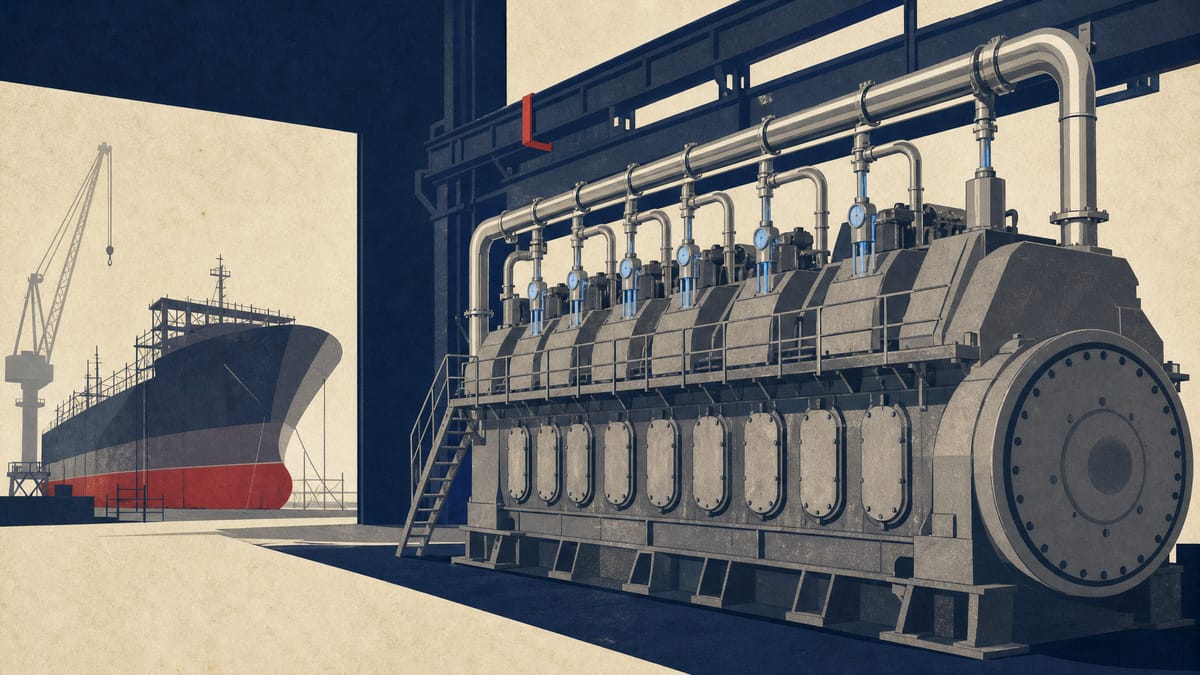
Japan Engine Corporation has completed land-based approval testing of what it describes as the world's first hydrogen-fueled engine built for large merchant ships, the 6UEC35LSGH. In factory trials the engine ran with a hydrogen co-firing ratio of 95% or more, cutting greenhouse gas emissions by 95% or more compared with a conventional heavy-fuel-oil engine of the same class. NEDO, Japan's state innovation-funding body, unveiled the engine on September 7 at Japan Engine's plant and announced the test result the following day.
The engine reaches that hydrogen share through high-pressure direct injection, spraying fuel straight into the cylinder rather than pre-mixing it, which the companies say keeps combustion stable. Japan Engine also built in a reinforced leak-prevention structure and double-walled piping for the hydrogen supply lines. Class society ClassNK (Nippon Kaiji Kyokai) witnessed the approval-operation test, which the companies said finished without issue.
That land-based pass is one link in a longer chain, not the finish line. The engine is due to be installed in January 2027 aboard a 17,500-deadweight-tonne multipurpose vessel that Onomichi Shipbuilding is building for Mitsui O.S.K. Lines and MOL Drybulk. Kawasaki Heavy Industries, which is developing the ship's Marine Hydrogen Fuel System and the liquefied-hydrogen bunkering equipment needed to load it, will supply fuel to the installed engine ahead of sea trials. Onboard demonstration testing, the stage that actually proves the engine under real operating conditions rather than on a factory floor, is not scheduled to start until April 2028. ClassNK will keep assessing safety through the ship's design, construction and operation stages.
| Date | Milestone |
|---|---|
| September 2026 | Land-based approval operation test completed at Japan Engine's plant, witnessed by ClassNK |
| January 2027 | Engine planned for installation on a 17,500-DWT multipurpose vessel at Onomichi Shipbuilding |
| April 2028 | Onboard demonstration trials planned to begin after sea trials, using hydrogen from Kawasaki Heavy Industries' fuel-supply system |
The project runs under NEDO's Green Innovation Fund program for next-generation vessels, alongside Kawasaki Heavy Industries and Yanmar Power Solutions, and carries the project name Blue Harmony. Japan Engine reached a related milestone in August 2025, when it completed what it also called the world's first ammonia-fueled marine low-speed two-stroke engine.
For readers tracking Japan's marine-fuel bet, the number to watch is not the factory result but the roughly nineteen months between now and April 2028, when the industry will learn whether a hydrogen engine can hold up on an actual voyage rather than a test bench.