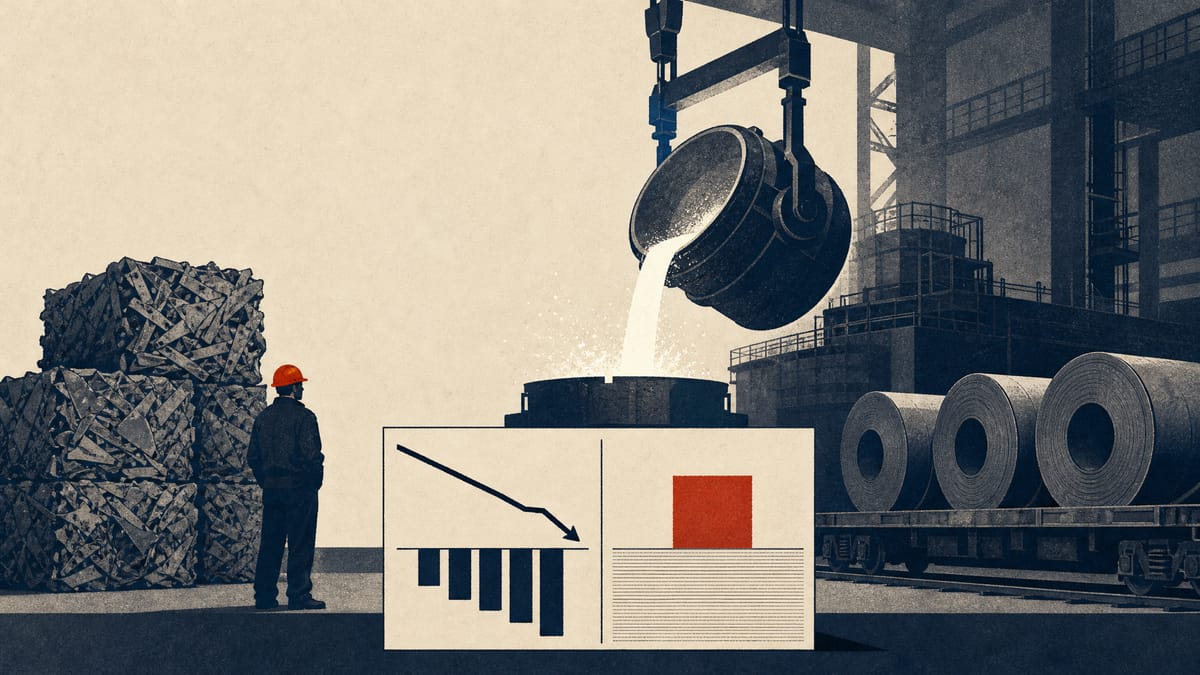
Tokyo Steel Manufacturing sold more steel at higher prices in the six months to September 2026 and still lost money from operations. Its non-consolidated interim earnings report shows sales of ¥150.422bn, up 12.3%, and an operating loss of ¥3.543bn against a ¥6.045bn operating profit a year earlier.
| Item | April-Sept 2026 | April-Sept 2025 |
|---|---|---|
| Sales | 150,422 | 133,894 |
| Operating profit (loss) | -3,543 | 6,045 |
| Ordinary profit (loss) | -2,949 | 6,983 |
| Net income | 2,389 | 4,568 |
Where the margin went
Gross profit fell to ¥9.421bn from ¥18.481bn. Cost of sales rose to ¥141.001bn from ¥115.413bn, while selling and administrative expenses edged up to ¥12.965bn from ¥12.436bn. Volume and price both improved: total sales volume was 1,528 thousand tonnes against 1,432 thousand, and the average unit price was ¥98.4 thousand per tonne against ¥93.4 thousand. Steel product exports reached 266 thousand tonnes at ¥100.4 thousand per tonne, against 199 thousand tonnes at ¥84.0 thousand a year earlier.
For the July-September quarter, the company said shipment unit prices rose as it had expected and that scrap, its main raw material, was bought below its assumptions. It said operating profit improved against its plan as a result. The report does not give the plan figures.
Asset sales carry the bottom line
The ordinary loss was ¥2.949bn, against a ¥6.983bn profit a year earlier. Special gains of ¥6.184bn then pushed the company to a pretax profit of ¥2.968bn. The income statement lists a ¥5.190bn gain on sale of investment securities, with none a year earlier, and a ¥993mn gain on sale of fixed assets. Special losses were ¥266mn. Net income was ¥2.389bn, down 47.7% from ¥4.568bn, or ¥23.46 a share. The company said asset sales improved net income against its plan. The report does not identify which securities were sold.
Recovery rests on price revisions
Management said the price revisions it has implemented will be reflected in shipment unit prices in turn, and that it expects an operating profit for the full year. It also pledged further cost cuts, including lower raw material use per unit of output. The full-year forecast was revised on October 16, and the earnings report notes that revision. It now calls for sales of ¥326bn, operating profit of ¥1bn, ordinary profit of ¥2bn and net income of ¥7bn. The percentage changes in the forecast table are against the prior year: sales up 21.6%, operating profit down 86.2% and net income down 39.4%. The company's own caution is that actual results could swing widely with scrap prices and steel market conditions. For earlier forecast detail, see Earlier Tokyo Brief coverage.
Balance sheet and payout
The equity ratio was 78.6%, up from 75.8% at March 31. Cash and deposits fell to ¥41.41bn from ¥63.47bn, and inventories of products and of raw materials and supplies both rose. The company bought back 1.5 million of its own shares between May 1 and September 30, which added ¥2.591bn to treasury stock. The interim dividend is ¥20, against ¥25 a year earlier, and the full-year forecast is ¥40 against ¥50, unchanged from the latest announced forecast. The interim earnings report states that it is outside the scope of review by a certified public accountant or audit firm.