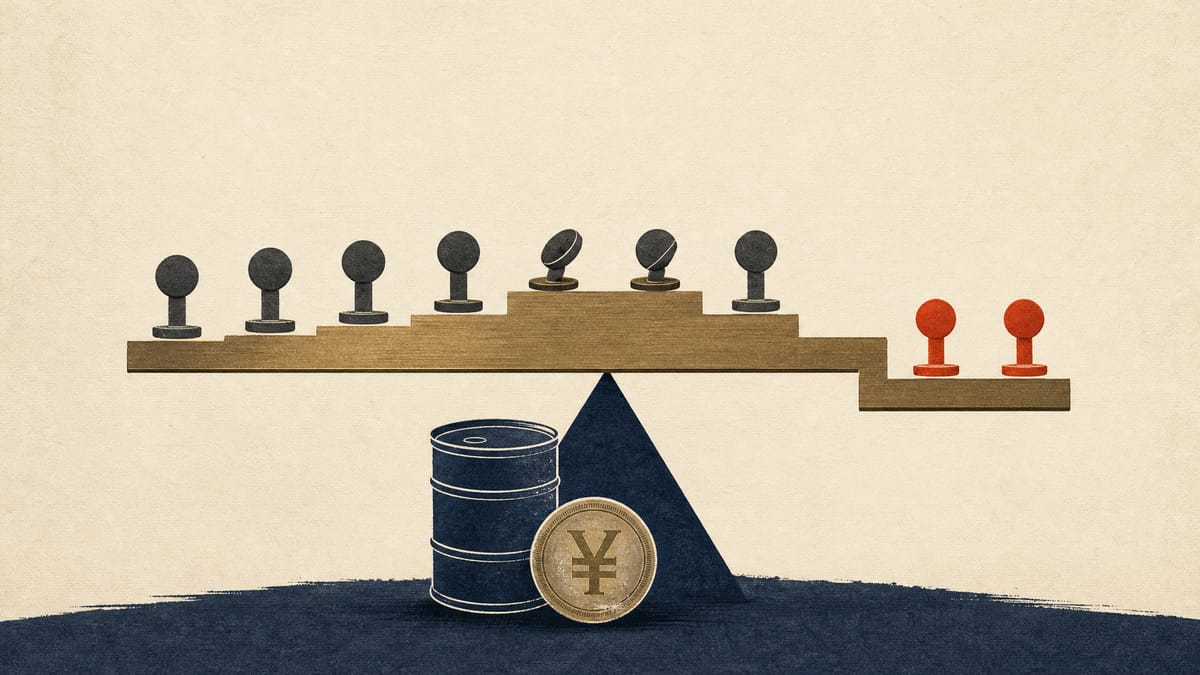
The Bank of Japan's Policy Board raised its overnight call-rate target by 0.25 percentage points to around 1.25% on September 18, 2026, by a 7-2 vote. Minutes released on November 5 show the objections ran in two directions: two members thought a hike was premature, and two who voted for it thought the bank's own statement understated how close inflation already was to target. Earlier Tokyo Brief coverage
Dissent from the dovish side
Toichiro Asada and Ayano Sato voted against all three rate proposals: the 1.25% call-rate guideline, a 1.25% rate on the complementary deposit facility and a 1.5% basic loan rate. The new settings were to take effect from September 24, 2026.
Asada pointed out that CPI inflation excluding fresh food was below 2% recently and that the economy could not necessarily be called strong. He argued that a hike so soon after June's could hurt production, employment and real income. Sato said economic and price developments had not substantially accelerated compared with before, and that it would take time to judge private consumption and whether inflation expectations were anchored around 2%.
| Members | Vote on rate proposals | Stated position |
|---|---|---|
| Asada Toichiro | Against | CPI ex fresh food below 2%; economy not necessarily strong; keep the 1.0% guideline |
| Sato Ayano | Against | Economic and price developments had not substantially accelerated; a hike was not appropriate at that time |
| Takata Hajime | For | Opposed the statement's price-outlook wording; CPI, including underlying, had generally reached target |
| Tamura Naoki | For | Opposed the statement's price-outlook wording; underlying CPI inflation already generally consistent with target |
Backers who wanted a bolder price outlook
Hajime Takata and Naoki Tamura voted for the hike but opposed the price-outlook wording in the board's statement. Takata held that CPI inflation, including underlying inflation, had generally reached the price stability target. Tamura said underlying inflation was already at a level generally consistent with it. The statement was adopted unanimously, with a note recording their objections.
The statement itself says underlying inflation has been approaching 2% and warns of a risk that it deviates upward above the target. Most members shared the view that the economy was tracking the baseline scenario of the July 2026 Outlook Report.
Why the pace quickened, and what comes next
One member said a hike would be the first in three months, since June, and the interval would be shorter than before; the member put this down to an economy more resilient than expected. Another said that with the US and Europe turning to hikes, the bank needed a nimble approach and should discuss the size of a hike rather than hold to a set pace. A third said a smaller gap to the neutral rate would let the bank adjust in either direction.
On the path ahead, members agreed the bank should keep raising the rate while underlying inflation approaches 2% and financial conditions stay accommodative. They differed on speed. One member said the bank would need to accelerate if signs of upward price deviation emerged. Another said inflation was not rising fast enough to put the bank behind the curve, so there was no need for hasty action. Several members described the task as shifting from pushing underlying inflation up to stabilising it near 2%.
The neutral rate remains unresolved. One member noted that the two-year forward one-year OIS rate, which is taken to reflect market views on the terminal rate, had recently exceeded 2%, while another said market expectations for hikes looked somewhat ahead of Japan's economy and wage-price dynamics. Many members said the neutral rate cannot be identified in advance and that the bank should judge accommodation after each hike.
Inflation risks members flagged
Members named the Middle East, AI-related demand and exchange rates as the main risks to prices. One member said crude oil had risen about 50% since July and the yen had strengthened about 5%. Many members said upside price risks stayed high as oil rose again; a few raised a tail risk of constraints on crude volumes, not only prices.
Staff projected that CPI excluding fresh food would run at around 2% in the near term, then accelerate toward the second half of the current fiscal year to a level exceeding 3%. The board's own statement says only "clearly above 2%". One member estimated that the food consumption tax cut now under consideration would lower the year-on-year CPI change in fiscal 2027 by over 1 percentage point if fully passed through to prices.
The government's representatives also weighed in. The Cabinet Office asked the bank to examine the cumulative effects of past hikes and said it might need to consider its neutral-rate estimates. The Ministry of Finance asked for careful explanation of the bank's policy intention to the market.