Rohm raised its forecast for the year to March 2027 on 5 November, lifting expected operating profit to ¥50bn from the ¥30bn it gave on 12 May. Sales are now seen at ¥550bn, up from ¥510bn. The chipmaker's net profit forecast rises to ¥45bn from ¥29bn, or ¥116.56 a share against ¥75.12.
| Item | Previous | Revised | Change |
|---|---|---|---|
| Net sales | ¥510.0bn | ¥550.0bn | +7.8% |
| Operating profit | ¥30.0bn | ¥50.0bn | +66.7% |
| Ordinary profit | ¥36.0bn | ¥53.0bn | +47.2% |
| Net profit attributable to owners of parent | ¥29.0bn | ¥45.0bn | +55.2% |
| Net profit per share | ¥75.12 | ¥116.56 | n/a |
The company reported a ¥10.9bn operating profit and a ¥158.4bn net loss for the year to March 2026, on sales of ¥481.1bn. The new net profit guide is therefore a swing back into the black rather than a recovery from a small profit.
A broader demand mix than AI
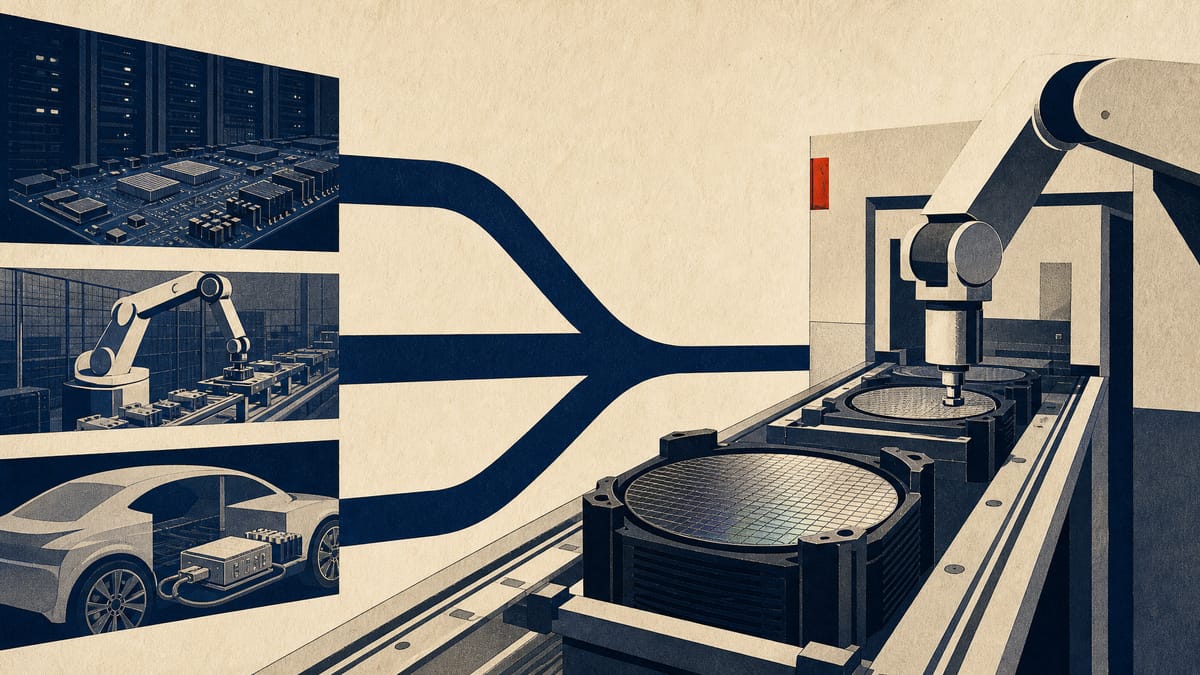
Rohm's notice names three demand sources. Data-centre investment, driven by the spread of generative AI, keeps demand "at a high level", mainly for servers and storage. In industrial equipment, demand is recovering, mainly for factory automation. In cars, demand for xEV products, a category Rohm uses without defining in the notice, remains resilient.
The notice does not split the ¥40bn sales increase among these markets. The half-year results give some texture: sales rose 14.4% to ¥279.5bn, with growth in automotive, industrial and computer and storage markets, while demand for home appliances softened. Rohm also said server-related products sold sharply higher in its LSI and discrete segments.
Price and cost, not only volume
On profit, Rohm says material, energy and logistics costs are still rising. It expects better profitability than it assumed at the start of the year because sales are growing and its "price optimisation" and cost-cutting efforts are progressing. First-half operating profit rose 128.5% to ¥17.5bn. Rohm credits higher sales and lower depreciation after impairments booked in the prior year. Net profit for the half was ¥15.6bn, up 51.0%.
The forecast assumes an exchange rate of ¥153 to the dollar for the second half.
Where SiC still falls short
Rohm lists making its silicon carbide (SiC) business profitable among its tasks, alongside structural reform. The first-half results show why. The discrete semiconductor segment, which includes SiC power devices, posted a ¥4.4bn operating loss, narrower than the ¥9.8bn loss a year earlier. Rohm said SiC sales to xEV and server customers held up. For the full year it forecasts segment sales of ¥245.6bn for discrete devices and ¥248.9bn for LSI, compared with last year's actuals rather than the earlier forecast.
Rohm kept its full-year dividend forecast at ¥50. It declared an interim dividend of ¥25 a share, payable from 4 December.
These are management forecasts, and Rohm says it does not promise to achieve them. The demand assessment is the company's own reading of its markets, not a measure of the wider industry.