Web View
AEON's record half hides a ¥12.6bn general-store loss
AEON posted a record half-year profit, then explained the stores that lost money. Hulic and Katitas tabled buyouts, and Metaplanet plans to repay part of a bitcoin-backed loan with new convertible debt.
MARKETS
Market pulse
Tokyo equities advanced; 10Y JGB data was unavailable.
Sourced from Nikkei, JPX, BOJ - values, not commentary.
lead
AEON's Record Half, Minus the Stores

AEON's record half-year profit rides on Tsuruha and malls as general stores lose money
AEON's operating profit rose 10.7% to ¥130.7bn in the six months to 31 August on operating revenue up 13.8% to ¥5.90tn, and the company's results deck calls both figures records.
What changed: Most of the growth came from three businesses AEON labels its profit drivers: health and wellness, developer and entertainment, and ASEAN. Health and wellness revenue rose 87.4% to ¥1.28tn and operating profit reached ¥59.7bn, from ¥22.7bn, after Tsuruha Holdings became a consolidated subsidiary on 14 January 2026. Developer and entertainment operating profit rose 32.3% to ¥54.2bn.
The catch: The retail operations at AEON's core went the other way. General merchandise stores lost ¥12.6bn, supermarkets lost ¥176mn against a ¥12.9bn profit a year earlier, and discount stores earned ¥455mn, down 87.7%. AEON points to the end of last year's rice demand boom, higher costs linked to the Middle East, and shoppers' thrift.
The number: AEON's deck also gives a simple sum for the health and wellness segment that excludes Tsuruha group results: revenue up 3.6% to ¥707.0bn and operating profit up 30.0% to ¥33.3bn. Headline revenue growth therefore mostly reflects a bigger group, not stronger shopper demand.
Context: The disaster loss in extraordinary losses was ¥4.2bn, against ¥6mn a year earlier, mainly earthquake damage. The release opens with condolences to those who died in accidents at AEON Mall Kumamoto and AEON Mall Uki, linked to the Kumamoto earthquake, and an apology to the bereaved families and the injured. An investigation committee made up solely of outside experts is examining the cause of the explosion, and AEON says it will disclose its report promptly on receipt.
What to watch: Full-year guidance is unchanged at operating revenue of ¥12tn, operating profit of ¥340.0bn and net profit of ¥73.0bn. Interim operating profit is 38.4% of that target and interim net profit of ¥13.3bn is 18.2%. For the second half AEON plans a reset of price policy and promotions, a push into its TOPVALU private label and a cost programme, while Tsuruha has delivered about ¥8.5bn of its ¥15.0bn annual synergy plan.
secondary
Deals and Capital Moves

Omron agrees $675mn deal for industrial PC maker OnLogic
Omron will pay $675mn on an enterprise-value basis, about ¥104.6bn at its ¥155-per-dollar conversion, for Vermont-based OnLogic and its parent Interlogic, mainly from cash on hand.
What changed: The board approved the deal and the contract was signed on 10 October 2026, Japan time. A new Delaware subsidiary will merge into Interlogic, which survives as a wholly owned Omron subsidiary with OnLogic beneath it. Closing is planned for around January 2027, subject to regulatory approvals, and Omron expects a minor effect on results for the year to March 2027.
By the numbers: The Interlogic group's US-GAAP sales were $154.2mn in 2025, up from $122.3mn in 2024, with EBITDA of $22.6mn. Omron's adjusted EBITDA of $27.1mn adds back costs its due diligence concluded would not recur. OnLogic sells configurable industrial PCs built to order, mostly direct, and books more than 90% of sales in the Americas, Europe and other regions. It had 301 employees and seven sites as of 24 March 2026.
Why it matters: Omron wants its control-equipment business to move toward what it calls a 'GEMBA DX x physical AI' company. It plans to pair OnLogic's PCs with its control technology, cross-sell to OnLogic's customers in the Americas and Europe, and run OnLogic as an independent business with its direct-sales model and brand. CEO Sean Larkin and the current management team are expected to stay.

Hulic bids ¥295 a share for the rest of Riso Kyoiku Group, with no majority-of-minority condition
Hulic, which already owns 50.87% of the tutoring and early-education operator, is offering a 41.15% premium to the 9 October close, ¥25 below the price it paid in 2024, and Riso's board backs the bid.
What changed: The tender offer runs from 14 October to 26 November 2026 with no cap on shares bought, and the aim is a wholly owned subsidiary. The ¥295 price compares with a ¥209 close on 9 October. Riso's special committee asked for a higher price six times and Hulic raised its bid four times from an opening ¥240, calling ¥295 its best and final offer. Hulic paid ¥320 in its 2024 offer, when it took control.
The catch: The minimum of 26,646,601 shares, 15.60% of the reference count, is sized so that Hulic and the restricted shares held by Riso directors reach two-thirds of voting rights. Hulic did not add a majority-of-minority condition, saying it could make completion uncertain, although the special committee had asked it to consider one or raise the price further. Riso's financial adviser gave a fairness opinion on the price. An educational foundation holding 6.05% has agreed to tender all its shares.
What to watch: The steps after the offer are planned, not done. Conditional on the offer succeeding, Riso will pay no dividend for the year ending February 2027, against an earlier ¥10 forecast, and no interim dividend is planned.
Metaplanet plans ¥52bn of zero-coupon convertibles to cut bitcoin-backed debt and fund buybacks
Metaplanet will use about ¥51.9bn from a zero-coupon convertible due 2031 to repay ¥23.6bn of bitcoin-backed borrowing and fund up to ¥28.3bn of buybacks, and it says plainly that total debt will rise.
What changed: The company decided to sell ¥52bn of the bonds to overseas investors, in 5,200 units of ¥10mn, expected to be issued on 29 October 2026 and due on 29 October 2031. They carry no coupon and no security or guarantee, and no credit rating is planned. Net proceeds are about ¥51.9bn after ¥117mn of issuance costs. The repayment is set for November 2026 and the buybacks for October to December 2026.
The catch: The conversion price is not set. It will be fixed from investor demand and cannot fall below Metaplanet's Tokyo closing price on the day the underwriting agreement is signed. The credit facility allows borrowing of up to $800mn, with about $650mn drawn at 30 September. Metaplanet's own guideline is to keep these borrowings below one-tenth of the market value of its bitcoin holdings; the ratio was about 17.7% at 30 September.
What to watch: A ToSTNeT-3 buyback order for 96,934,800 shares at ¥261, about ¥25.3bn or 7.1% of ordinary shares, goes in at 8:45am on 14 October, and the notice says some or all of it may not fill. Holders can demand repayment at par on 29 October 2029. The press release says bond proceeds will not go to new bitcoin purchases.
secondary
Cyber, Compliance and Controls

Bookoff says 6.38 million people hit by member-data breach
Bookoff Group Holdings says 6,383,279 people were affected, drawn from 6,427,735 leaked member records, and it will start emailing them on 15 October.
What changed: The larger figure counts member numbers whose data the system logs show were sent outside; the smaller counts people, with several records under one email address treated as one person. Of the people affected, 6,170,908 are current members and 212,371 have withdrawn. Only app, online-store and Web members are covered. Data that may have leaked includes name, date of birth, gender, email address, phone number, address, password hash, point-card number and member number. The company says payment details such as card and bank account information are not managed in the affected system.
What happened: A third party accessed a subsidiary's domestic member-management system. The company confirmed the intrusion on 6 October and says the data was obtained between 4 and 6 October. It says it has cut off the attacker's route and that no new extraction has been confirmed. It also says it has not confirmed that the data was published or that points were misused. These are the company's own statements. It has reported to the Personal Information Protection Commission and consulted the police.
What to watch: Individual emails begin on Thursday 15 October and will go out in sequence. Affected members are asked to change passwords, and the company says its emails will carry no link to a password-change page. The financial effect is still being assessed and is not in the forecast for the year ending May 2027.

Olympus gets FDA warning letter covering six sites, says no recall or production limit
Olympus says an FDA warning letter on quality-system findings at six facilities does not limit production or sales or require a recall, and that it will respond within 15 business days.
What changed: The letter is dated 7 October 2026, US time, and follows FDA inspections in the second half of 2025. It covers sites in Hachioji and Hinode, Aomori, Shirakawa, Hamburg and Brooklyn Park. Olympus says the letter addresses the adequacy of its response to quality-management matters raised in a Form 483 after those inspections; the notice does not set out the specific findings.
Why it matters: According to Olympus, the letter does not restrict the production, sale, manufacture or distribution of its products, does not require a recall, and does not bar applications for FDA 510(k) clearance of new products. Olympus does not expect an effect on its consolidated results. These are the company's own assertions, and the notice does not reproduce the FDA's letter.
What to watch: Olympus will respond within 15 business days of receiving the letter. It says it has already carried out substantial corrective and preventive actions and will disclose material developments under applicable rules.
Arclands restatement cuts year's net profit 26% after pet-unit accounting probe
Arclands cut net profit for the year to February 2026 from ¥8.09bn to ¥5.95bn, a 26.4% fall, after a special committee found a pet-business subsidiary group used consolidation numbers that differed from its accounting system.
What changed: Arclands set up the committee on 3 July 2026 and received its report on 2 October. The review found that the subsidiary group's reporting package used different numbers from its accounting system, that unrealized profit on inventory had not been eliminated, and that bad-debt and bonus provisions were booked late. It also reviewed whether deferred tax assets can be recovered. Arclands bought 100% of the group on 6 June 2025 for ¥6.5bn in cash.
By the numbers: Revenue barely moved. Operating profit fell 4.6% at the interim stage, 6.7% after nine months and 8.6% for the year. Total assets fell from ¥346.21bn to ¥343.93bn and net assets from ¥128.36bn to ¥126.17bn.
What to watch: On 13 October Arclands filed amended annual and half-year securities reports and re-issued its earnings summaries; the restated annual statements were audited by PwC Japan. A disclosure of material weaknesses in financial-reporting controls is covered in a separate announcement, and the notice does not set out what remediation Arclands plans.
secondary
Earnings Reset

Takeuchi raises profit guidance and dividend, adds ¥15bn buyback
Takeuchi lifted its operating-profit forecast for the year to February 2027 to ¥44.5bn from ¥37.3bn, raised its dividend and approved a buyback of up to ¥15bn, though first-half operating cash flow turned negative.
What changed: The full-year sales forecast rises to ¥261.0bn from ¥244.0bn and the net profit forecast to ¥31.5bn from ¥25.9bn. In the six months to August, sales rose 16.0% to ¥132.4bn and operating profit rose 3.4% to ¥24.2bn. US tariffs cut half-year operating profit by ¥1.7bn.
The number: Takeuchi names US tariff refunds as the main profit driver for the year: ¥2.6bn in the second quarter, ¥4.2bn in the third and ¥6.8bn in total. Orders rose 48.1% to ¥146.0bn, and the company will stop disclosing orders and backlog after the year to February 2027.
The catch: Operating cash flow was an outflow of ¥11.1bn in the half, against an inflow of ¥3.5bn a year earlier, as receivables rose ¥24.0bn. Cash and equivalents fell ¥22.0bn to ¥34.2bn.
Reader takeaway: The year-end dividend forecast rises to ¥135 from ¥110, taking the full-year dividend to ¥245 against ¥220 previously forecast. The board approved buying back up to 2.2 million shares, 4.8% of shares outstanding excluding treasury stock, between 14 October and 19 February 2027. An investor and analyst briefing is scheduled for 21 October.
secondary
Policy Watch
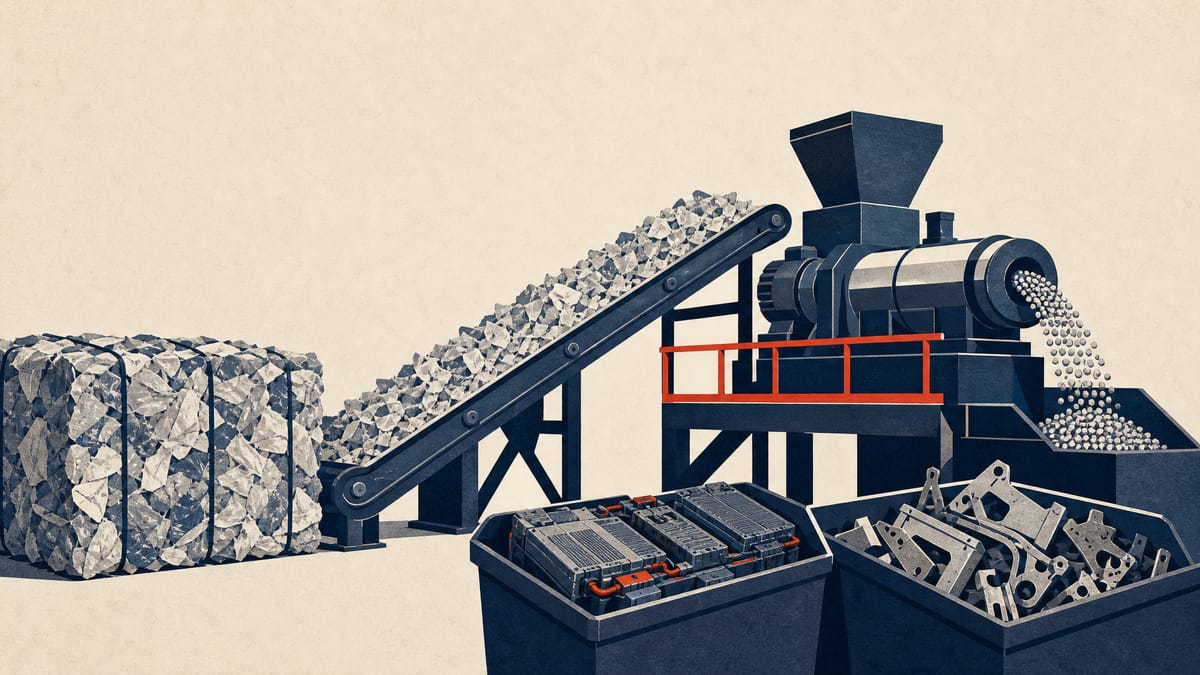
Recycling-plant grants: apply by 6 November, and hold off announcing the investment
Japan's second recycling-investment grant call closes at noon on 6 November and pays one-third of eligible costs, or one-half for qualifying small and medium-sized firms. In principle it excludes projects whose investment decision was announced before the grant decision.
What changed: Companies planning large waste-plastic, e-scrap, battery or waste-oil recycling plants in Japan can apply from Tuesday 13 October. The online application requires a gBizID Prime account that can take two to three weeks to obtain. The grant pays one-half of eligible costs to small and medium-sized enterprises and one-third to other applicants, but an SME that meets the guidelines' exclusion criteria is treated as a large company. The rate awarded can come in below the one applied for.
The catch: A project is in principle ineligible if its investment decision was announced publicly before the grant decision date. Orders, contracts and payments made before the call opened are not eligible, and an informal signal to a supplier that an order will follow counts as an order. A pre-start notification promises neither selection nor a grant.
What to watch: Screening starts on 9 November and selected projects are due to be published in December or later. The secretariat asks applicants to contact it by 23 October if possible to check eligibility. Beneficiaries must keep using the equipment for at least five years, and part or all of the grant can be reclaimed if the social-implementation plan is not met.
quick hits
Quick Hits
DIP cuts full-year guidance to a range that includes an operating loss
Read moreDIP lowered its guidance for the year to February 2027 to revenue of ¥49bn to ¥53bn and an operating result of minus ¥2.5bn to plus ¥2.5bn, blaming lower contract prices, slower agency sales and continued advertising spending.
Kanaden lifts interim forecasts on data-centre power gear and chip tools
Read moreKanaden lifted its interim sales forecast to ¥69.3bn from ¥63bn and operating profit to ¥1.95bn, crediting AI and data-centre demand across chip equipment, switchgear and power systems, while full-year guidance is still under review.
Ride On Express warns up to 6.5 million sushi-delivery records may have leaked
Read moreRide On Express Holdings says up to about 6.5 million registrant records from its Gin no Sara, Kamatora and Sushi Jouto sites and apps may be exposed, though no leak is confirmed and official-channel ordering stays suspended.
Katitas bids ¥2,000 a share for Toubujyuhan, with 45% of the register pledged
Read moreKatitas's ¥2,000-a-share cash offer for Toubujyuhan has the board's backing and pledges from holders of 45.01%; if it succeeds, the company pays no year-end dividend and ends its shareholder benefit scheme.
Toyota buys back ¥108.5bn of shares in September, lifting total to ¥195bn
Read moreToyota spent ¥108.5bn repurchasing 35.6mn shares in September, bringing cumulative buybacks under the ¥1tn authorization approved on 4 August to ¥195bn, or 19.50% of the yen cap.
Tokyo Electron has spent nearly all of its ¥150bn buyback budget on a third of the authorized shares
Read moreTokyo Electron had bought ¥149.999bn of stock against a ¥150bn board ceiling by the end of September, yet only 2,443,900 of the 7.5mn authorized shares, and the purchase window runs to March 2027.
Tokio Marine's September buyback reaches 34% of its ¥200bn cap
Read moreTokio Marine bought ¥68.3bn of its own shares in September, 34.17% of the ¥200bn programme approved in May, after its March programme hit the yen ceiling. A 15-for-1 split took effect on 1 October.
Gakken confirms it has opened a sale process for a group company's shares, nothing decided
Read moreGakken Holdings confirmed it has started a bidding process aimed at selling its shares in a group company under its portfolio restructuring review, but says no decision has been made and discloses no buyer or price.