Web View
Three Tohoku banks open integration talks; NISA buying clears its 2027 target
Three northern Tohoku banks open integration talks aimed at April 2028, NISA buying sprints past a 2027 target, and a spark-plug deal unravels. Coffee first, due diligence later.
MARKETS
Market pulse
Tokyo equities softened while the 10Y JGB yield nudged higher.
Sourced from Nikkei, JPX, BOJ, MOF - values, not commentary.
lead
Three Banks, One Possible Group
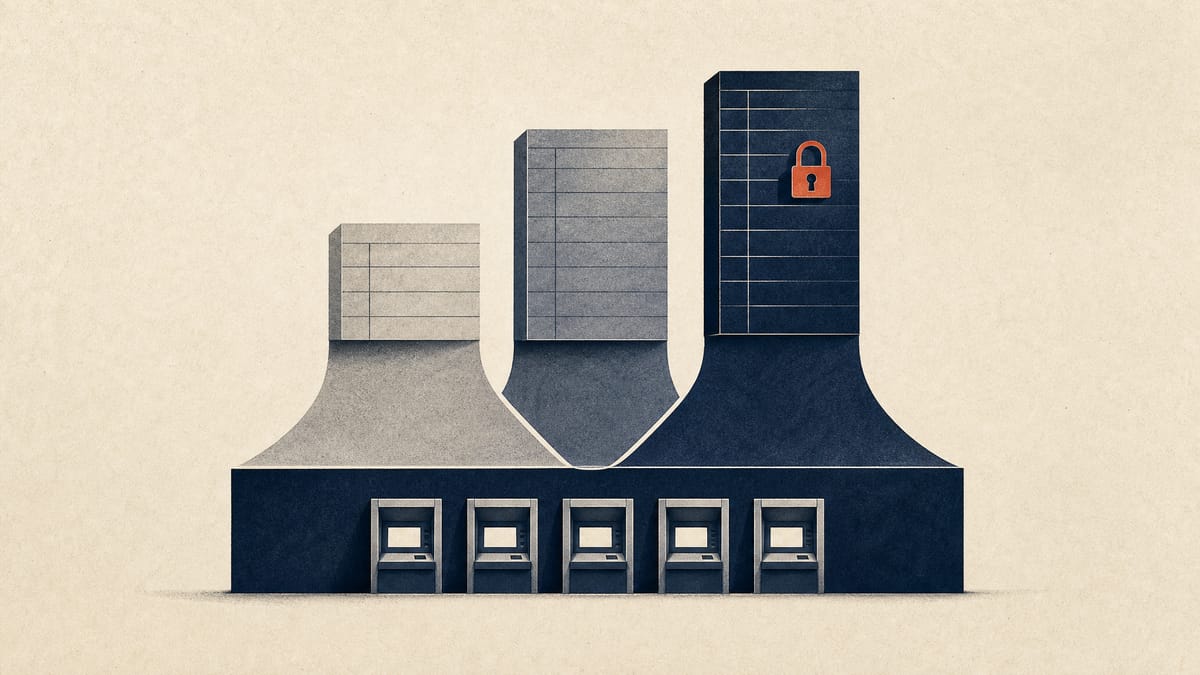
Three northern Tohoku banks begin integration talks, aiming for April 2028
Procrea Holdings, Akita Bank and Bank of Iwate resolved on 2 October to open talks on a business integration, citing faster-than-average depopulation and the burden of AI and cybersecurity costs. The three boards each resolved to discuss and examine an integration, with a planned target of April 2028. That is a decision to negotiate, not a merger agreement. Procrea is the holding company that owns Aomori Michinoku Bank, and the three describe themselves as the leading banks in Aomori, Akita and Iwate. They say starting talks has no effect on their consolidated results for the year ending March 2027.
Why now: The banks name two pressures. The three prefectures are depopulating faster than the national average, and the banks worry that falling numbers of business establishments will weigh further on regional economies. They also say AI and cybersecurity are management issues growing more varied and complex, and that scale would help absorb costs that are heavy for any one bank, including specialist hiring and training, system investment, compliance and risk management.
By the numbers: The balance sheets differ most on capital. At 31 March 2026 Procrea's consolidated capital ratio was 8.83%, against 11.26% at Akita Bank and 11.17% at Bank of Iwate. For the year to March 2026, consolidated net profit attributable to owners of the parent was ¥8.92bn at Bank of Iwate, ¥7.69bn at Akita Bank and ¥3.78bn at Procrea.
Context: The banks have worked together for 26 years, starting with a shared ATM network in April 2000 and a joint cybersecurity response team in August 2015. Akita Bank and Bank of Iwate signed a comprehensive business alliance in October 2021.
What to watch: The announcement gives no integration structure, share exchange ratio, group name or quantified cost-saving target. The only date is the planned April 2028 integration, and the banks say they will announce promptly any event that requires disclosure.
secondary
Rules, Data and Savers
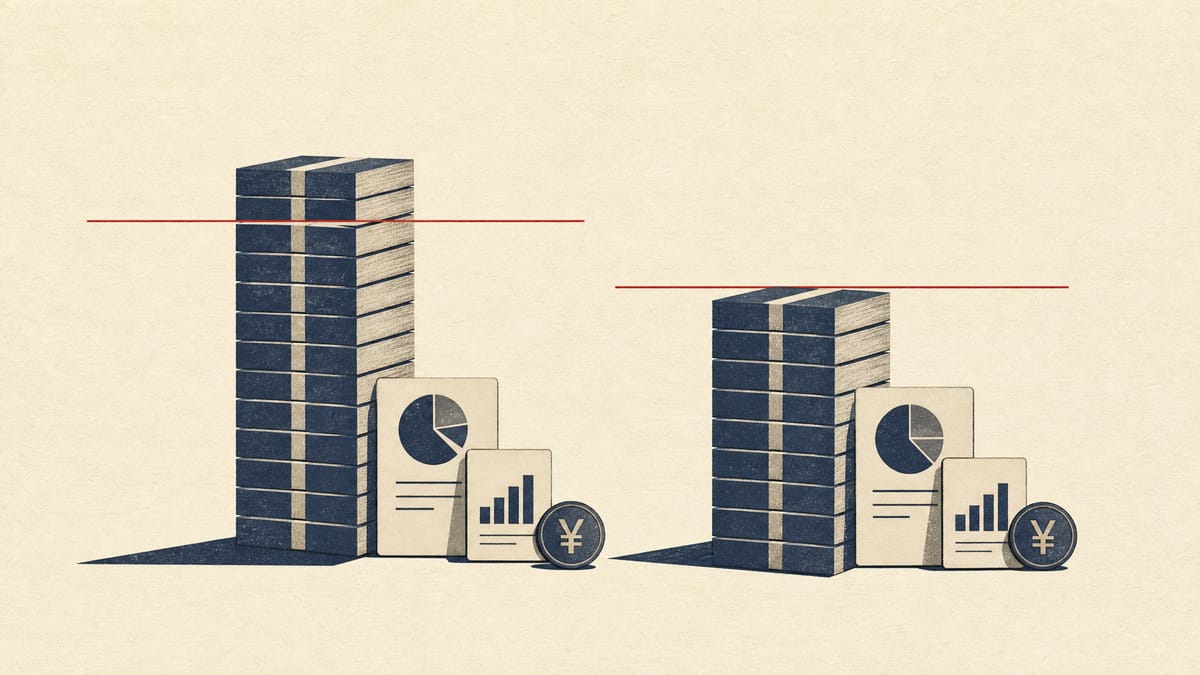
NISA purchases of ¥85tn already top the 2027 target, but account numbers still trail
The FSA counts 30.48 million NISA accounts and ¥85tn of cumulative purchases at end-June 2026, against government targets of 34 million accounts and ¥56tn for end-December 2027. The Financial Services Agency said on 2 October that Japan had 30,480,850 NISA accounts at the end of June 2026. Cumulative purchases stood at ¥85tn, so buying has passed its 2027 goal while account numbers have not reached theirs.
The catch: The figure is cumulative purchases since 2014, not assets. The FSA's transition table puts the NISA balance at ¥36.8tn at end-2025 and gives none for end-June, so the headline total says nothing about net flows or what investors hold today.
By the numbers: Purchases within the 2026 allowance totalled ¥13.82tn by end-June: ¥10.16tn in the growth investment allowance and ¥3.66tn in the accumulation investment allowance. Investment trusts took 61.9% of the total and listed stocks 34.5%.
Read-through: Savers in their 50s hold the most accounts, 5,999,082 or 19.7%, and lead purchases at 23.0%. Those in their 20s hold 12.4% of accounts but made 6.6% of purchases.

JFTC finalises guidance on unpaid know-how and last-minute cancellations
The Japan Fair Trade Commission's final guidance under the subcontracting and freelance acts counts know-how as intellectual property, and says a client that forced a contractor to hold its schedule for a substantial period, then cancelled just before the work and left the contractor unable to take other work that day, cannot ask for changes without covering the contractor's full costs and losses. The JFTC published final revisions on 1 October 2026 to its operating standards under the subcontracting act and its interpretation guidelines under the freelance act. Both are interpretive texts under existing laws; the release announces no new statute and no enforcement case. The JFTC took comments on its draft until 23 July, received 20 submissions and made technical changes only.
What changed: The old text covered intellectual property rights. The revised standards cover "IP etc.", meaning IP rights plus technical or business secrets, including know-how. When a contractor's transfer or licence of such rights is part of the deliverable, the client must state its scope and take it into account when setting the price. New examples of improper requests include a character design commissioned for a poster and later used for merchandise with no further payment, and a promotional video whose copyright was taken without explaining the price breakdown.
The catch: Where a client changes or redoes work, the text now refers to the contractor's "costs and losses", not costs alone. In the new schedule-hold case the text says the contractor is not at fault. In its replies, the JFTC said the amount of loss is judged case by case, and that a freelance event cancelled shortly before it was held may breach the freelance act unless the client pays an amount equal to the fee in the written notice.
What to watch: The operating standards now treat a client as refusing to negotiate if a contractor asks about the IP price, or for revenue sharing, and the client gives no specific explanation and either keeps the old price or presents a lump sum it set itself. The release gives no effective date, and the JFTC says it will keep dealing strictly with violations, including in the intellectual property field.
Japan's special-fraud losses reach ¥236bn in eight months, up a third on the year
Losses from special fraud reached ¥236.1bn in January to August, up 33.2% on a year earlier, with social-media investment scams the largest category at ¥93.7bn, the National Police Agency's provisional data show. Reported cases rose 14.4% to 29,687, so losses grew faster than the case count.
By the numbers: Social-media investment fraud recorded 7,097 cases, up 49.4%, and losses up 53.8%. Fake-police fraud cases fell 4.1% to 6,346, yet losses rose 27.0% to ¥72.9bn.
The catch: The latest month is softer. August losses were ¥25.3bn against ¥29.7bn in August 2025, and social-media investment losses fell from ¥15.7bn in January to ¥5.6bn in August. Police cleared 5,443 cases, up 25.2%, though the 2026 clearance figures include organised-crime-law violations that were mostly excluded in 2025, so that comparison is not like for like.
secondary
Capital and Deals

Infroneer seeks up to ¥147bn in new equity to clear acquisition loans
Infroneer plans to issue 47.8 million new shares, with estimated net proceeds of up to ¥147.24bn, of which ¥117bn is earmarked to repay short-term loans from two acquisitions by December 2026. The board resolved on 2 October 2026 to proceed with a combined domestic and overseas offering of 47,826,100 new ordinary shares. Nothing has been priced: the headline figures are ceilings built on the Tokyo Stock Exchange close of 25 September 2026, and they include up to ¥19.24bn from an over-allotment-linked share issue that may shrink or not happen. Where the money goes: The ¥117bn covers two loans. One is ¥77bn due 25 March 2027, the balance of a ¥95bn facility used to buy the contractor formerly called Sumitomo Mitsui Construction for ¥94.13bn. The other is ¥40bn due 1 July 2027, borrowed to buy a water-treatment company in a deal that closed on 1 July 2026 at ¥75.20bn. Any remainder is reserved for M&A by the end of March 2028, centred on contracting, infrastructure operation, and stadium and arena businesses.
By the numbers: Ordinary shares outstanding would rise from 274,845,024 to 322,671,124 after the main offering, and to 329,845,024 if the third-party issue is fully taken up. The indicative price range is 0.90 to 1.00 times the Tokyo close on the pricing date.
The catch: Infroneer says the raise does not change its current-year forecast. It also lifted its dividend floor to ¥90 per share from the year ending March 2027, from ¥60, with a payout ratio of at least 40%. Pricing is the next fact, due between 21 and 26 October.
Nippon Express closes Metro Supply Chain purchase at C$1.8bn enterprise value
Nippon Express Holdings has completed its purchase of Canadian contract-logistics group Metro Supply Chain at a C$1.8bn enterprise value, with up to C$400mn more payable if financial targets are met and a merger of the holding vehicle with Metro planned for 1 November. The deal closed on 1 October 2026 Canadian time. Nippon Express holds 100% of the Montréal-based company's 11,754,647 shares through a Canadian special-purpose company, 18268738 Canada Inc.
The number: The company's notice puts the price at an enterprise value of C$1.8bn, or ¥207bn at the ¥115-per-Canadian-dollar rate it used throughout. A further sum of up to C$400mn (¥46bn) is payable in cash to the sellers, LDC Metro Holdings Inc. (56.0%) and CDP Investissements Inc. (44.0%), only if Metro hits financial indicators set in the share transfer agreement.
By the numbers: Metro, founded in 1974, runs contract logistics mainly in Canada, the US and the UK. In the year to September 2025 it reported revenue of about C$1.38bn, operating profit of about C$56mn and net income of about C$2mn, after a net loss of about C$16mn the year before.
What to watch: A local-law merger of 18268738 Canada and Metro is planned for 1 November 2026, with the combined company keeping the Metro Supply Chain Group name. Nippon Express says the effect on its consolidated results for the year ending December 2026 is still under review, and it plans to announce its integration plan and progress in February 2027.
Niterra drops Denso spark plug deal after Denso asks out
Niterra will cancel its purchase of Denso's spark plug and exhaust sensor businesses after Denso asked to terminate the contract, and says the effect on current-year guidance is minor while it re-examines growth investment in its 2030 plan. In a notice dated 2 October 2026, Niterra said it would sign an agreement with Denso cancelling the business transfer contract. The deal had been announced on 1 September 2025. Niterra attributes Denso's request to recent changes in its market environment and a review of its future policy toward the target businesses.
Context: Niterra says it kept negotiating in good faith but concluded that a drawn-out process would add uncertainty to its outlook, affect integration planning and shrink the benefit of the acquisition if closing slipped, so it accepted the request. Its forecast for the year ending March 2027, published on 30 April 2026, already included preparation costs for the deal.
What to watch: The Mid-Term Management Plan 2030 includes the acquisition's effect. Niterra expects no major change to its target figures, but will re-examine its business plan, including capital allocation, and announce the outcome on its investor relations website, with no date given. The notice states no transaction value and no termination payment.
secondary
Earnings and Controls

Arclands committee finds pet unit's CFO overstated profit; restatement due October 13
An independent committee estimates the damage to Arclands' net profit for the year to February 2026 at ¥1.30bn after its pet-retail subsidiary's CFO overstated results, but Arclands expects the final restated accounts, due October 13, to differ. Arclands' special investigation committee concluded that the chief financial officer of PFH, its pet-retail subsidiary, carried out fraudulent financial reporting, overstating profit in the numbers sent to the parent. Arclands received the report on October 2 and said it will file corrected earnings summaries and amended securities reports on October 13. It bought all of PFH's shares on June 6, 2025, for ¥6.5bn in cash. What the committee found: For April to December 2025, the numbers reported to Arclands overstated operating profit by ¥857mn, ordinary profit by ¥718mn and net profit by ¥721mn against the accounting-system figures. The committee said the CFO built his own forecast simulations, did not tell Arclands that reported figures were estimates or adjusted numbers, and then told staff to align the consolidation packages with what had already been reported. It found no evidence that other Arclands or PFH officers directed or approved the treatment. Separately, intercompany profit left in inventory was not eliminated on consolidation, overstating Arclands' inventory by ¥438mn at the interim period and ¥471mn at the year-end. A ¥65mn bad-debt provision and a ¥60mn bonus provision were booked in March 2026 rather than when due.
The catch: Arclands said the committee's figures are not the final restatement. It plans to add minor uncorrected items and a review of PFH's deferred tax asset recoverability, which the committee did not examine, and it expects the final corrections to differ. On October 13 it will also publish delayed first-quarter results for the current year and its recurrence-prevention measures.
IDEC lifts full-year profit forecasts by up to 43% on automation demand
IDEC lifted its forecast for operating profit in the year to March 2027 to ¥9.4bn from ¥7.2bn, citing firm semiconductor, robot and machine-tool demand centered on Japan and China and sales above its original assumption, while the dividend forecast stays at ¥130. IDEC raised its full-year forecasts on 2 October, lifting sales by 12.6% to ¥85.0bn from ¥75.5bn and operating profit by 30.6% against the guidance it gave on 14 May. The percentages measure the change from the earlier forecast, not growth on last year.
The number: Profit attributable to owners of the parent is now guided at ¥8.6bn, up from ¥6.0bn, a 43.3% upward revision, and forecast earnings per share go to ¥290.46 from ¥203.25. For the year to March 2026 IDEC reported sales of ¥72.97bn and operating profit of ¥6.12bn, so the new guidance sits above both.
Why it matters: IDEC says capital spending demand, centered on AI and digital-related fields, is expanding, and that demand for semiconductor, robot and machine-tool applications has been firm across all regions. That explanation is the company's own and covers its group only. Domestic sales are guided at ¥30.1bn, up 18.5%, and overseas sales at ¥54.9bn, up 9.6%.
quick hits
Quick Hits
Otsuka's Taiho Starts US Filing for Zipalertinib as a First-Line Lung Cancer Combination
Read moreOtsuka says Taiho has begun an FDA application for zipalertinib with chemotherapy in untreated EGFR exon 20 lung cancer, with the filing due to finish by end-2026 and no change to the company's current-year forecast.
FSA Drafts Would Add Corporate Numbers to Critical-Infrastructure Supplier and Intermediary Filings
Read moreSix draft orders from the FSA would have designated operators report corporate numbers for suppliers, holders of 5% or more of their voting rights and supply-chain intermediaries, with comments due by noon on 31 October 2026.
Toshin Holdings Plan Would Swap an Estimated ¥635mn of Interest Claims Into Creditor Shares
Read moreToshin Holdings' rehabilitation plan would swap an estimated ¥635mn of interest and penalty claims for Class A shares, cutting founder-linked votes to about 26%, with creditors voting from October 29 and cash tranches unfilled.
Tokai Kisen told to idle three vessels for 20 days from October 9
Read moreJapan's transport ministry has barred Tokai Kisen from using three vessels from October 9 to October 28 after inspections found alcohol-related and record-falsification lapses; the company is still assessing the earnings impact.
Ikegami Tsushinki says data apparently held by the company is on an attacker's leak site
Read moreIkegami Tsushinki said on October 2, 2026 that information it apparently held has been published on an attacker's dark-web leak site, and it is still checking what was posted and how far it extends.
Komori closes ¥26.46bn purchase of chiller maker Maruyama Chiller
Read moreKomori has bought all of Maruyama Chiller, a maker of chillers for semiconductor equipment, for about ¥26.46bn including fees, and renamed it KOMORI Precision Technologies; its standalone net profit was ¥364mn in 2025.
JAPEX closes $278mn Colorado and Wyoming oil purchase, funding most of it with reserve-backed debt
Read moreJAPEX has completed its $278mn purchase of four Colorado and Wyoming tight oil and gas companies, borrowing about $220mn against confirmed reserves for assets that sit near the Verdad holdings it bought in February.
JCR hands US, European and Latin American rights to Hunter syndrome drug to Italfarmaco
Read moreJCR Pharmaceuticals will keep manufacturing JR-141 while Italfarmaco takes over sales in the US, Europe and Latin America after approvals, with the upfront payment already in JCR's current-year forecast.
Rohto lifts its 2030 sales target to ¥444bn but trims the margin goal
Read moreRohto Pharmaceutical lifted its 2030 sales target to ¥444.0bn from ¥415.0bn while lowering the margin goal to 12.8% from 13%, and set 2031 targets including a 40% dividend payout ratio.
METI opens second round of Global South grants: ¥100mn for feasibility studies, ¥500mn for pilots
Read moreUp to half of eligible costs, or two-thirds for qualifying SMEs, is covered, with ceilings of ¥100mn for feasibility studies and ¥500mn for demonstrations; applications close at noon on 23 October and payment generally comes after projects end.
Zojirushi books ¥207mn of US tariff refunds as ¥1.03bn more arrives after quarter-end
Read moreZojirushi booked ¥207mn of US tariff refunds in its nine-month results, received a further $6mn (about ¥1.03bn) after the period, and kept full-year guidance unchanged, citing raw-material costs.