Web View
Japan Hiked Rates. The Yen Shrugged Anyway.
Japan raised its policy rate to about 1.25% and long bonds hit a 30-year high above 3.115%, yet the yen weakened anyway — now Katayama says Trump raised the currency directly with Takaichi at their summit.
MARKETS
Market pulse
Tokyo equities softened while the 10Y JGB yield nudged lower.
Sourced from Nikkei, JPX, BOJ, MOF - values, not commentary.
lead
The Rate Hike That Didn't Save the Yen
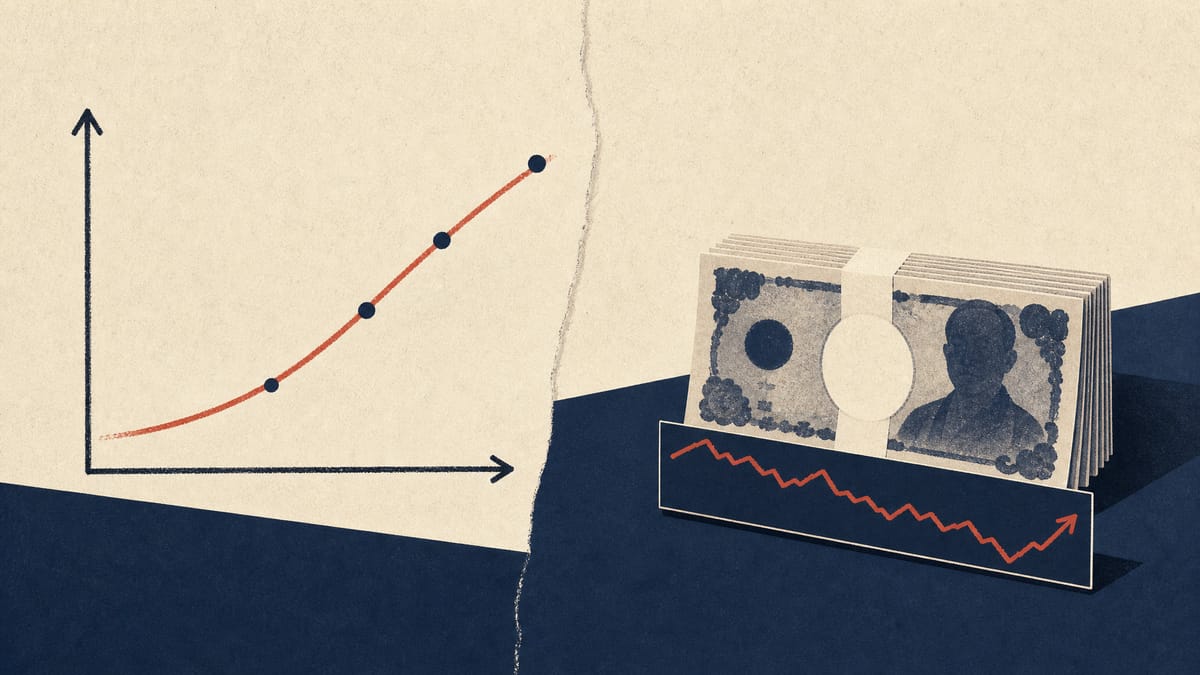
Trump Raised Yen-Weakness Concerns at Japan-US Summit, Finance Minister Discloses
Finance Minister Katayama made a disclosure on September 25 that had little to do with interest rates on paper but everything to do with them in practice: at a recent Japan-US summit, President Trump raised concerns about yen weakness, and Prime Minister Takaichi responded, in general terms, that an undervalued yen is a problem. Katayama said this was the first time he had spoken publicly about the exchange, and that he and US Treasury Secretary Bessent will continue close exchanges on currency and other matters going forward.
What changed: The disclosure came a week after the Bank of Japan's September 18 meeting, where the central bank raised its policy rate from about 1.0% to about 1.25%, its first hike in three months. Katayama said Governor Ueda told reporters afterward that stabilizing underlying inflation near 2% has become the key consideration, marking a shift in the policy phase. Katayama declined to discuss the specifics of monetary policy, repeating that the central bank's methods are the BOJ's alone to decide.
Why it matters: Reporters at the briefing noted that the yen weakened sharply after the rate decision and that long-term Japanese government bond yields briefly exceeded 3.115%, a 30-year high. Katayama did not dispute either point but declined to discuss the yen's move or confirm reports of a BOJ rate check on the evening of September 18, saying only that his ministry is doing what it can on the many factors affecting interest rates.
Zoom out: Katayama anchored the currency conversation in recent history rather than new commitments, pointing to the coordinated intervention of July 31, the first joint Japan-US intervention in 28 years, and the joint statements both governments issued on August 3. He said the summit had reconfirmed that history, and described how Takaichi opened the summit by telling the American delegation that Japan's officials had not changed: despite a Cabinet reshuffle that moved ten of eighteen ministers, the officials facing Secretary of State Rubio, Treasury Secretary Bessent, Commerce Secretary Lutnick and Defense Secretary Hegseth, in that seating order, all remained in their posts.
The catch: Katayama would not characterize the nature of Trump's concern beyond the single remark, or say whether the summit discussed specific intervention methods. He confirmed only that the July 31 intervention and the August 3 statements were reaffirmed at the summit table, leaving further currency exchanges to run through his ongoing channel with Bessent.
secondary
Policy and Regulatory Watch
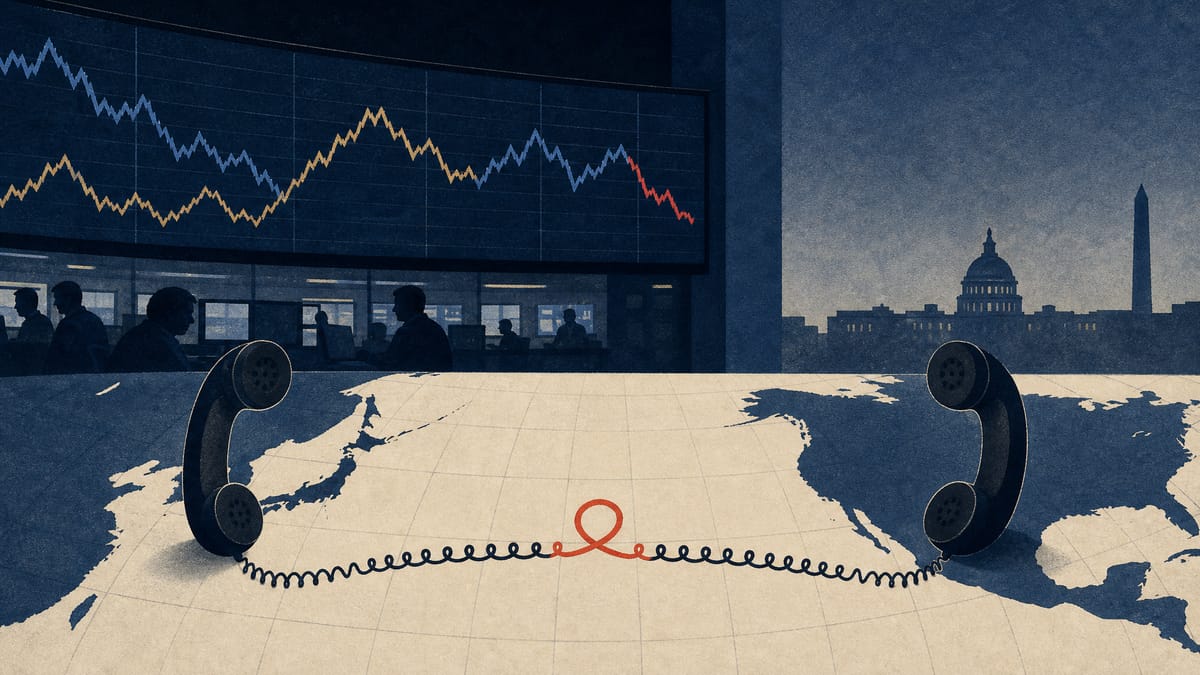
Japan and U.S. Finance Chiefs Reaffirm Yen Concern in Follow-Up Call
Japan's Ministry of Finance published a document titled "Japan-U.S. Finance Ministerial Meeting (September 25, 2026)," tying an exchange between Finance Minister Katayama and U.S. Treasury Secretary Scott Bessent to the Japan-U.S. summit and Prime Minister Takaichi's stated concern over yen undervaluation.
The catch: The material available to Tokyo Brief establishes the meeting's subject and date but not further specifics of timing or content beyond what the ministry's own title and framing set out. Katayama's own account of the summit exchange, including his plan to keep in close contact with Bessent on currency matters, is covered in the lead item above.

FSA Opens a Forum to Rebuild Japan's Payment Rails for an AI-Agent Economy
Japan's Financial Services Agency has scheduled the first meeting of a new cross-agency forum for September 30, 2026, aimed at reworking the country's payment infrastructure for an economy where AI agents, not just humans, strike deals. Called the Forum for On-chain Finance in the AI Era, the group brings together the FSA and other ministries and agencies under an initiative first set out in the FSA's growth-investment financial strategy of July 21, 2026.
Why it matters: The agency warns that if Japan's payment rails cannot run around the clock and link programmatically with commerce data, the country risks deeper dependence on overseas payment infrastructure, which it says would weaken competitiveness and raise economic-security concerns.
What to watch: Two dedicated study groups will handle the harder regulatory questions. One covers stablecoin reserve-asset rules, decentralized exchanges and decentralized finance, wallet-provider risk, and the tokenization of a range of assets. The other covers how markets and financial institutions should be supervised as AI use spreads, identity-verification tools such as verifiable credentials, and the risk that quantum computing could eventually break blockchain cryptography. The FSA wants an interim summary of the forum's work by early 2027.
BOJ's July Minutes Reveal a Board Split Over How Fast to Raise Rates
Minutes from the Bank of Japan's July 30-31 meeting, released September 28, show most board members held the policy rate near 1.0% while one member pushed for an immediate move to 1.25%, and staff flagged inflation accelerating past 3% later in the fiscal year.
METI Drafts Tougher Supply-Crunch Rules for Its Critical-Materials Subsidy Program
Japan's Ministry of Economy, Trade and Industry has opened a one-month public comment period, running September 25 to October 25, 2026, on a draft amendment to the ministerial ordinance governing certification of "supply assurance plans" under the Economic Security Promotion Act. Certification under the scheme is what lets a company tap subsidies, two-step loans and interest subsidies for shoring up domestic production of materials the government has designated critical.
What changed: The draft splits the existing shortage-response option in two: companies choosing that route would now pair a new item, setting out how they will handle supply counterparties and end-uses when a material runs short, with a second item covering the remaining shortage-response measures. Companies can still choose the investment-and-R&D track instead, without taking on the new counterparty-and-use commitment.
What to watch: The revised certification application would also ask for more disclosure: production and sales volumes split domestic versus overseas, the top three raw-material suppliers by trade volume or share, named by company and sourcing country, and a breakdown of funding sources for supply-security investment. The revised form also adds a checkbox: an applicant that agrees to it commits that, if it suffers a cyberattack or suspects one, it will promptly report the incident through METI to the Cabinet Secretariat's national cyber coordination office. Comments close October 25, 2026; the notice does not state when the amended ordinance would take effect.
secondary
Governance and Control

Nidec Confirms It Is Studying a Leadership Change and a Large Writedown, But Says Neither Is Decided
Nidec Corporation confirmed it is examining a change to its top executive ranks and a large-scale impairment charge, but said no decision has been made, after Diamond Online reported that the company had decided to dismiss its president and faced writedowns on the scale of ¥1 trillion.

JFTC Orders ¥1.64bn in Surcharges Over Rigged Condo Renovation Bids
Japan's Fair Trade Commission has ordered a combined ¥1.64bn in surcharges against a network of Kanto-region condominium-renovation contractors that rigged bids for years, alongside cease-and-desist orders against two design consultancies that orchestrated the schemes. The commission's tally lists 57 firm-level violations across two schemes, covering only 42 distinct companies since several contractors, including HASEKO's renovation subsidiary, were named as violators under both schemes; it issued cease-and-desist orders against 38 unique firms and surcharge orders against 37, effective September 28.
What changed: In each scheme, a design consultancy hired by a condominium management association to help pick a contractor instead built a standing relationship with one contractor per project, decided in advance who would win, and passed that contractor the association's confidential design budget. Rival bidders then submitted the relayed price or declined to bid. Winning contractors typically paid the consultancy about five percent of the contract price.
Why it matters: HASEKO Reform, the renovation subsidiary of Tokyo-listed HASEKO Corporation, was named in both schemes. Its combined surcharge comes to ¥329.4mn, reduced 25% under Japan's leniency program, due by the same April 30, 2027 deadline set for all 50 surcharge orders. HASEKO says the subsidiary's chairman will resign effective September 28 and its president will forgo 10% of monthly pay for three months. The parent expects to book the surcharge as a one-off non-operating loss for the current half-year and says its full-year earnings guidance published in May remains unchanged.
Park24 Says Times Car Breach Exposed Data From 6.6 Million Accounts
Park24 says a hacker viewed or improperly obtained names, addresses, driver's license images and other data from about 6.6 million Times Car and Times Business Service accounts, but that credit-card numbers were not leaked and passwords were stored in a form the company says cannot be read.
Blackstone Vehicle Offers ¥2,200 a Share to Take Project Holdings Private
TX1 Kabushiki Kaisha, a shell company wholly owned by TechnoPro Holdings, itself indirectly owned by funds managed, advised or operated by Blackstone Inc. or its affiliates, is offering ¥2,200 for each share of Project Holdings (TSE Growth: 9246), the digital-transformation consultancy whose board, with the CEO recused as one of the shareholders agreeing to tender, voted unanimously among its other six directors to recommend shareholders tender. The offer runs September 29 to November 11, 2026, with a floor of 3,554,400 shares (62.43% of shares outstanding), and represents a 98.20% premium to the stock's ¥1,110 close on September 25, the last trading day before the announcement.
What changed: Getting to ¥2,200 took three rounds of pushback from Project Holdings' independent special committee. TechnoPro Holdings first proposed ¥2,050 on August 26; the committee judged it too low. TechnoPro raised the price to ¥2,150 on September 7, was rebuffed again, then set ¥2,200 on September 15 and called it final. The committee pushed once more on September 17, but TechnoPro Holdings held at ¥2,200 on September 24.
Why it matters: The buyer arrived with a majority of the register already secured: SBI Holdings (28.65%), Project Holdings' CEO (15.51%) and DY Investment Limited Partnership No. 1 (15.10%) have signed agreements to tender a combined 59.27% stake.
What to watch: If the tender leaves TX1 with 90% or more of voting rights, it can use a statutory share-sale demand to buy out remaining holders directly. Below that threshold, TX1 plans a share consolidation under Article 180 of the Companies Act to reduce holdouts' stakes to fractional shares redeemable at the same ¥2,200 price, through an extraordinary shareholders' meeting pencilled in for mid-January 2027. Delisting from TSE Growth follows either path, but neither the tender's success nor the squeeze-out has happened yet. Project Holdings' board separately resolved to scrap its shareholder-benefit-point program if the offer goes through.
quick hits
Quick Hits
Tohoku Electric to Raise Power Rates for All Customers From November
Read moreTohoku Electric will raise electricity rates for every customer class from November 1, adding ¥485 a month to a typical household bill and around ¥17,000 to an office or commercial building's, as its grid subsidiary's revised wheeling charges take effect the same day. The company expects the change to improve group earnings by roughly ¥30bn this fiscal year, but has not folded that into full-year guidance.
Japan's Antitrust Watchdog to Add Regional Councils Policing Freight-Payment Law
Read moreJapan's competition authority is teaming with the transport ministry and the country's small-business agency to run block-by-block liaison councils and joint shipper patrols enforcing the law against delayed payments to subcontractors, months before a separate rule covering shipper conduct takes effect in April 2027.
Tungsten Costs Tied to China's Export Curbs Nearly Quadruple Naito's Profit
Read moreCutting-tool distributor Naito says higher tungsten costs tied to China's export controls, plus customers rushing orders ahead of feared shortages, helped drive a nearly fourfold jump in first-half profit, prompting an upward revision to its full-year guidance.
AEON Kyushu to Book ¥1.75bn Earthquake Charge, With More Bills Still Coming
Read moreAEON Kyushu has decided to record a ¥1.75bn quarterly charge for Kumamoto earthquake repairs and lost stock, reopened 18 of 20 affected stores, and says further costs and the full-year hit are still being assessed.
SBS Holdings Agrees to Buy Mitsubishi Chemical Logistics in Estimated ¥19.35bn Deal
Read moreJapan's SBS Holdings has signed to buy all of Mitsubishi Chemical Logistics from its parent for ¥19.2bn in share consideration, plus advisory costs, bringing the estimated total to ¥19.35bn subject to adjustment at closing, as the target's earnings flipped into a ¥1.07bn net loss, with completion pending regulatory approval and due April 1, 2027.
Chugai Set to Reclaim Myostatin Drug Rights From Roche After Obesity Trial Falls Short
Read moreAn interim analysis of Chugai's Phase 2 obesity trial for the myostatin antibody emugrobart found the targeted weight loss unlikely, so Roche is exiting the program entirely and is set to return all license rights to Chugai, which is now preparing, but has not decided, a possible return to spinal muscular atrophy development.
Achilles to End China Vehicle-Materials Production After Three Loss-Making Years
Read moreAchilles Corporation's board has resolved to end production at its wholly owned vehicle-materials plant in Foshan, China, by the end of September, after three years of losses that included a ¥3.26bn impairment, citing the retreat of Japanese automakers from China among its reasons, though it expects only a minor effect on its earnings outlook for the year to March 2027.
Amvis to Sell 47 Western Japan Hospice Homes to NSSK-Backed Buyer for ¥17.4bn
Read moreAmvis Holdings is splitting off 47 western Japan hospice homes and has agreed to sell them to an NSSK-backed buyer for a combined ¥17.4bn, refocusing its remaining hospice network on high-acuity, end-of-life patients around Tokyo and eastern Japan.
NZAM US Treasury ETF Traded at Nearly Double Its Net Asset Value
Read moreA Tokyo-listed US Treasury ETF, ticker 538A, closed at almost double its net asset value on September 25, and its manager warns the mismatch could persist if exchange trading in the fund stays thin.
KDDI Gives Up Its Board Seat at Kakaku.com but Keeps Its 17.7% Stake
Read moreKakaku.com dissolved its eight-year capital alliance with KDDI on September 28, stripping the telecom group of its board-nomination and pre-consultation rights, even though KDDI keeps its 17.70% stake and the underlying data-sharing business alliance.
Happinet Lifts Interim Profit Forecast 80% on Capsule-Toy and Trading-Card Demand
Read moreHit capsule-toy releases and strong convenience-store lottery and trading-card sales push Happinet's six-month net profit forecast to ¥9.0bn from ¥5.0bn, while the toy distributor keeps its full-year guidance unchanged pending the Christmas selling season.
Shimamura's First-Half Profit Rises Even as Apparel Price War Grinds On
Read moreJapan's value-clothing chain Shimamura grew first-half operating profit 5.3% to ¥33.13bn, yet management still describes fierce price competition and thrifty shoppers as the norm, with full-year guidance left unchanged.
Furuya Metal's Profit More Than Doubles, Beating Its 2030 Target Early
Read moreFuruya Metal's ordinary profit more than doubled to ¥24.7bn in the year to June on semiconductor and data-centre demand, precious-metal prices and a weak yen, and the company now says it will revise its 2030 profit target, though it has not yet said to what.
AXELL Raises Profit Guidance 91% and Nearly Doubles Its Dividend
Read moreAXELL CORPORATION now expects full-year net income of ¥1.7bn, up 91% from its May plan, and is raising its dividend to ¥79 from ¥41, pointing to stronger pachinko-chip demand and price increases that are offsetting a global memory-cost jump the company links to generative-AI demand.
AeroEdge's Share of Safran's LEAP Blade Orders Set to Jump From 2028
Read moreAeroEdge, one of only two global suppliers of titanium-aluminide blades for Safran's LEAP jet engine, has locked in a market-share increase from 40% to the high-40s per cent range starting January 2028, tied to a new alloy it developed with Japan's materials-research institute.
NTK Appeals Tokyo Court's Dismissal of ¥203.3bn Damages Claim Against Daiichi Sankyo
Read moreNorthern TK Venture has appealed to the Tokyo High Court after the district court threw out its entire ¥203.3 billion damages claim against Daiichi Sankyo over a blocked Fortis Healthcare tender offer, and the pharma company now says the earnings impact is under review rather than nil.
One REIT Buys Okinawa Resort Hotel Below Appraisal, Raises Payout Forecast
Read moreThe Tokyo-listed trust is swapping a 38-year-old Nagoya office building for a 300-room Okinawa resort priced 19.3% below appraisal, bridging the gap with a ¥5bn Mizuho loan and issuing a first, record ¥2,780 per-unit payout forecast for the half to August 2027.
Nippon Paper's Lintec share sale set to add ¥84.6bn for parent, ¥37bn for group
Read moreNippon Paper's sale of Lintec Corporation shares is expected to add an estimated ¥84.6bn gain to the parent company's own accounts, but only ¥37bn once consolidated with its group results, alongside a ¥3.6bn deferred-tax reversal.
Tokio Marine Settles Credit Suisse Lawsuit Over Greensill Insurance, Terms Kept Confidential
Read moreTokio Marine & Nichido settled a Credit Suisse-linked lawsuit over Greensill-linked insurance on September 24, its second confidential Greensill settlement this year, without admitting liability or disclosing terms.
freee's Growth Plan: 1% Churn as Profit Target Doubles
Read moreThe Tokyo-listed accounting and payroll software maker closed the year to June 2026 with ¥43.5bn of platform recurring revenue and a 1.0% average monthly revenue churn rate, and is now guiding for adjusted operating profit to more than double as it prioritizes margin over pure growth.