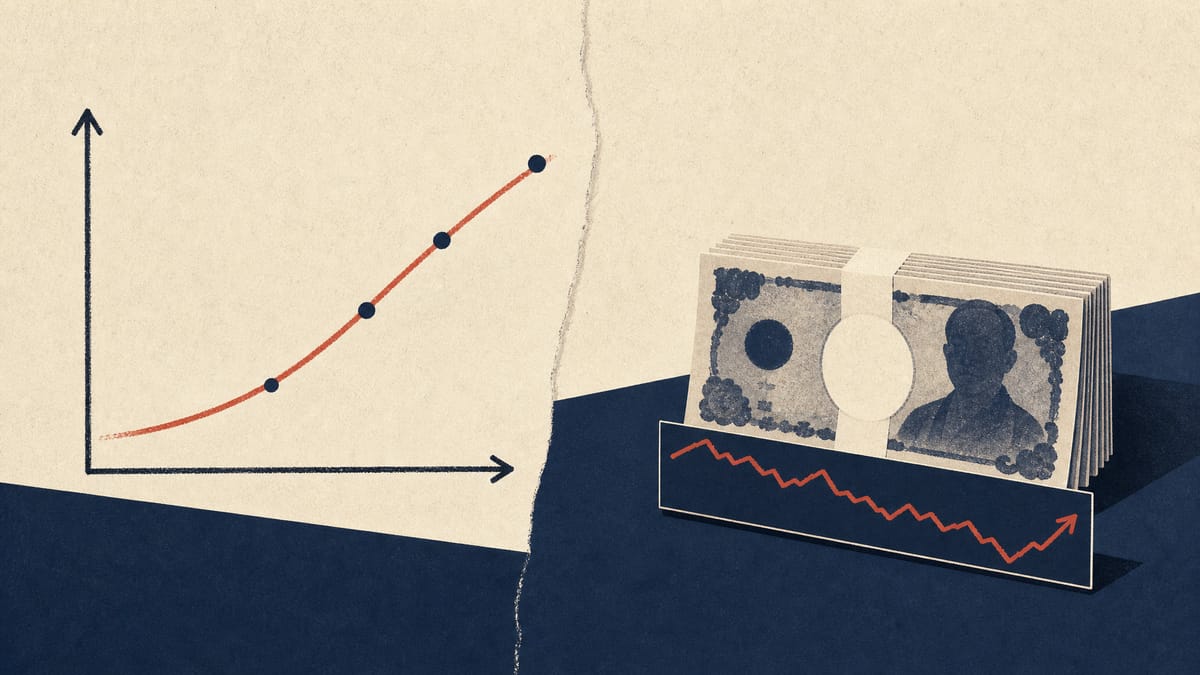
Finance Minister Katayama made a disclosure at his September 25 press conference that had little to do with interest rates on paper but everything to do with them in practice. Katayama said that at a recent Japan-US summit, President Trump raised concerns about yen weakness, and Prime Minister Takaichi responded, in general terms, that an undervalued yen is a problem. Katayama said this was the first time he had spoken publicly about the exchange, and that he and US Treasury Secretary Bessent will continue close exchanges on currency and other matters going forward.
The disclosure came a week after the Bank of Japan's September 18 meeting, where the central bank decided to raise its policy rate from about 1.0% to about 1.25%, its first hike in three months. Katayama said Governor Ueda told reporters afterward that stabilizing underlying inflation at around 2% has become the key consideration, and that this marks a shift in the policy phase. Katayama declined to comment further on the specifics of monetary policy, repeating that the central bank's methods are the BOJ's to decide.
Reporters at the briefing noted that the yen weakened sharply in the market after the rate decision, and that long-term Japanese government bond yields had briefly exceeded 3.115%, a 30-year high. Katayama did not dispute either point but declined to discuss the yen's move or confirm reports that the BOJ conducted a rate check on the evening of September 18, saying only that his ministry is doing what it can on the many factors affecting interest rates.
Katayama anchored the currency conversation in recent history rather than new commitments. He pointed to the coordinated intervention of July 31, the first joint Japan-US intervention in 28 years, and the joint statements both governments issued on August 3, saying the summit had reconfirmed that history. He also described how Takaichi opened the summit by telling the American delegation that their Japanese counterparts had not changed: despite a Cabinet reshuffle that moved ten of eighteen ministers, the officials facing Secretary of State Rubio, Treasury Secretary Bessent, Commerce Secretary Lutnick and Defense Secretary Hegseth, in that seating order, all remained in their posts.
What Katayama would not do is characterize the nature of Trump's concern beyond the single remark, or say whether the summit discussed specific intervention methods. He confirmed only that the July 31 intervention and the August 3 statements were reaffirmed at the summit table, leaving further currency exchanges to run through his ongoing channel with Bessent.