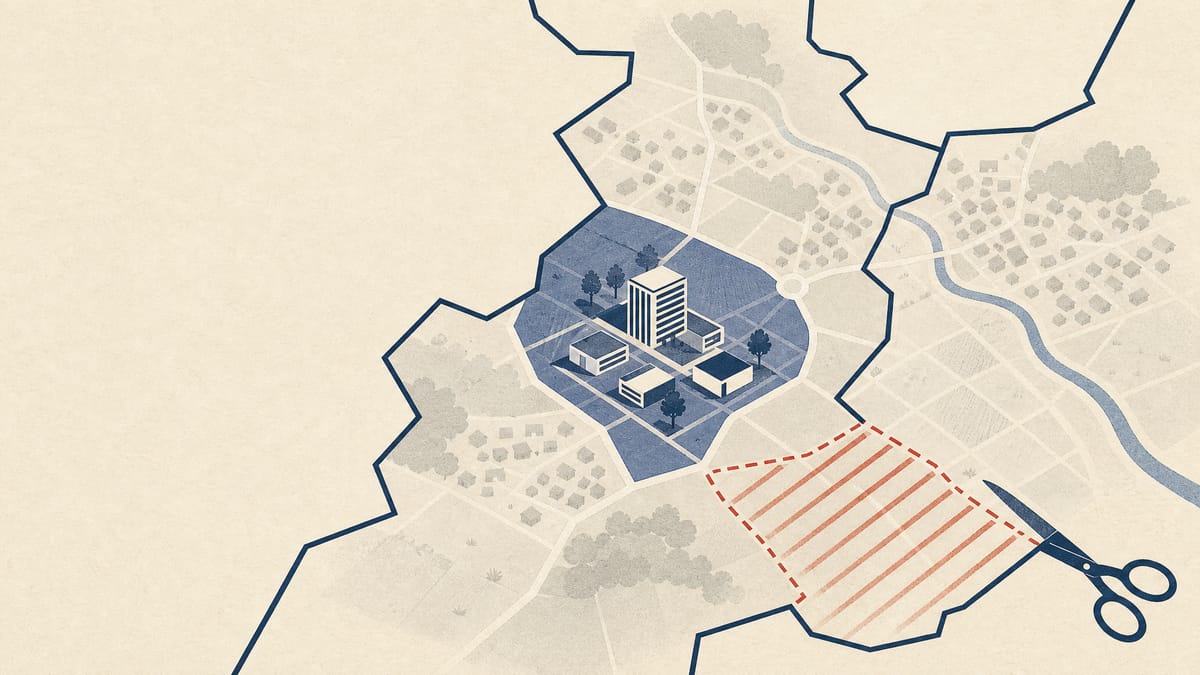
Japan's Cabinet Office has opened public comment on a redraft of the Urban Regeneration Basic Policy, the cabinet-approved guideline that has directed the country's urban-redevelopment programs since it was first adopted in July 2002. The policy has been revised repeatedly since, most recently in October 2022, and the new draft implements a freshly amended Urban Regeneration Special Measures Law, Reiwa 8 Law No. 23. Comments close September 30.
Why now
The draft outline states its own rationale: population decline is concentrated in regional areas, and a shortage of jobs and town-center appeal is deepening the exodus of young people, making it harder for smaller cities to sustain basic living services. The stated response is what the source materials call "Reiwa-era town renovation," the goal of drawing private investment into distinctive urban spaces by strengthening each region's earning power.
Prefectures get a coordinating role, offices get a town-center push
Under the draft, municipal "location normalization plans," the zoning tool Japanese cities use to steer growth toward walkable centers, would designate offices, incubation facilities and visitor-drawing facilities for those centers, explicitly factoring in visitors from outside the city as well as residents. Where siting decisions cross municipal lines, prefectures would gain authority to coordinate among the affected towns and cities from what the draft calls a wide-area, metropolitan perspective.
Heritage renovation and two new administrative tools
The draft also promotes renovation of buildings tied to local history, culture and landscape, using existing public and private stock to build area-wide appeal. It creates two new mechanisms: an agreement system for developing and managing public-purpose facilities, and a planning system for area-management activities.
| Provision | What the draft says |
|---|---|
| Town-center facility siting | Location normalization plans would designate offices, incubation facilities and visitor-drawing facilities for town centers |
| Prefecture coordination | Prefectures would gain authority to coordinate location normalization plans where siting decisions cross municipal boundaries |
| Heritage renovation and area management | New agreement system for developing and managing public-purpose facilities, plus a new area-management activity planning system, alongside renovation support for buildings tied to local history and culture |
| Disaster-zone exclusion | Location normalization plans would exclude every disaster-hazard zone from the residential-guidance areas they designate |
Every disaster-hazard zone comes out of residential planning
On safety, the revision would have location normalization plans exclude every disaster-hazard zone from the residential-guidance areas those plans designate.
The trigger law and the clock
The Basic Policy revision follows amendment of the Urban Regeneration Special Measures Law, published May 27, 2026, which takes effect within six months of that date, with some provisions phased in over as long as a year. Comments on the Basic Policy draft itself must be submitted in Japanese, either through an online form or by mail to the Cabinet Office's Regional Revitalization Promotion Office in Tokyo, by 23:59 on September 30. The office notes this is a voluntary solicitation, not one required under the Administrative Procedure Act. Until a subsequent cabinet decision formally adopts the changes, every provision described here, from the coordination power to the hazard-zone exclusion, remains a proposal open for comment, not settled policy.