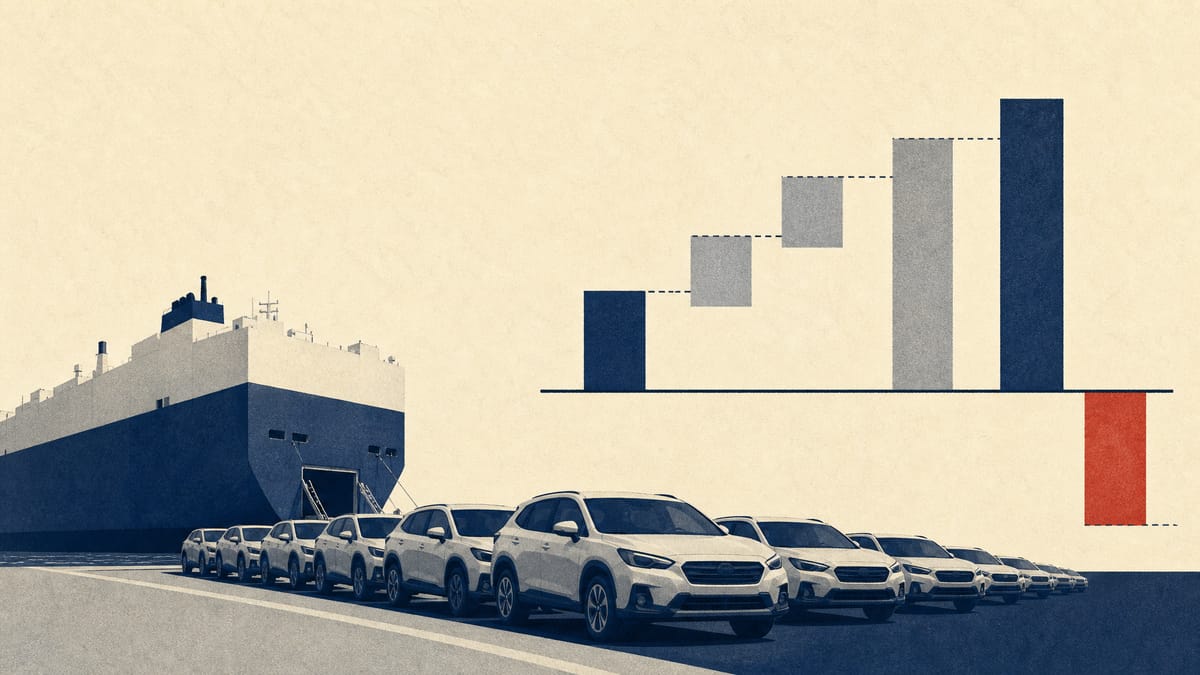
Subaru sold fewer cars in the six months to September and still made more money. Operating profit rose 12.9% to ¥116.0bn on revenue of ¥2.51tn, up 5.4%, according to its interim results.
Volumes fell
Consolidated sales were 444,000 vehicles, down 29,000 or 6.1%. Overseas sales fell 6.3% to 394,000, and domestic sales fell 3.8% to 50,000. The company said the year-earlier period included an inventory build.
What offset them
Subaru credits the yen, a smaller US tariff impact, cost reduction and lower warranty repair costs, including provisions. Raw material costs, weaker market conditions and higher sales incentives pulled the other way.
The analyst presentation puts numbers on it. Currency added ¥61.4bn, with the dollar averaging ¥159 against ¥146 a year earlier. Warranty repair costs added ¥57.6bn, cost reduction ¥11.1bn, and price and mix ¥59.8bn, a line that includes a ¥92.9bn positive from US tariff impact. Lower volume cost ¥45.3bn, incentives ¥48.2bn and raw materials and market conditions ¥51.7bn.
Against its own plan, the company said the yen (¥18.0bn), a ¥25.0bn drop in warranty repair costs and ¥14.0bn of expenses pushed into the second half added about ¥57.0bn to profit. The expense timing is a deferral.
Guidance held
Subaru left its full-year forecasts unchanged: operating profit of ¥150bn on revenue of ¥5.2tn, and 940,000 vehicle sales at an assumed ¥155 to the dollar. It expects higher raw material and market costs in the second half than in the first, and plans sales of 496,000 vehicles in that period.
The ¥150bn share buyback cap had reached about ¥67bn by October 31, with purchases due by March 16, 2027. Earlier Tokyo Brief coverage