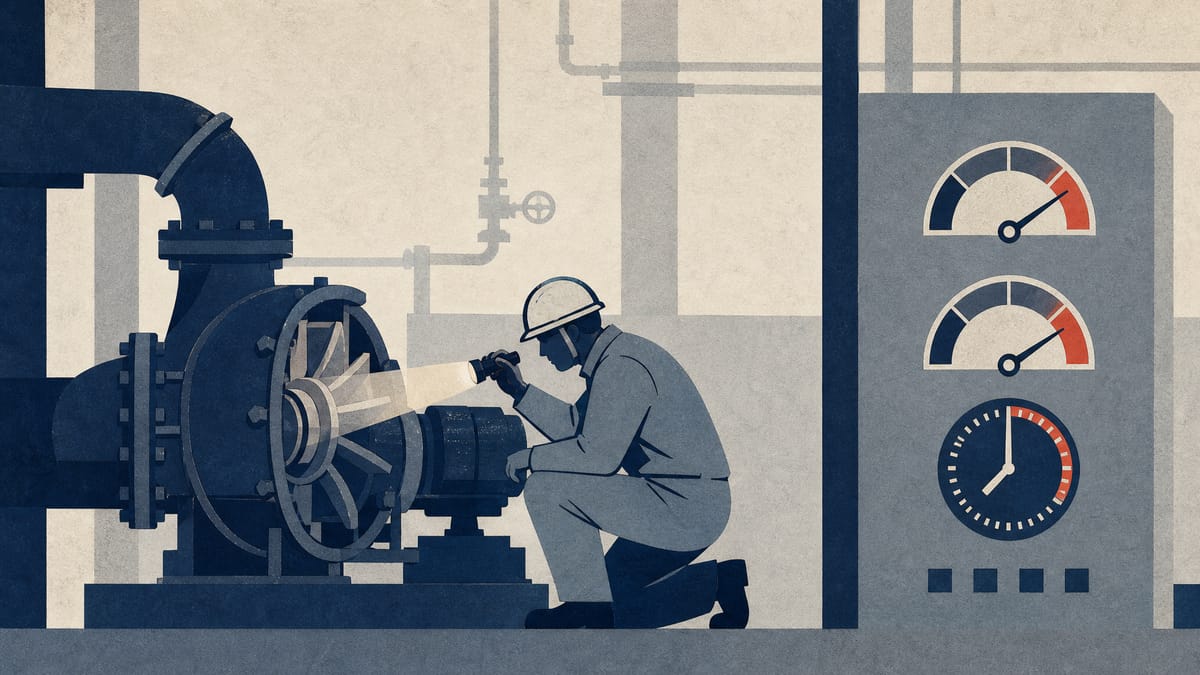
Japan's Nuclear Regulation Authority (NRA) opened a 30-day public comment window on September 3, running to October 2, 2026, on a draft amendment to the safety-review criteria that govern power reactor operating rules. The proposal targets a specific and until-now unregulated activity: maintenance that operators plan in advance on equipment covered by a reactor's Limiting Conditions for Operation (LCO), carried out while the unit keeps running.
What the current rule misses
Existing criteria only spell out required safeguards for LCO-covered equipment when maintenance is done "unavoidably" in response to an anomaly. There has been no specific provision for maintenance an operator plans ahead of time as part of routine facility management. The draft closes that gap by adding a new clause: planned maintenance on such equipment must, in principle, be completed within the plant's existing Allowed Outage Time (AOT), safety measures must be defined for the duration of the work, and their effectiveness must be verified beforehand using probabilistic risk assessment (PRA).
Why regulators think it works
The amendment follows three field trials the NRA ran with operators in 2025 and early 2026: insulation-resistance testing and simulated air-cooler cleaning on an emergency diesel generator at Shikoku Electric's Ikata Unit 3, a breaker inspection and switching test on a high-pressure injection pump at the same plant, and a lubricant change and test run on a reactor auxiliary cooling water pump at Kansai Electric's Oi Unit 3.
| Trial | Plant / operator | Equipment | Work performed |
|---|---|---|---|
| Trial 1 | Ikata Unit 3, Shikoku Electric | Emergency diesel generator 3B | Insulation resistance test and simulated air-cooler tube cleaning |
| Trial 2 | Ikata Unit 3, Shikoku Electric | High-pressure injection pump 3B breaker | Precision inspection and switching test |
| Trial 3 | Oi Unit 3, Kansai Electric | Reactor auxiliary cooling water pump | Lubricant oil replacement and test run |
The regulator found no safety issues that would require changing existing AOT limits, and concluded that letting operators schedule this work has practical value: it spreads workload more evenly, uses experienced technicians more efficiently, and creates training opportunities at a time when plants report a shrinking pool of younger maintenance staff and retirements among veteran engineers. None of this authorizes online maintenance that wasn't already allowed. Operators have long been permitted to keep equipment offline for planned upkeep within the AOT window; the new clause simply writes explicit advance-planning and risk-verification requirements into the criteria the NRA uses to judge whether a plant's safety regulations are adequate.
What happens next
Comments can be filed through the e-Gov portal or by post under Article 39 of the Administrative Procedure Act. The amendment takes effect on the date the Commission formally adopts it, after reviewing submitted comments alongside a companion revision to the inspection guide that field regulators use, which adds a dedicated procedure for checking that operators stay inside AOT and manage any new risk that surfaces once equipment goes offline for planned work. Separately, operators have told the NRA in preliminary meetings that they intend to file their own applications to amend plant-specific safety regulations to make the practice explicit at the plant level, even though the agency says it is technically already permitted under current AOT terms. That signals the industry wants formal sign-off, not just a clarified national standard, before scheduling maintenance on running reactors becomes routine.