Japan's agriculture ministry has opened a voluntary public comment period on a draft honeybee assessment for propargite, a mite-killing pesticide also known as BPPS. The draft concludes that the chemical is unlikely to impair bee colonies as long as it is used as applied for and with the exposure-limiting conditions attached. Comments are open from 15 October to 13 November 2026, with the deadline at 23:59 on the last day.
The condition that carries the finding
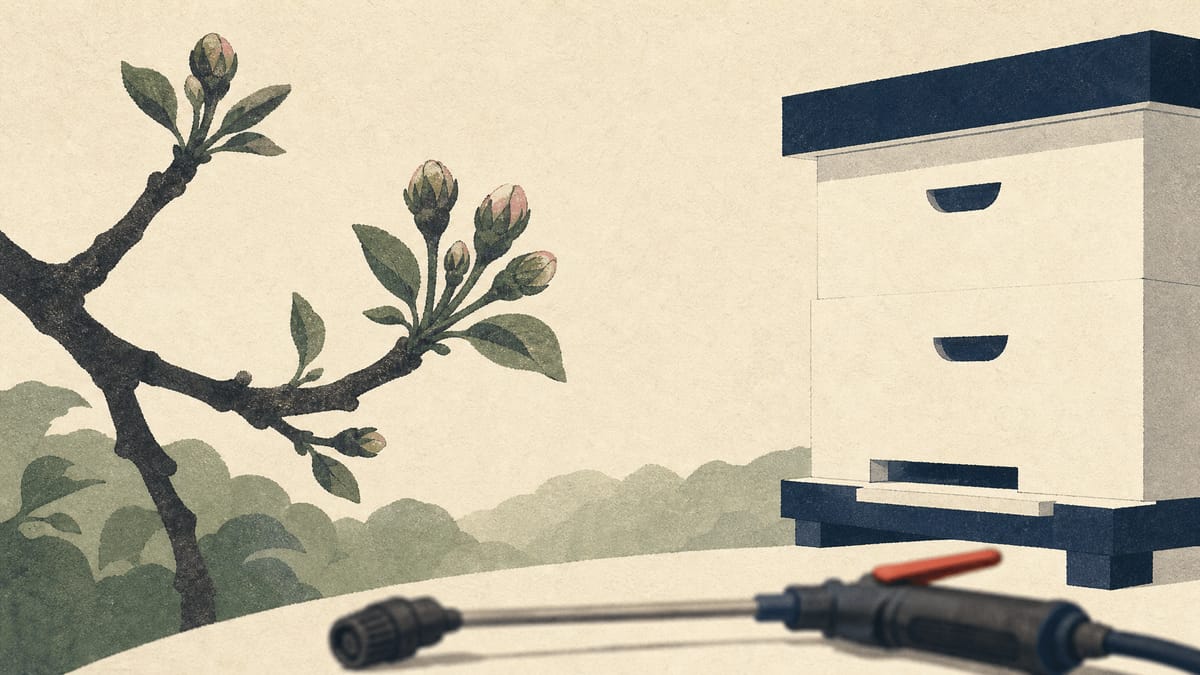
The applicant company seeks registration for a 30% wettable powder on apples, mandarin oranges (mikan), other citrus, grapes, peaches and plums. The draft says honeybees might be exposed on all of these uses, so each carries one restriction: use only in closed-facility cultivation, or only outside the period from bud break to petal fall (the end of flowering).
Because that restriction is judged to prevent exposure, the panel did not estimate exposure levels, and it found the first- and second-stage risk assessments unnecessary. The conclusion is therefore built on the restriction, not on a margin of safety between toxicity and expected doses.
What the bee tests found
The toxicity indices come from unpublished laboratory studies submitted by the applicant, dated 1994, 2002 and 2016. For adult contact toxicity, the panel took the geometric mean of the 48-hour LD50 values from two contact tests (15 and 75.5 µg of active ingredient per bee), 33.7, and set the index at 33.
| Life stage | Test | Index value |
|---|---|---|
| Adult | Single contact, 48 h LD50 | 33 µg ai/bee |
| Adult | Single oral, 48 h LD50 | 100 µg ai/bee |
| Adult | Repeated oral, 10 d LDD50 | 3.4 µg ai/bee/day |
| Larva | Single oral, 72 h LD50 | 30 µg ai/bee |
Because the acute contact and oral LD50 values were both 11 µg per bee or higher, the draft says no precautionary labelling is needed. The 3.4 µg per bee per day figure for repeated adult feeding is the lowest of the four indices, though the units differ across tests.
The draft lists no pollen or nectar residue studies and no colony-level studies for propargite. Its literature search found nothing for the panel to deliberate, and the call for published literature (7 October to 6 November 2025) drew no submissions.
Process and timing
The farm minister must consult the Agricultural Materials Council before registering or amending a pesticide under the Pesticide Control Act, and honeybee impact is handled by a specialist panel. The council received the referral on 25 November 2025, and the panel's 22nd meeting approved the draft on 10 September 2026. The ministry says it will decide after considering the comments it receives. The notice sets no decision date.
Comments must be in Japanese, and the ministry will not answer them individually. Mailed submissions must arrive by the deadline. Comments may be published, with personal details withheld. The procedure is a voluntary consultation, not one required by the Administrative Procedure Act.