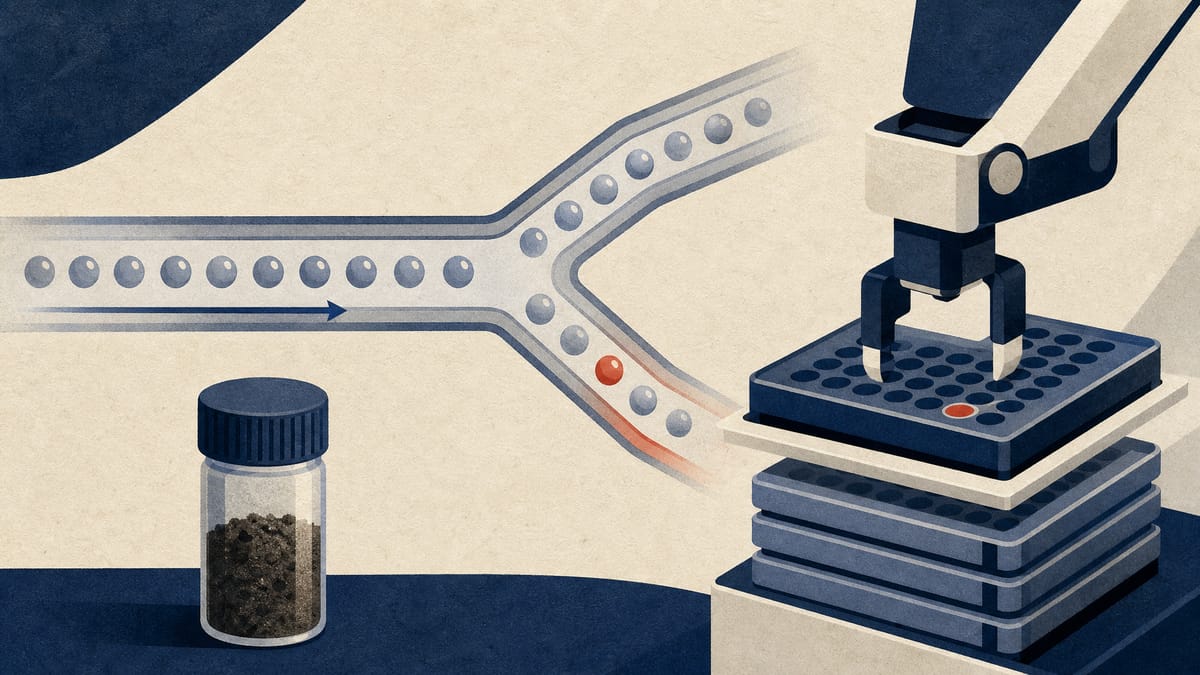
NEDO and five partners say they have built a system that sorts microbes in oil droplets, picks candidates by image and collects them on plates. In a soil test, the consortium says, it cut a search that once took months to years to days or weeks.
The test result
Nagaoka University of Technology searched soil from its campus for microbes that produce endopeptidase, a protein-digesting enzyme. It analysed and sorted about 1mn droplets in six hours and obtained four highly active bacteria. From one, Lysobacter soli, it isolated a new enzyme with 2.4 times the activity of a commercial industrial enzyme sold for peptide analysis. The release puts throughput at 1,000 times the conventional microplate method.
The partners also report culturing up to about 50% of environmental microbes using droplets, a result from AIST and Hiroshima University. For filamentous fungi, sorting ran at 8,000 droplets a minute with a target-strain acquisition rate of 96% or more.
What the system does
Nikon Solutions built an imaging unit that uses AI to judge droplets, so sorting can rest on microbial shape and growth rather than fluorescence alone. On-Chip Biotechnologies built the automation that moves liquid to the imaging unit, dispenses into plates, and swaps and stores them. AIST improved the sensitivity of first-pass sorting that does not use fluorescence.
Nagaoka has only begun validating the whole system on real environmental samples, and that work continues. The "world first" label for the system is NEDO's own claim.
From prototype to product
Test operation is due to start in fiscal 2027 at a screening hub centred on Nagaoka. On-Chip Biotechnologies plans to commercialise the integrated system by the end of fiscal 2027. It and Nikon Solutions also plan a simpler, imaging-only version. A Nagaoka spin-off, ECHIGO MICROBES, founded in March 2026, is developing contract screening and breeding services. NEDO's project runs to the end of fiscal 2026.