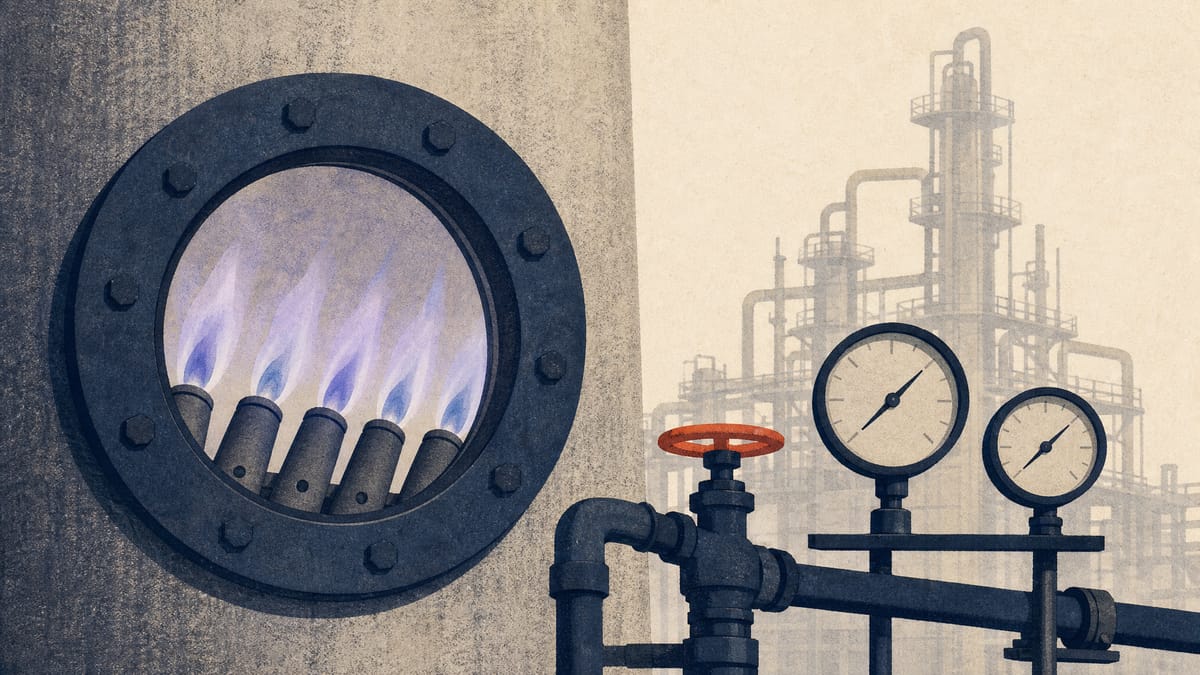
A four-company consortium working under a Japanese government fund ran a naphtha cracking furnace, one of the main CO2 sources inside a petrochemical complex, through a test using newly developed ammonia-combustion burners. The furnace burned 85% of its heat input as ammonia on a calorific basis, a rate the participants call world-leading, while nitrogen-oxide (NOx) emissions stayed at the same level as existing furnaces.
The project, run by NEDO with Mitsui Chemicals, Maruzen Petrochemical, Toyo Engineering and Sojitz Machinery, split the furnace's burners into two roles. Floor burners, which supply most of the furnace's heat, ran on 100% ammonia. Wall burners, used to shape the flame and even out temperature inside the furnace, still ran on conventional off-gas made mostly of byproduct methane. That combination is what produced the 85% furnace-wide figure: full ammonia firing where the heat load is heaviest, methane everywhere else.
The engineering problem is not trivial. Ammonia burns more slowly than methane and produces fuel-derived NOx, so any burner design has to hold a stable flame, deliver enough heat to the reaction tubes that crack naphtha into ethylene and propylene, and keep NOx in check all at once. Naphtha crackers are among the largest single sources of CO2 inside a petrochemical complex, and because ammonia releases no carbon dioxide when it burns, converting their fuel mix from off-gas to ammonia offers a rare route to cutting combustion emissions in ethylene and propylene production without changing the chemistry those plants exist to run.
The work sits inside NEDO's Green Innovation Fund program on plastics-related CO2 technology, a project scheduled to run from the 2021 fiscal year through fiscal 2030. The world-leading characterization is a comparison by the four participating companies, current as of August 2026, and it describes a test furnace rather than a commercial unit.
The next step is converting the wall burners to ammonia as well, with the goal of running the entire furnace on 100% ammonia rather than the current mixed configuration. The consortium also plans to pursue technology development and demonstration toward applying the approach to commercial-scale naphtha cracking furnaces, work it ties to reconciling decarbonization of the petrochemical industry with steady supply of basic chemicals like ethylene and propylene.