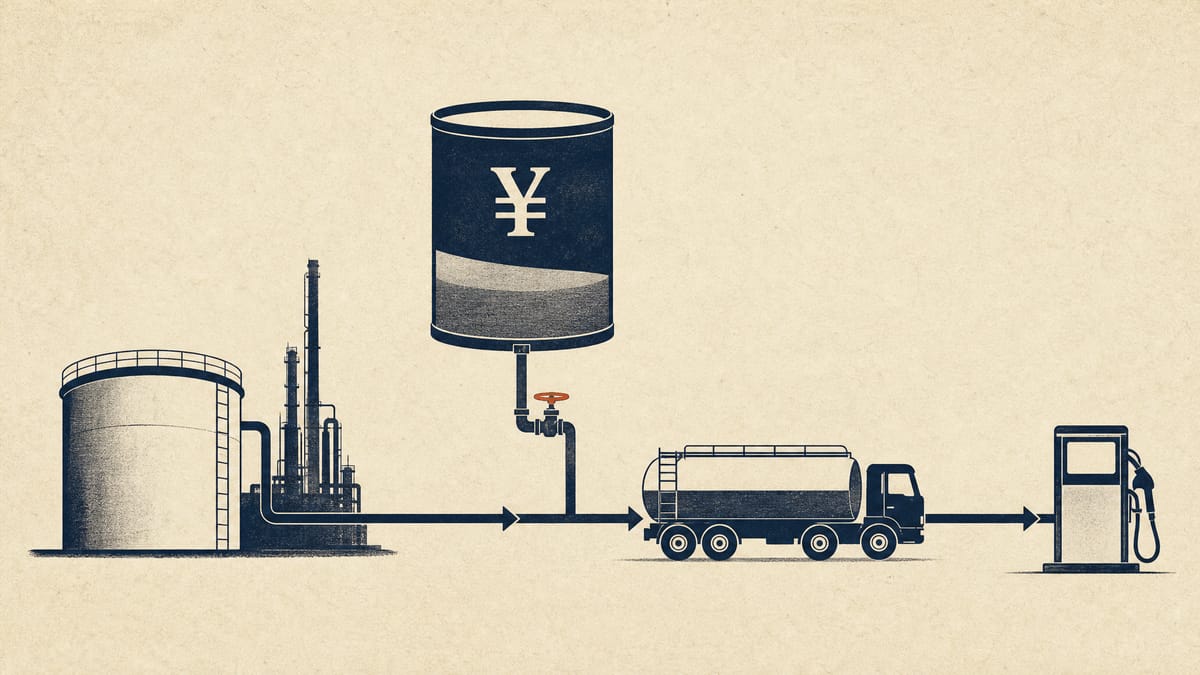
Japan's Cabinet approved ¥1.148tn of spending from this year's general-account reserve for responding to the Middle East situation on 30 October 2026, and almost all of it is earmarked for one programme: holding down fuel prices. The Ministry of Finance's decision table splits the money between two ministries, and the split is lopsided.
Where the money goes
The Ministry of Economy, Trade and Industry (METI) gets ¥1.146tn for the fuel-oil price mitigation programme. The Ministry of Land, Infrastructure, Transport and Tourism gets ¥2.25bn for a separate programme that cushions liquefied petroleum gas prices for taxi operators. The two lines add up to the ¥1.148tn total. The decision table gives its amounts in thousands of yen.
The METI line is one programme, not two. Its request form, dated 29 October, asks the finance minister to date approval 30 October.
What the fuel money does
METI's request says the money pays for building up the fund behind the programme. The subsidy is a fixed-amount grant to a general incorporated association that runs the programme. It does not pay for fuel directly. The stated reason is that Middle East developments have pushed energy prices up, and the ministry wants to keep fuel costs from disrupting people's lives and economic activity.
METI's scheme outline describes an emergency measure "for the time being". The state funds the programme, and money goes to petroleum wholesalers to hold down wholesale prices, which is meant to restrain retail prices. Covered products are gasoline, diesel, kerosene, heavy oil and aviation fuel. The stated target is to keep the national average retail price of regular gasoline at an assumed price level.
The outline lists a reserve budget of ¥1.1459tn for the programme. The request form says the spending falls under the latter part of item 3 of paragraph 3 of the 1954 Cabinet decision on the use of reserve funds. The METI documents do not state the assumed gasoline price level or an end date for the programme.
Reserve accounting
The Cabinet decision also reports where the reserve stands. Funding authorisation is not the same as money paid out to wholesalers, and the table records only the first.
| Item | Amount |
|---|---|
| Reserve budget | ¥2.5tn |
| Used before this decision | ¥616.0bn |
| Used in this decision | ¥1.148tn |
| Remaining balance | ¥735.9bn |
After this decision, ¥735.9bn of the ¥2.5tn reserve remains, according to the decision table. The table gives the amounts used before this decision and in this decision as separate lines, so they are shown here as the source gives them.