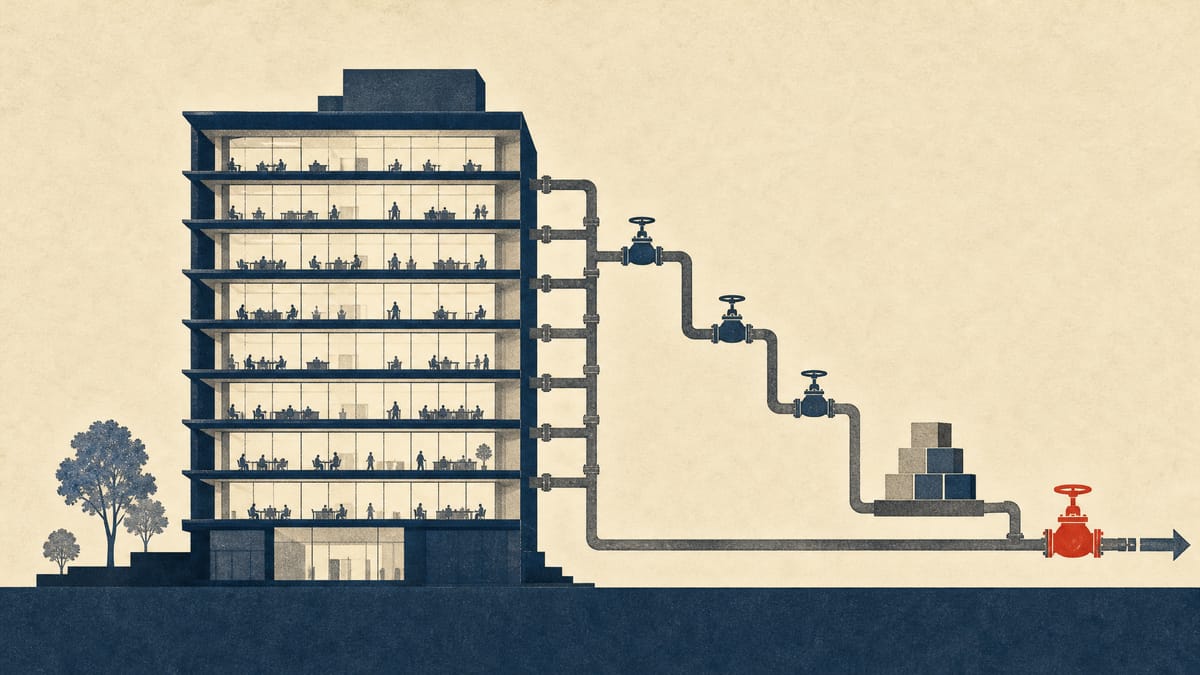
Japan Real Estate Investment Corporation paid out more and earned more in the six months to September 2026, but its forecast shows profit dropping while the payout keeps rising. The gap between the two rests on property sales and reserves, not on rent alone.
What the half-year delivered. Operating revenue was ¥43.76bn, up 3.1%, and net income was ¥19.21bn, up 3.3%. The distribution was ¥2,561 a unit, against ¥2,536 in the prior half. Rental revenue was ¥38.03bn, against ¥36.82bn, and period-end occupancy was 98.8%. Property sale gains were ¥5.73bn, close to the prior half's ¥5.63bn.
The cost of debt. Interest expense rose to ¥2.05bn from ¥1.64bn. The REIT's commentary cites higher rates after the Bank of Japan's further policy-rate increase. Interest-bearing debt fell by ¥25bn to ¥478.19bn, helped by an April 2026 unit issue that raised ¥19.0bn, and debt was 42.8% of total assets.
The guidance. For the six months to March 2027, the REIT forecasts operating revenue of ¥42.44bn, down 3.0%, and net income of ¥18.34bn, down 4.5%. It still projects a distribution of ¥2,593 a unit, rising to ¥2,625 for the six months to September 2027.
The forecast assumes sale gains from the staged disposal of Akasaka Park Building of ¥4.01bn and ¥4.10bn in those two periods. It also assumes the payout is supported by drawing down internal reserves of ¥840mn and ¥630mn. Non-operating expenses, which include interest on borrowings and bonds, are assumed at ¥2.23bn, then ¥2.44bn. The REIT cautions that actual results could differ and that the forecast does not guarantee any distribution.
The occupancy and rental figures describe this portfolio only. Whether the payout path holds depends on those disposals going ahead and on the pace of financing costs.