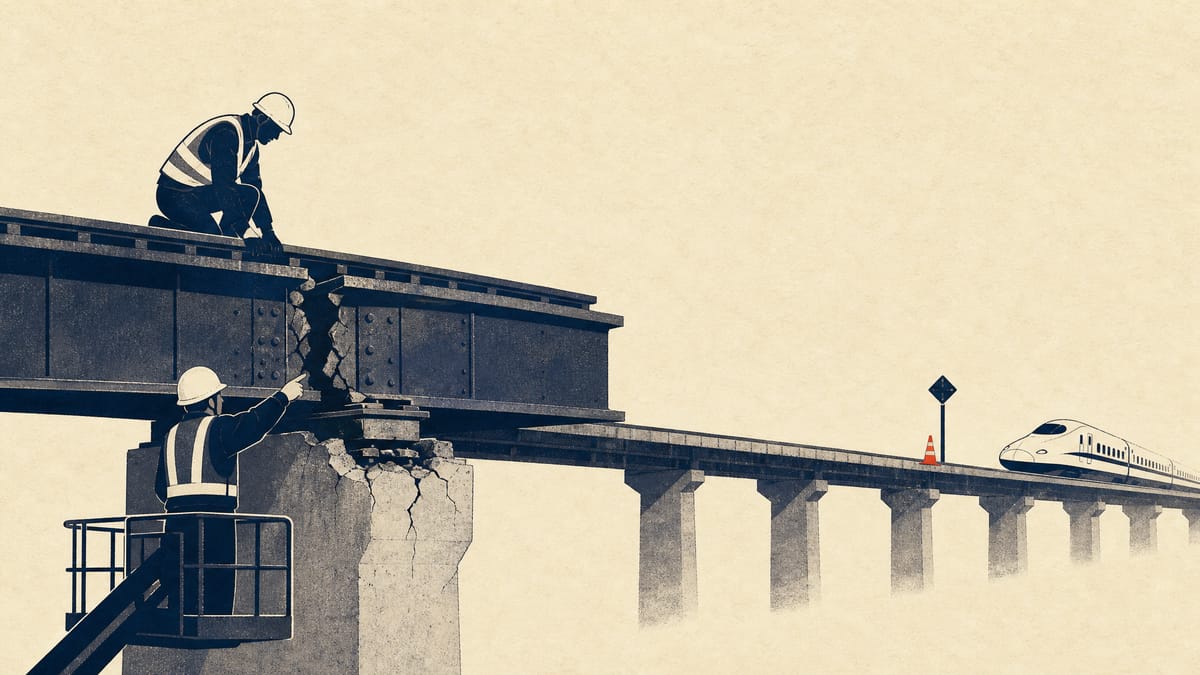
Kyushu Railway put the cost of the July earthquake in Kumamoto Prefecture at about ¥6.9bn in lost revenue and about ¥9.0bn in a special loss, according to its first-half results presentation. The revenue hit came mainly from rail suspensions. The special loss reflects damage to rail facilities. The two measures are separate. Earlier Tokyo Brief coverage
Service gaps and restoration
An intensity-7 earthquake struck on 28 July 2026, centred on Uki city and Hikawa town. The Kyushu Shinkansen between Kumamoto and Shin-Minamata stopped for 51 days and resumed on 18 September. The Kagoshima Main Line between Uto and Yatsushiro stopped for 73 days and resumed on 10 October. Some damaged Shinkansen sections still run at reduced speed, and the company says full repair will take time.
First-half numbers
Operating revenue for the first half rose 3.7%, helped by property rental income. Operating profit fell to ¥36.2bn from ¥40.8bn, ordinary profit to ¥35.1bn from ¥41.0bn, and net profit to ¥21.4bn from ¥22.3bn. Shinkansen passenger revenue was ¥29.6bn against ¥33.9bn a year earlier, with the quake accounting for a ¥6.2bn drag on non-commuter Shinkansen revenue.
Forecast and recovery
The full-year net profit forecast now stands at ¥47.0bn, down from ¥51.6bn in the 4 August forecast, but still above last year's ¥45.4bn. Forecasts for operating revenue, operating profit (¥75.0bn) and ordinary profit (¥70.9bn) are unchanged. The company set the annual dividend forecast at ¥121 per share, with an interim ¥60.5.
Use of the Shinkansen between Hakata and Kumamoto has returned to near pre-quake levels since full reopening. It was 96% of the year-earlier level in October on a preliminary basis, after 61% in August and 86% in September.