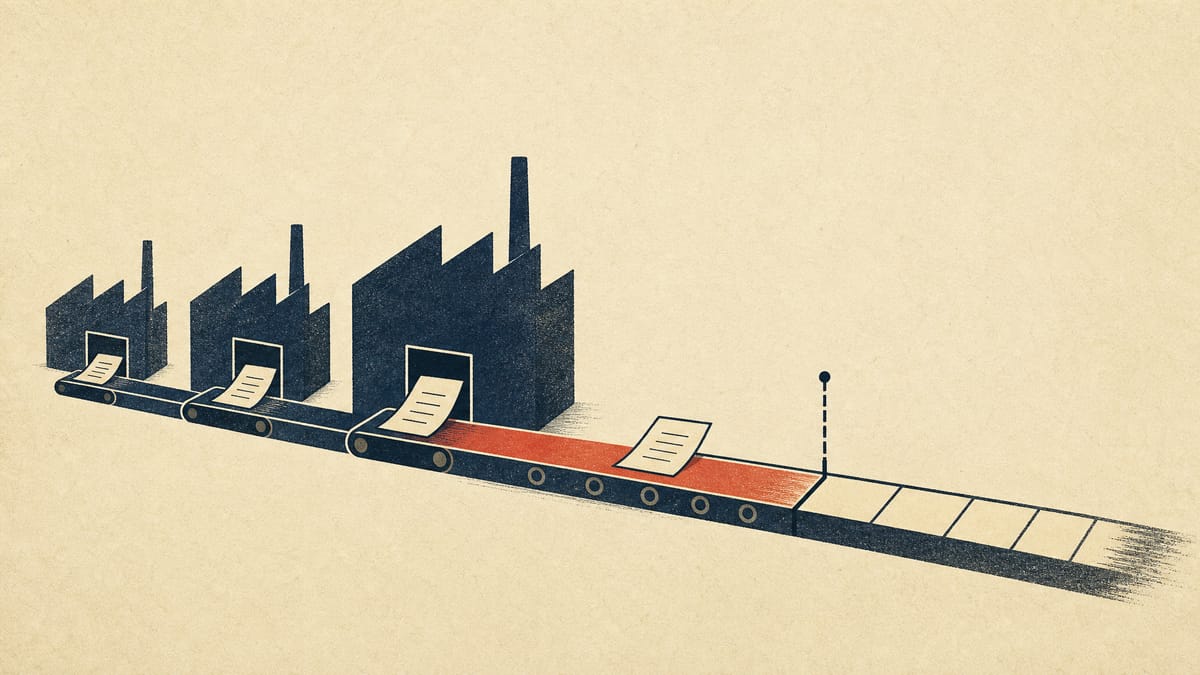
The Japan Fair Trade Commission has sent advisory letters to 1,135 businesses that set payment terms longer than 60 days, ahead of a rule that will require buyers to pay within 60 days of receiving delivery. The letters are not sanctions: the JFTC describes them as a way to prevent late payment and to encourage voluntary improvement.
What the 60-day requirement says
The JFTC's payment notification (Notification No. 3 of 18 June 2026) requires a buyer in manufacturing and related outsourcing to pay the contractor within 60 days of receiving the delivered work, unless there is a justifiable reason. It reaches transactions that fall outside the subcontracting payment law, and it takes effect on 1 April 2027. The release does not say what counts as a justifiable reason.
The law itself already bites. For orders placed from 1 January 2026, paying by bill is banned outright. Paying by electronic receivable or collective settlement with a maturity beyond the statutory payment due date generally counts as late payment.
What the survey found
The JFTC sent a web questionnaire on 26 June 2026 to 150,000 businesses in 47 industries, asking about conduct in May 2026. It received 35,734 responses, a rate of 23.8%. Of those, 43.6% were involved in manufacturing outsourcing and the like. The results describe respondents, not all Japanese companies.
Among those respondents, 97.1% paid in cash and 8.9% used electronic receivables or collective settlement (multiple answers allowed). The median period from receipt of delivery to the payment point was 35 days, with a mean of 38.9 days. The period is measured to the due date for cash, to the recording date for electronic receivables, to the transfer-approval date for collective settlement and to the delivery date for bills. It is not a measure of overdue payment.
Some buyers run far longer terms. Among those with any term over 60 days, the median longest term was 145 days in telecommunications and 120 days in 15 industries, including pulp and paper products. Asked why they used terms beyond 60 days, 1,331 respondents cited cash flow (32.8%), being paid by their own customers after more than 60 days (32.2%) and the subcontracting law not applying (25.6%). The JFTC notes that the new notification can reach deals outside that law.
Who got letters, and what happens next
The 1,135 letters went to consignors found to be paying on terms beyond 60 days. Electrical machinery, production machinery and metal products manufacturers were the top three industries by count. Separately, the JFTC inspected 415 consignors on site from August to October 2026 and orally told those whose conduct might fall under the notification that similar conduct after it takes effect could lead to Antimonopoly Act problems.
The JFTC flags a squeeze in supply chains that mix covered and uncovered deals. Some firms are paid on terms beyond 60 days by customers outside the law, yet must pay their own suppliers within 60 days. The regulator says buyers should prepare for the April 2027 start.
The JFTC says it will spread the notification and survey results through ministries and trade groups. It also says it will act firmly on specific cases of abuse of superior bargaining position or prohibited conduct under the subcontracting law.
The ban on bills has had effects. Among respondents, 33.9% reported wage rises or investment, 31.2% reported no change and 16.0% reported lower financing costs. Average receivables turnover fell from 2.7 months to 1.7 months in a smaller sample of 897.
For procurement and finance teams, the check before April 2027 is whether any supplier terms exceed 60 days from receipt, including those with suppliers the subcontracting law does not cover. Earlier Tokyo Brief coverage