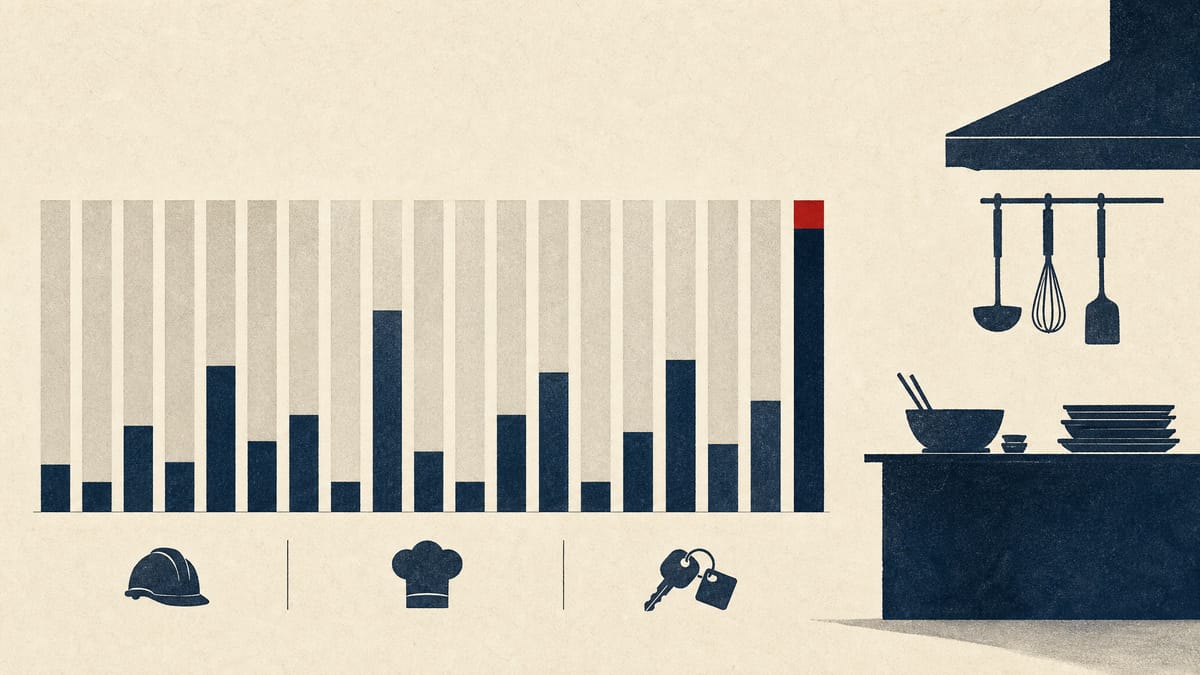
Japan's first-tier Specified Skilled Worker visa was 54.4% full at the end of August 2026, with 438,128 holders against a combined limit of 805,700, according to preliminary figures from the Immigration Services Agency. The spread between sectors is wide. Restaurants are almost out of room; road transport has barely started.
Where the ceiling is close
Restaurants and other food service businesses hold 49,092 places against a cap of 50,000, a fill rate of 98.2%. Food and beverage manufacturing is next at 77.4% (103,264 of 133,500), followed by construction at 69.1% (52,501 of 76,000) and care at 65.5% (83,111 of 126,900).
The care figure leaves out a separate group: 22,243 foreign workers were in Japan under the dedicated "nursing care" residence status at end-August, and the table's notes say care can also be filled through that route.
| Sector | Cap | Holders | Fill rate |
|---|---|---|---|
| Food service | 50,000 | 49,092 | 98.2% |
| Food and beverage manufacturing | 133,500 | 103,264 | 77.4% |
| Construction | 76,000 | 52,501 | 69.1% |
| Care | 126,900 | 83,111 | 65.5% |
| Industrial products manufacturing | 199,500 | 64,211 | 32.2% |
| Lodging | 14,800 | 2,917 | 19.7% |
| Road transport | 22,100 | 843 | 3.8% |
| All sectors | 805,700 | 438,128 | 54.4% |
Where it has barely started
Industrial products manufacturing has the largest cap of any sector, 199,500, and 64,211 holders, or 32.2%. Lodging stands at 19.7% (2,917 of 14,800). Road transport has 843 holders against 22,100 places, and rail has 109 against 2,900, both at 3.8%. The notes say road and rail were added as eligible fields in March 2024. Linen supply has 6 holders against 4,300 places.
For logistics warehousing and resource recycling, the table shows a cap (11,400 and 900) but no holder count or fill rate. The notes say both were added as eligible fields in January 2026.
How the cap works
The current caps come from a cabinet decision of 23 January 2026 and cover intake through March 2029. The table notes say each sector's limit on first-tier workers is set after taking account of the domestic workforce in that sector, including second-tier foreign workers. Those second-tier holders, shown only for reference, total 23,348.
The table puts the rise in first-tier holders over the year to end-August at 87,422, measured as the gap between end-August 2025 and end-August 2026 and also preliminary. For employers in food service, a cap with 908 places left matters more than the national average. For more on the scheme, see Earlier Tokyo Brief coverage.