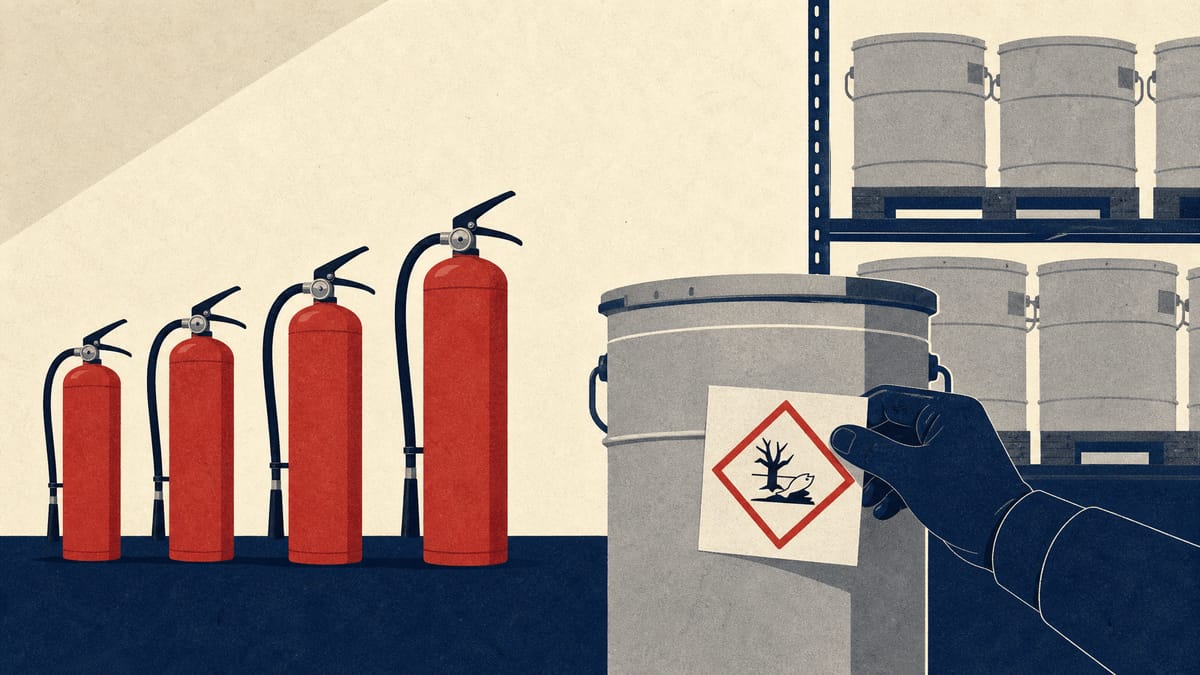
Two new categories of long-chain PFAS substances are about to join Japan's list of Class I Specified Chemical Substances, and the ministries writing the rules have picked an unglamorous but consequential target: fire extinguishers and the foam used to fight fuel fires.
On September 1, three ministries opened a public comment period on a draft ordinance covering product labels, while a separate six-ministry group that includes the Fire and Disaster Management Agency opened comments on a parallel ordinance covering technical handling standards. Both drafts respond to the same trigger: Cabinet Order No. 171 of 2026, which designates "long-chain perfluoroalkanoic acids or their salts" and "long-chain perfluoroalkanoic-acid-related substances" as Class I Specified Chemical Substances under the Chemical Substances Control Law, effective November 22, 2026.
What actually changes
The first ordinance, run by the health, trade and environment ministries under Article 29(1) of the law, amends a 2011 notice governing what must appear on the containers, packaging and invoices of products containing Class I Specified Chemical Substances. The draft redline simply adds the two new substance categories as items six and seven, marked "newly established," to the list of chemicals that already trigger a label. The ministries note the label wording itself does not change: because the two new categories land in the same disclosure bucket as PFOS, PFOA and PFHxS-related products, no new label text is required, just an expanded list of what counts.
The second ordinance, run jointly by the Fire and Disaster Management Agency and the health, trade, transport, environment and defense ministries under Article 28(2), rewrites the technical standards that manufacturers and handlers of fire extinguishers, extinguisher refill chemicals and foam extinguishing agents must follow. Its redline adds the same two substance categories as new categories of "contaminant" inside the ordinance's definitions section. Once in force, anyone handling PFOS-linked firefighting products under the existing Article 28(2) regime has to apply the same technical-handling rules to products containing the newly designated long-chain substances.
| Draft ordinance | Lead agencies | Legal basis | Comment deadline | Effective date |
|---|---|---|---|---|
| Labeling notice (case 195260055) | Health, trade and environment ministries | Chemical Substances Control Law Art. 29(1) | September 30, 2026 | November 22, 2026 |
| Technical handling standards (case 195260054) | Fire and Disaster Management Agency with health, trade, transport, environment and defense ministries | Chemical Substances Control Law Art. 28(2) | September 30, 2026 | November 22, 2026 |
The clock
Both comment windows run from September 1 to September 30, 2026, accepting submissions only in Japanese through the e-Gov portal, post (postmark valid through September 30) or email; phone and anonymous submissions are not accepted. Case 195260055 covers the labeling notice; case 195260054 covers the technical-standards ordinance. Both changes take effect November 22, 2026, the day Cabinet Order No. 171 itself comes into force, six months after its promulgation.
For companies making, importing or servicing fire extinguishers and foam extinguishing agents in Japan, the near-term task is narrower than the paperwork suggests: confirm whether products contain the newly listed long-chain PFAS substances, and if so, be ready to relabel and update handling procedures by late November. Neither draft specifies a compliance grace period beyond that date, and the text can still change before the ordinances are finalized.