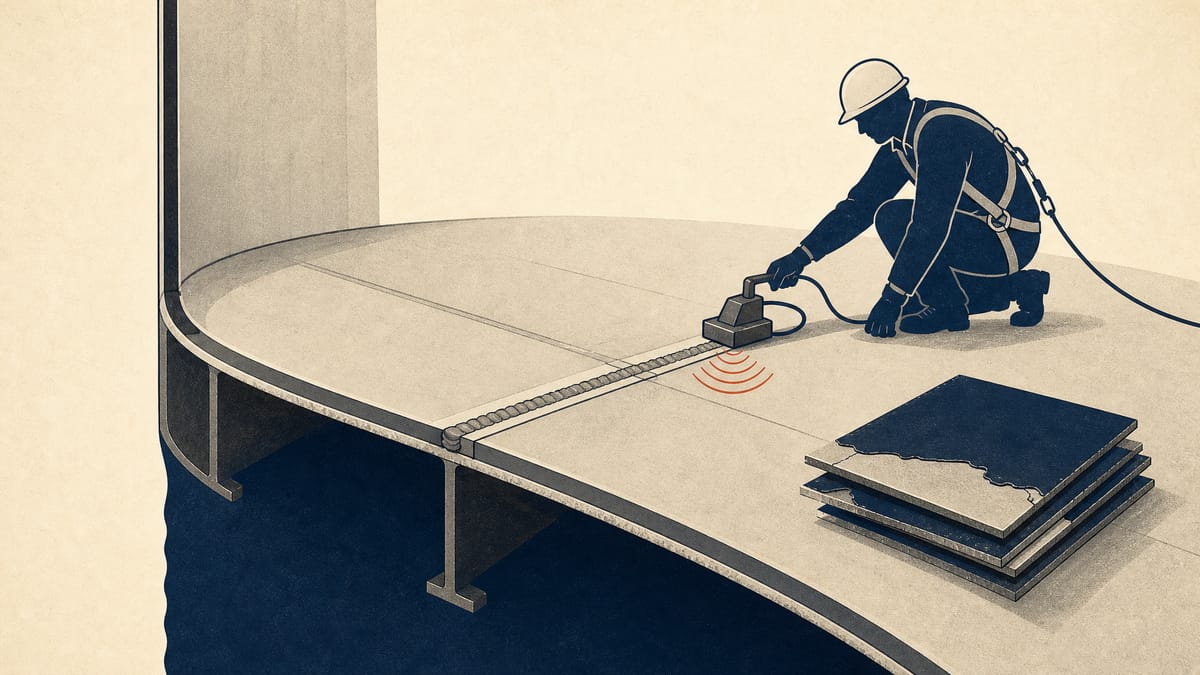
Japan's Fire and Disaster Management Agency has proposed letting operators of large oil storage tanks inspect bottom welds without stripping and recoating the tank's internal coating. The agency expects a saving of about ¥15mn to ¥30mn and one to two months of work per 100,000-kilolitre tank, compared with magnetic particle testing and similar methods. Public comment on the draft rules runs from November 7 to December 7, 2026.
Tank inspections without the strip-out
The draft covers specified outdoor storage tanks, defined as tanks holding a maximum of 1,000 kilolitres or more of liquid hazardous materials. Current safety inspections of bottom welds rely on magnetic particle or penetrant testing, which require the anti-corrosion coating to be removed and reapplied each time. Eddy current testing, added by a 2025 ministerial ordinance, can already be used.
The proposal adds an alternating-current field measurement test, which the agency says a study panel in the year to March 2026 found performed on a par with eddy current testing. Industry groups raised no particular objection there. The draft limits the new test to weld joints that have previously passed magnetic particle or penetrant testing, and keeps the pass mark used for eddy current: the signal must not exceed that from a reference flaw 4mm long and 1.5mm deep. The agency puts the total burden at under ¥1bn a year and expects no new burden from the easing.
Closed sprinkler heads for battery stores
The ordinance draft also changes rules for indoor warehouses that store lithium-ion batteries. Today only open-type sprinkler heads qualify under the exemption from the standard fire-equipment rules. The draft would also admit closed-type heads that meet set standards. The standards depend on how the batteries are stored. For one group of storage methods, closed heads must deliver at least 560 litres a minute at 0.24 megapascals at the nozzle tip, and the water supply is sized by head count, capped at 12 heads. For another storage method, the draft requires a discharge density of at least 17.5mm a minute, with water supply sized to floor area, capped at 150 square metres.
The agency cites US fire tests in which closed heads met performance standards, and requests from operators. It says wider head spacing may cut installation costs but that savings cannot be quantified because sites vary.
Foam at self-service stations
The third change concerns foam extinguishing agents in packaged fixed foam systems at self-service fuel stations. These are now limited to aqueous film-forming or mechanical foam agents. Under the draft, any type would be allowed if its performance is confirmed in the test set out in the standard's appendix.
Timing
All three changes take effect the day after promulgation. The agency says it will promulgate after reviewing the comments, and the draft gives no date. The agency plans a post-implementation review within about five years of enforcement.