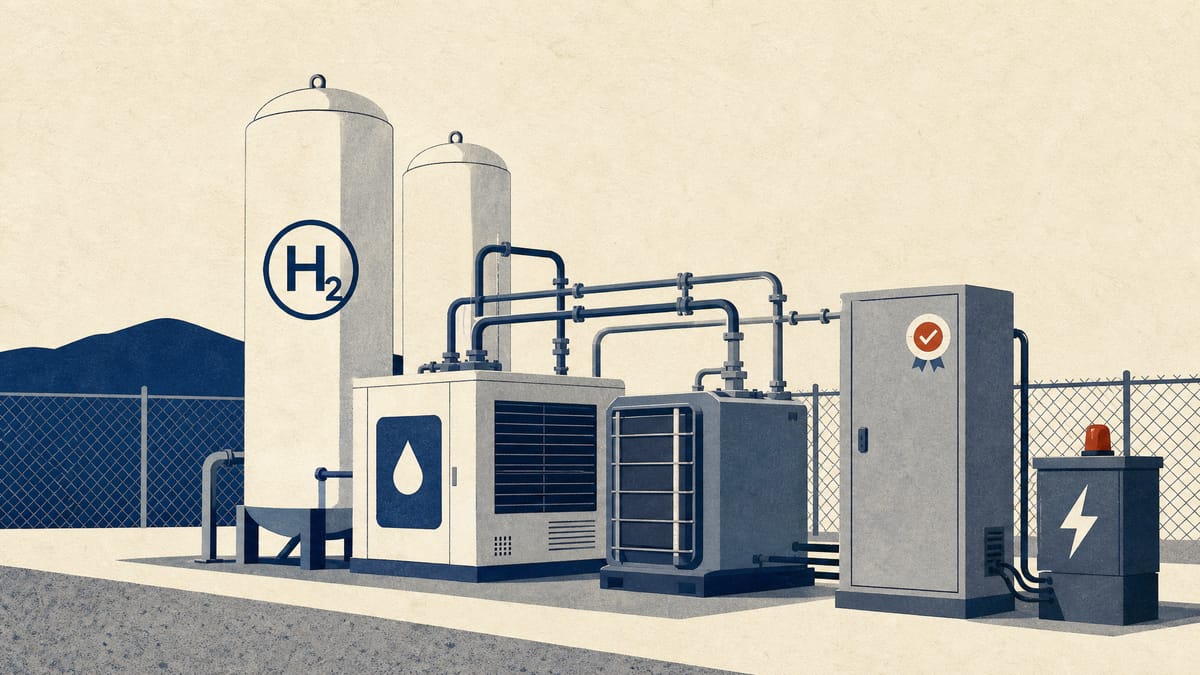
The Hokkaido Environmental Foundation, a public-interest incorporated foundation, is running a hydrogen-equipment subsidy under a grant decision from Japan's Ministry of Environment, and companies, municipalities and other eligible applicants can now apply for awards worth up to ¥300mn per project. Applications opened June 22, 2026 and close October 30 at 6pm, with the foundation reviewing submissions roughly once a month rather than all at once.
The money splits into two tracks. One funds self-sustaining, distributed energy systems, batteries, electrolyzers, hydrogen storage tanks, fuel cells and energy-management software, installed at sites that are, or are expected to become, designated disaster-response hubs under a local government's disaster-prevention plan or similar arrangement. The other backs industrial equipment for regional hydrogen supply chains: water-electrolysis units, storage and filling gear, industrial fuel cells, hydrogen boilers and generators, using hydrogen made from renewable energy sourced at the installation site, elsewhere within its own prefecture, or a nearby location the foundation recognizes as adjacent. Hydrogen that is a byproduct of other industrial processes can also qualify if the applicant has a plan to shift to renewable-derived supply.
How much a project gets depends on who is applying:
| Applicant type | Subsidy rate |
|---|---|
| Municipalities other than government-designated cities; small and medium-size enterprises | Two-thirds |
| Prefectures, government-designated cities, special wards, and other private companies | One-half |
The conditions attached are specific. The self-sustaining track bars subsidized batteries and fuel cells from feeding power onto general transmission or distribution lines, restricting output to the applicant's own site, and requires the system to keep running as an emergency power source once ordinary grid supply is cut. The equipment-support track treats on-site consumption of subsidized power and heat as the general rule rather than an absolute ban. Any newly installed equipment with IP communication capability must either carry a JC-STAR security-compliance label of at least one star from Japan's Information-technology Promotion Agency, or be committed to obtaining one before the project wraps up, or fall outside JC-STAR's certification scope entirely; equipment such as surveillance cameras that is not directly linked to the subsidized system falls outside this check. Applicants confirm this through a project-level checklist that screens whether IP-connected equipment is planned, backed by a list of any products that already carry the JC-STAR label.
Other exclusions narrow the field further. Used equipment cannot be subsidized, and projects that would supply hydrogen only to fuel-cell vehicles do not qualify; vehicles are, in principle, excluded from subsidized equipment even in plans that combine them with other uses. Projects can span two fiscal years if the applicant files a separate budget and schedule for each year; work funded within the fiscal 2026 period must be completed by February 26, 2027, and any second year of work requires its own, separate grant decision.
The guidelines do not say whether the installation itself must sit within Hokkaido, only that it must be in Japan; the foundation running the program is Hokkaido-based, but eligibility for projects outside the prefecture is left unstated in the material reviewed.
Applicants file through Japan's jGrants portal, or by email with five core forms attached first, though local governments are exempt from one of those five, a pledge against organized-crime ties. The foundation then tells email applicants how to submit further attachments, such as system diagrams and the cybersecurity checklist, once it has accepted the application.