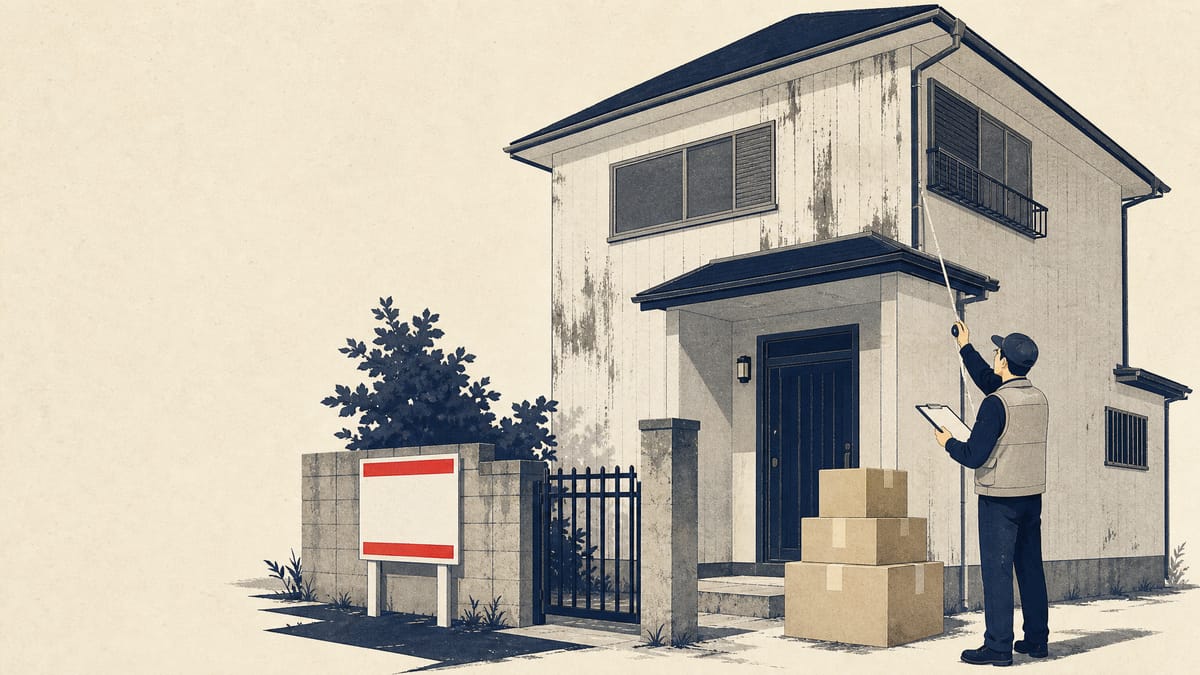
Japan's jGrants portal has posted a new subsidy that pays homeowners, brokers and inspectors to move idle housing stock back onto the market in major metro areas where housing prices have surged. The Emergency Subsidy Program to Boost Existing-Home Circulation covers the Tokyo, Kansai and Chubu regions, plus the urban areas around Sapporo, Sendai, Hiroshima and Fukuoka, but only in districts where housing demand is high and residential land prices have already risen past a threshold set out in the program's application manual.
The target stock is specific: vacant houses, and detached or multi-unit homes expected to sit empty because owners are ageing or an inheritance is pending. To qualify, the property must take one of several steps toward circulation: signing a brokerage contract for sale or rental, listing the home for sale or rent (including registering it with a local akiya, or vacant-home, bank), drafting an official "ending note" in the format the land ministry specifies, reaching an heir agreement on future disposal, signing a family trust contract, or another effort to promote the property's circulation, such as a recruitment flyer.
| Program Component | Subsidy Amount | Paid To |
|---|---|---|
| Existing-home condition inspection (mandatory) | ¥50,000 per unit, or actual cost rounded down to the nearest ¥1,000 if lower | Homeowner or inspection technician |
| Renovation design and proposal (optional) | ¥30,000 per unit | Licensed real-estate broker |
| Repair work (optional) | ¥50,000 per repair location, capped at ¥150,000 per unit | Homeowner |
Money flows to three different parties. A mandatory existing-home condition inspection, carried out under a 2017 land ministry technical standard and including a defect-warranty insurance check, pays ¥50,000 per unit to the homeowner or the inspection technician, or the actual cost rounded down to the nearest ¥1,000 if that figure is lower. An optional renovation design and proposal service pays ¥30,000 per unit to the broker who prepares it. Optional repair work on structural or waterproofing defects, and on kitchens, toilets and bathrooms tied to those repairs, pays ¥50,000 per repair location, capped at ¥150,000 per unit. Total support per home can reach up to ¥230,000, though the mandatory inspection payment itself drops below ¥50,000 if the actual inspection cost is lower.
Only two kinds of business can apply: licensed real-estate brokers and certified existing-home condition inspection technicians. Delivery applications open March 23, 2026 and close November 30, 2026 at 17:00 Japan time; completion reports are due by December 25, 2026 at 17:00. The program will stop taking applications early if its budget runs out before that deadline.
One filing detail matters for resellers: if a buy-and-resell operator carries out the existing-home condition inspection itself rather than hiring an outside technician, its delivery application must go in by email rather than through the standard process. A dedicated support office runs the program and hosts the manuals and forms applicants need, reachable at [email protected].