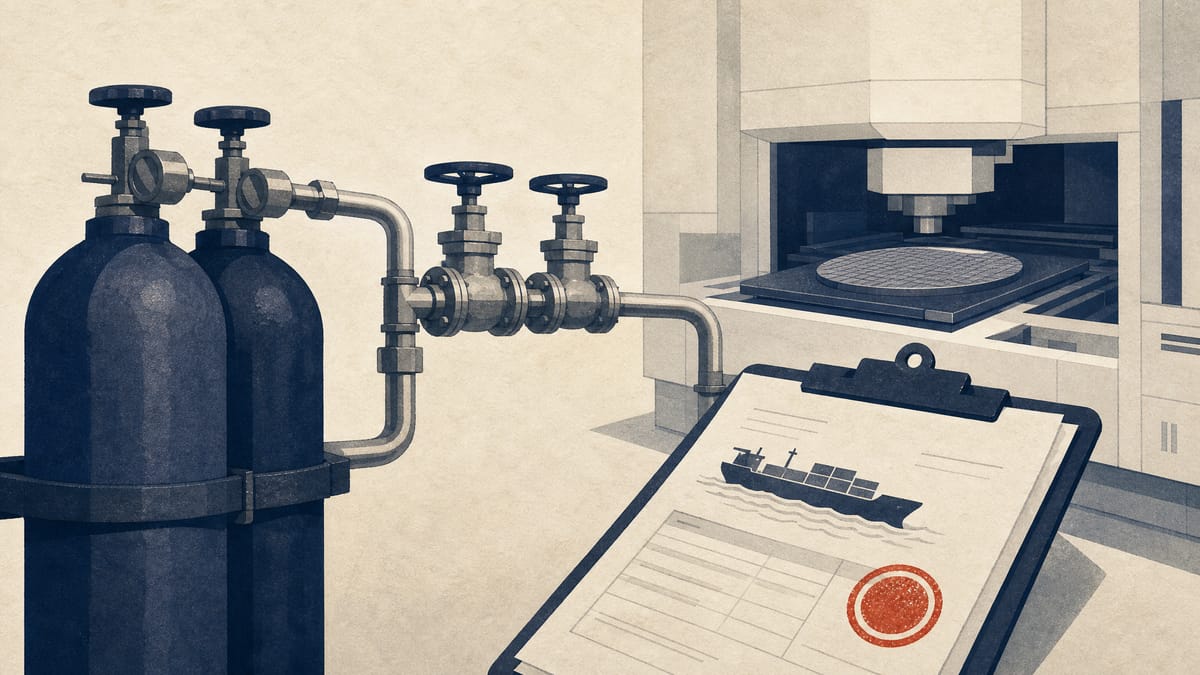
China's commerce ministry moved on September 7 to slap provisional anti-dumping duties of up to 99.2% on Japanese suppliers of dichlorosilane, a raw-material gas used in semiconductor manufacturing to form silicon insulation layers on chips. Japan's Minister of Economy, Trade and Industry, Ryosei Akazawa, confirmed the decision at his post-cabinet press conference on September 8, describing it as a provisional finding in an ongoing Chinese investigation rather than a final ruling.
Akazawa said Tokyo would work closely with the Japanese companies under investigation, scrutinize the scope of the inquiry and its effects, and try to prevent undue damage to their business activity. He did not name the companies or estimate the financial exposure.
The minister tied the dichlorosilane case to a broader complaint: China's export controls on dual-use items that, he said, target Japan specifically. He called that approach a breach of the international norm against singling out individual countries or blocs for export restrictions, said Japan has formally protested and demanded the controls be withdrawn, and pledged to keep coordinating with the G7 and other like-minded governments while working with affected Japanese firms.
Investment initiative: one year in, a fifth of the framework covered by announced deals
On the other file raised at the briefing, Akazawa gave a status update on the Japan-US strategic investment initiative a year after the two governments signed their memorandum of understanding last September. Six projects have been announced under the framework so far, and he called the pace steady.
He pointed to one concrete financing milestone: a second-tranche gas-fired power plant project has secured participation from a foreign bank, which he specified is a US bank, easing the project's foreign-currency funding. Akazawa said he raised that point with US Commerce Secretary Howard Lutnick during meetings last week.
| Item | Figure | Status |
|---|---|---|
| China's provisional anti-dumping duty on dichlorosilane | Up to 99.2% | Provisional decision dated September 7, 2026; final rate not yet set |
| Japan-US strategic investment initiative: value of announced projects | About 20% of the $550bn framework | Six projects announced since the September 2025 memorandum of understanding; further projects require joint US-Japan committee sign-off |
A reporter noted that the six announced projects, split across two tranches, total roughly $109bn, about a fifth of the $550bn framework. Akazawa echoed that figure back in his answer without disputing it. He said every project must clear three tests, worked out under the memorandum, before Japan and the US jointly sign off through a bilateral consultative committee: the numbers have to balance, repayment has to be assured, and the deal has to benefit Japanese companies, whether through profit or a credible path to future business. If those conditions are not confirmed, he said, a project simply does not proceed.
Akazawa framed both threads inside a wider claim about where growth is heading: AI and semiconductors are playing a growing role in future economic growth and prosperity, he said, and AI specifically is becoming what he called the "meta-layer" of the economy and society. Economic-security-sensitive sectors will stay under close watch even as Tokyo tries to keep the US relationship on track.
What is still open: China's dichlorosilane ruling is provisional, so the final duty rate, its effective date and which specific Japanese suppliers it will apply to were not disclosed at the briefing. On the investment side, Akazawa declined to preview which projects might form a prospective third tranche, and gave no figure for how much of the $550bn commitment is still tied up in the joint committee's profitability and benefit review.