Japan's trade minister has confirmed two instructions on fuel subsidies, but not a decision. At his post-cabinet press conference on 27 October, METI Minister Akazawa said Prime Minister Takaichi told him on Friday 23 October to review future support and to settle the size of the fund needed to keep it going. Earlier Tokyo Brief coverage
What the prime minister ordered
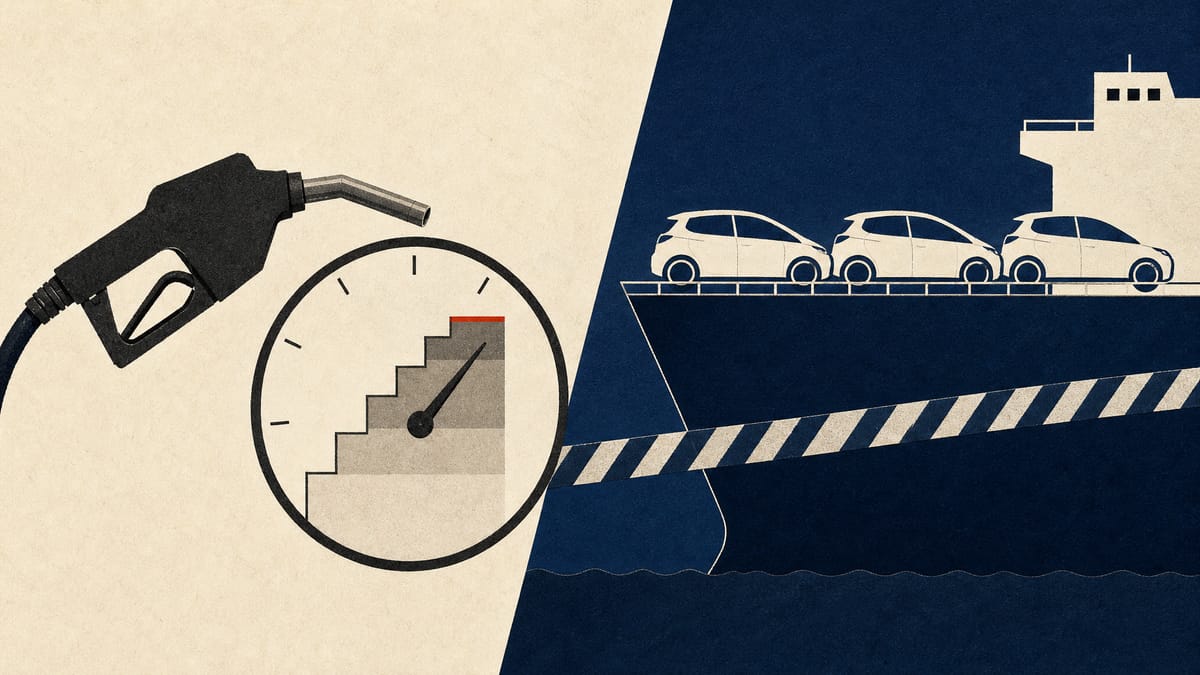
Akazawa described two instructions. First, consider the shape of future support while watching how the Middle East situation affects prices and the economy, and taking into account proposals from the parties. Second, coordinate with Finance Minister Katayama to secure the fund size needed for fuel-oil support in the near term.
The minister said the review is under way and he could not prejudge it. He said he would consider the support unit rate and the measure's exit flexibly. He called the subsidy a shock-absorbing measure and said both ruling and opposition parties had raised fiscal-burden worries and urged a phased review and an exit strategy.
He gave no figure or timetable for a revised subsidy.
The ruling-party proposal is not policy
Asked whether a proposal compiled the previous day by the Liberal Democratic Party would be the basis for the review, he did not say it would. According to the question put to him, the proposal would raise a 170-yen target price by about 5 yen a month. Akazawa said he would weigh input from the ruling party and opposition parties together and judge comprehensively, and that it was not a stage at which he could speak with a presumption.
He rejected the idea that the government was reading exchange rates or crude supply. He said METI does not comment on the yen and was not reasoning from individual market moves. Pressed that a high oil price would hit users if the subsidy shrinks, he pointed to firms passing on costs and to the winter: a sharp rise in kerosene prices would matter for cold regions such as Hokkaido. He said the Middle East situation had run since 28 February and that the shock-absorbing measure was introduced in the confusion after it began.
The EU origin rule
On Europe, Akazawa said Japan is concerned that an EU origin requirement under the Industrial Accelerator Act, known as the IAA, could leave Japanese-made electric vehicles outside support schemes and shut them out of the European market. That is his characterisation of the impact. The press conference record does not give the rule's legislative status, and the question referred to a proposal for preferential treatment of European-made EVs.
He said Japanese products, EVs included, being treated as equivalent to EU-made ones is extremely important to both sides. He plans to give an opening address at a Japan-Germany high-level business summit that about 300 business figures from both countries, including German Chancellor Merz, are due to attend, and wants a direct word with Merz there. The question put to him said Merz arrives in Japan the next day; the record does not give the summit's date.
He said the volumes are not on the scale of the US market, but Japanese carmakers export heavily to Europe and some produce there, so the harm to them could not be overlooked. He gave no vehicle numbers.
Other items
Akazawa said METI will set up a free cybersecurity consultation desk on 27 October at the Yorozu support centres in each prefecture and at an SME support agency's IT management support centre, after a 26 October cabinet-level meeting on cybersecurity. He also said the white-hat team METI plans to launch next month is not meant for active cyber defence, which under the cyber response law falls to the Cabinet Secretariat, the National Police Agency and the Defense Ministry. It will use advanced AI to run penetration tests. He was responding to a question about GMO's urgent request for active defence.