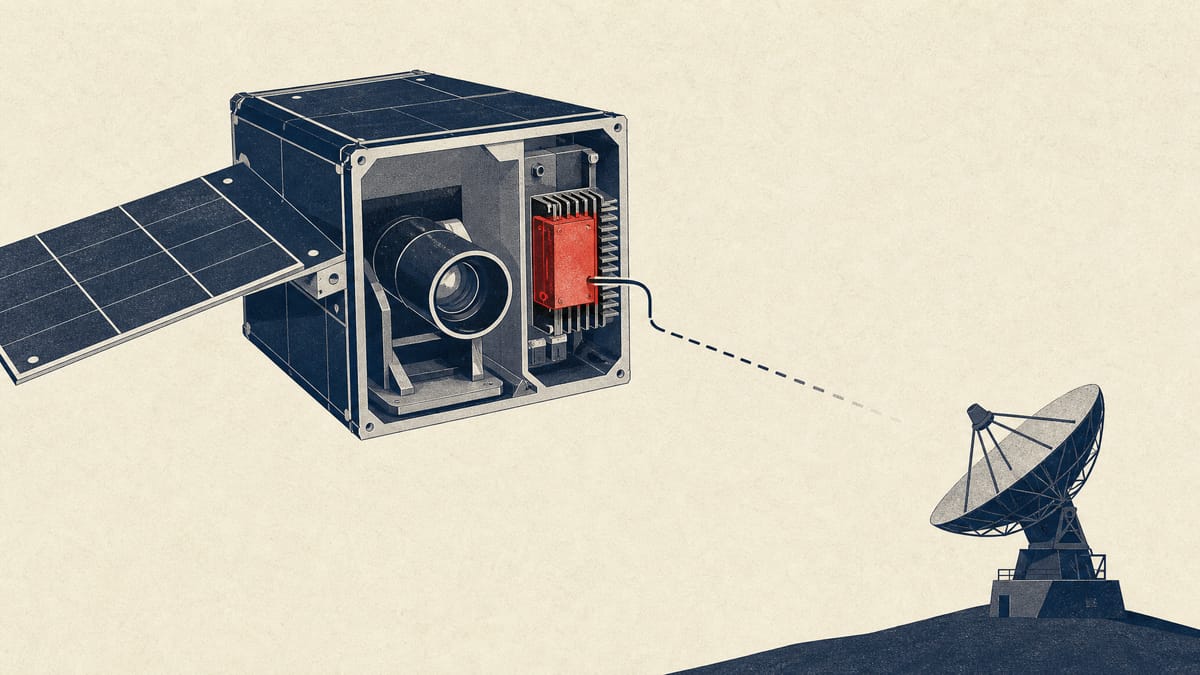
Axelspace Holdings has concluded that the high-speed communications link on four of its seven GRUS-3 satellites has failed permanently, and it will book a ¥1.879bn impairment on the four in the first quarter of the year to May 2027. The satellites are not dead. The company says every function other than that link works normally, and that photographing the ground remains possible.
The company first disclosed the fault on September 29. The October 6 disclosures add the finding of permanent failure, the writedown, the revised full-year outlook and an outside review.
Imaging is not the problem; sending pictures is
Each GRUS-3 carries two independent communications systems. The low-speed one carries telemetry such as position, attitude, temperature, voltage and equipment status. The high-speed one sends large image files to ground stations, and its power amplifier is the failed part: it boosts the radio signal enough to reach the ground.
Axelspace's estimate, as of October 6, is that the amplifier could not shed heat, its temperature rose and the amplifier element was damaged. The same element has run normally on the older GRUS-1 satellite, so the company considers it highly likely that the heat-dissipation design of the high-speed system modified for GRUS-3 was at fault. That remains the company's own inference, and the advisory board it has decided to establish is to test it.
Axelspace has given up the planned image-data supply from the four satellites. It says it is studying whether images can be delivered over the low-speed link and whether telemetry can be used commercially, and it does not say either will work. The insurance held on GRUS-3 does not cover the fault.
Three satellites, two months later
The three unaffected satellites share the same design. Axelspace plans to cut the amplifier's power draw and shorten communication time to keep it cool in vacuum, and to run the satellites one at a time. Commercial operation, once aimed for during 2026, is now targeted for February 2027, with initial operations continuing through January.
The company says imaging capacity will fall in line with the number of satellites affected, but that the overall service level is still being examined. It declined to discuss the impact on individual contracts, including the defence ministry's satellite constellation project, and says no change to its plan for roughly 30 satellites by the end of May 2031 is currently foreseen.
The guidance cut
Axelspace lowered its full-year forecast for the year to May 2027, which runs from June 1, 2026. It says the forecasts carry the largest impact it can currently estimate.
| Item | Previous forecast | Revised forecast |
|---|---|---|
| Sales | ¥9.0bn | ¥6.7bn |
| Operating loss | ¥800mn | ¥2.3bn |
| Ordinary loss | ¥150mn | ¥1.7bn |
| Net loss attributable to owners of parent | ¥240mn | ¥3.65bn |
In the AxelGlobe segment, sales are now forecast at ¥4.24bn, down from ¥6.08bn, because image delivery will come later than assumed. Segment profit falls to ¥1.97bn from ¥3.4bn, on an ordinary-profit basis. AxelLiner sales are forecast at ¥2.46bn, down from ¥2.92bn, a revision the company ties to a different matter.
What the review will examine
Axelspace decided on October 6 to establish the GRUS-3 failure verification advisory board, with outside experts. It will assess the cause the company has estimated, the fixes planned for future satellites and the project-management structure. The schedule is a company report in mid-October to mid-November, then board evaluation and a final report planned for the end of November. The status release puts the timeline at about 1.5 months after members are confirmed, and it has not named them.