Web View
BoJ sets 1.25% guide over one dissent, speeds up ETF sales
The BoJ set its rate guide at 1.25% over one dissent and will sell ETFs faster from January, while a ¥1.148tn fuel-price reserve draw and Murata's ¥90bn forecast lift fill the rest of the page.
MARKETS
Market pulse
Tokyo equities softened while the 10Y JGB yield nudged higher.
Sourced from Nikkei, JPX, BOJ, MOF - values, not commentary.
lead
The BoJ Speeds Up ETF Sales

BoJ sets rate guide at 1.25% over one dissent and quickens ETF sales from January
The Bank of Japan set its guideline for money market operations at an uncollateralized overnight call rate of around 1.25% on 30 October by an 8-1 vote, and decided unanimously to sell ETFs faster from January. Takata Hajime, the lone dissenter, proposed 1.5%. The bank's Outlook Report says it will continue to raise the policy interest rate.
What changed: From January 2027 the bank will sell ETFs at about ¥860bn a year on a book-value basis, up from about ¥330bn. That is about 0.1% of market trading value, up from about 0.05%, and about ¥2.46tn at market value. The bank's own calculation puts the time to finish at about 43 years, against about 112 before. J-REIT sales stay at about ¥5bn a year.
Why it matters: Takata argued that underlying CPI inflation had reached the price stability target and that the bank should speed up moving the policy rate toward the neutral rate. The board defeated his proposal. The Outlook Report sees CPI (all items less fresh food) accelerating to a level clearly above 2%, then declining toward about 2% in the second half of the projection period, with risks skewed to the upside. It gives no date or size for the next rate move.
What to watch: The forecasts exclude the proposed temporary consumption tax cut on food and beverages. If it covered all items in the Cabinet's September 2026 tax outline, the bank estimates it would lower next fiscal year's CPI (all items less fresh food) by about 1.3 percentage points. The full Outlook Report is due on 2 November, the Summary of Opinions on 10 November and the minutes on 23 December.
secondary
Policy Desk
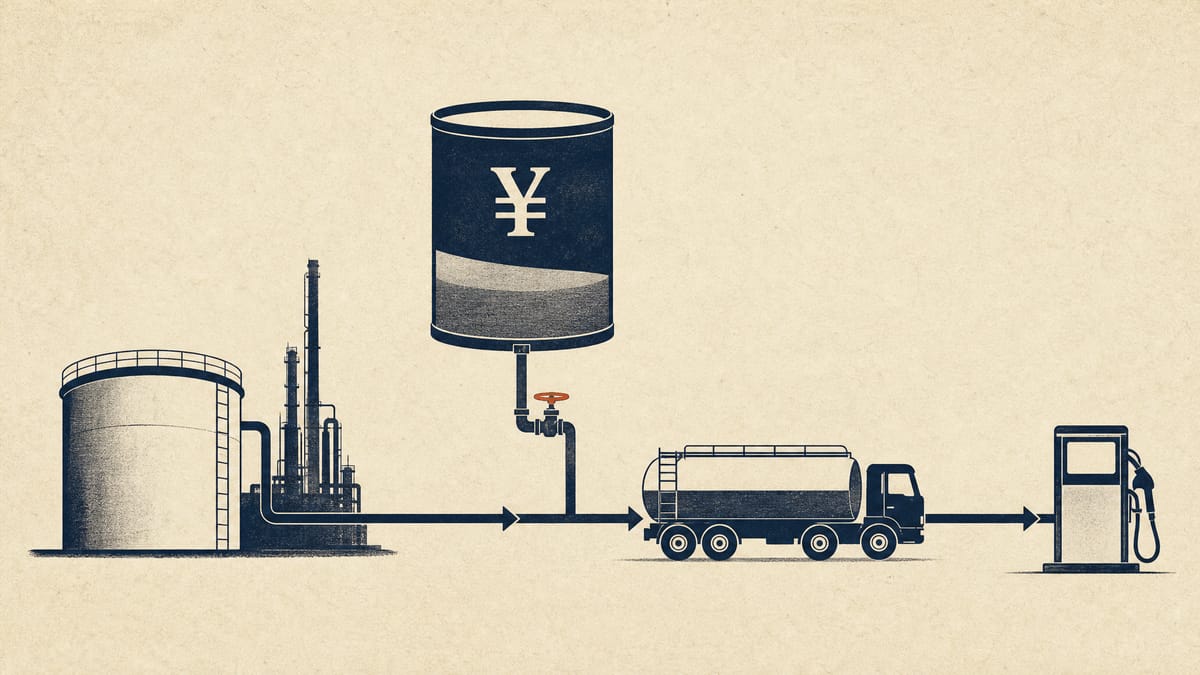
Cabinet taps ¥1.148tn of Middle East reserve, nearly all for fuel-price cushion
Japan's Cabinet approved ¥1.148tn from this year's general-account reserve on 30 October, and ¥1.146tn of it goes to one programme: holding down fuel prices.
What changed: METI gets ¥1.146tn for its fuel-oil price mitigation programme. The transport ministry gets ¥2.25bn for a separate programme that cushions liquefied petroleum gas prices for taxi operators. After the decision, ¥735.9bn of the ¥2.5tn reserve remains.
Why it matters: METI's request describes a fixed-amount grant that builds up the fund behind the programme, run by a general incorporated association. It does not pay for fuel directly. METI's scheme outline has money going to petroleum wholesalers to hold down wholesale prices, covering gasoline, diesel, kerosene, heavy oil and aviation fuel, with the aim of keeping the national average retail price of regular gasoline at an assumed level. METI's papers state neither that price level nor an end date.
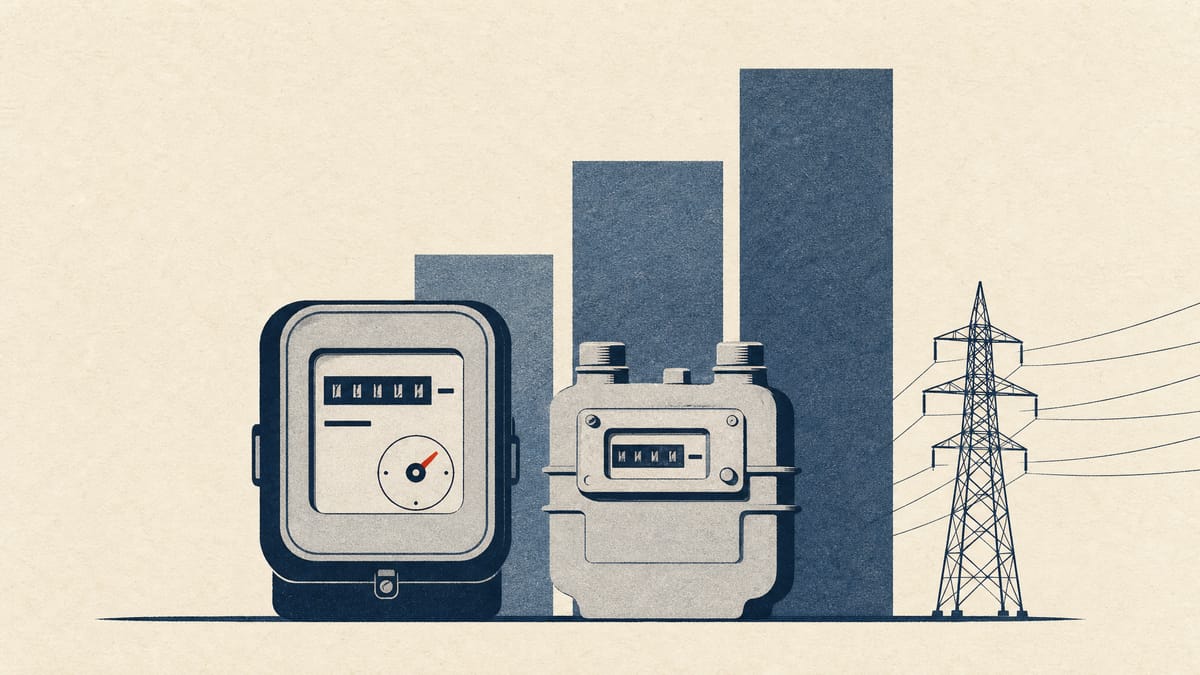
METI starts formal process toward a business-improvement order against Chubu Electric
The industry ministry began procedures under the Administrative Procedure Act on 30 October aimed at an order under the Electricity Business Act. No order has been issued.
What changed: The minister said the ministry received Chubu Electric's responses on 29 October to reporting orders covering three improper cases. He called the string of cases 'the height of regret' and said the ministry would act 'as strictly as possible', aiming to issue the order 'early'.
Context: In the same press conference the minister set winter subsidies for December to February, starting a month earlier than last winter. Low-voltage power gets ¥1 per kWh in December and ¥4.5 in each of the next two months, and gas gets ¥4 per cubic metre in December and ¥18 in January and February. METI says a standard household would see its burden cut by about ¥7,000 across the three months for electricity and gas combined. From December the fuel-oil base price rises ¥5 a month toward spring, as a basic approach, while the ministry watches crude prices.
FSA asks panel to weigh permanent state backstop for failed life insurers
The Financial Services Agency's secretariat asked an insurance working group on 30 October to consider making the government subsidy for failed life insurers permanent. The provision, created in 2000 and extended six times, runs only to the end of March 2027.
What changed: The subsidy sits on top of two other layers: a pre-funded reserve capped at ¥400bn and government-guaranteed borrowing of up to ¥460bn. It has never been used. The secretariat accepts that near-term need is not necessarily high but argues that wars, pandemics and other uncertainty justify preparing for tail risk. The agency's simulation puts the aid needed in a one-in-1,000 scenario at ¥1.14tn.
The catch: Permanence comes with conditions: raise the industry-funded layer, state that investment income on the reserve feeds the safety net, and review cost-sharing periodically. The Life Insurance Association asked for permanence and puts past failure costs at about ¥781.1bn in cumulative aid, all met by industry funding. One working group member backed permanence only as an exception, with industry funding first.
What to watch: A government financial strategy dated 21 July 2026 aims to take a bill to the next ordinary Diet session.
Japan's privacy regulator proposes a required intrusion-detection duty and wants it in force sooner
Japan's Personal Information Protection Commission has put draft changes to its core security guidance out for comment until 27 November 2026. The draft would add 'detection of unauthorised access' as a fifth required technical safeguard.
What changed: Businesses would have to put measures in place in normal times to catch intrusions early and stop damage spreading across the internal network. Examples include keeping access and authentication logs, intrusion detection and prevention systems, endpoint detection and response tools, and isolating compromised systems. Multi-factor authentication would be an example for access from outside networks, administrator access and access to important personal data.
The catch: The commission's overview describes the update as additions of examples that create no new rules. Its explanatory paper says the detection item is added as a required measure. Failure to meet a required measure can be judged a legal violation.
What to watch: The earlier schedule had a decision around February 2027 and entry into force in April 2027. The commission now says it will bring entry into force forward as far as it can, citing recent intrusions at widely used operators. The draft puts the effective date in 2027, and comments must be in Japanese.
secondary
Companies and Deals

Mitsubishi Electric lifts annual profit guide to ¥710bn on factory-automation and chip demand
Mitsubishi Electric reported record first-half sales of ¥3.13tn, up ¥392.6bn, and adjusted operating profit of ¥344.7bn, against ¥204.5bn a year earlier. The adjusted margin rose to 11.0% from 7.5%.
What changed: Full-year adjusted operating profit is now guided at ¥710bn, up ¥90bn from the 31 July forecast, on sales of ¥6.55tn, up ¥280bn. The company ties the upgrade to factory automation, air conditioning and home appliances, infrastructure, and better profitability in semiconductors and devices. Net profit went the other way: profit attributable to owners of the parent was cut by ¥30bn to ¥465bn even as pretax profit was raised by ¥25bn.
The number: Factory-automation orders rose 42% year on year in the first quarter of the current fiscal year and 54% in the second, with AI and semiconductor-related capital spending cited. Currency helped: of the ¥140.2bn rise in adjusted operating profit, ¥41.0bn came from exchange rates and ¥99.2bn from scale and other factors. Digital innovation swung to a ¥0.3bn adjusted operating loss.
Details: The company decided on a buyback of up to ¥200bn, which with dividends implies a total payout ratio of 69%. The buyback is a ceiling, not completed purchases.

Murata lifts operating-profit forecast by ¥90bn to ¥520bn on data-centre demand
Murata Manufacturing raised its operating-profit forecast for the year to March 2027 to ¥520bn from ¥430bn, up 20.9% on its 31 July guide. Revenue guidance rose to ¥2.26tn from ¥2.11tn.
What changed: The revision notice gives two reasons: more data-centre-related demand, and profit gains from higher production volume and a better product mix. The company expects data-centre-related revenue of ¥425bn for the year, up from ¥370.6bn in July.
The number: In Murata's own breakdown of the ¥90bn, higher production volume adds ¥80bn, milder price erosion ¥16bn, currency ¥5bn, and mix and other items ¥5bn, against ¥13bn of higher fixed and semi-variable costs and ¥4bn of depreciation. The dollar assumption from the third quarter stays at ¥155. The new forecast implies second-half operating profit of ¥274.1bn.
The catch: Murata flags higher raw-material prices, the effect of the Strait of Hormuz closure and labour costs, and says it is watching concern about pull-forward orders in some uses. Capital spending guidance rose to ¥270bn from ¥255bn, and the ¥150bn buyback goes ahead as planned.
Yokohama Reito's Hofseth write-off turns a ¥6.3bn profit forecast into a ¥13.8bn loss
Yokohama Reito wrote off almost all of its outstanding funding to Hofseth International, its Norwegian salmon partner. The company booked a ¥23.6bn valuation loss on investment securities and a ¥0.5bn allowance for doubtful accounts, and its slides put the total special loss at ¥24.2bn.
What changed: It now forecasts a net loss attributable to owners of the parent of ¥13.8bn for the year to September 2026, against a previous forecast of a ¥6.3bn profit. Sales guidance rose to ¥130.5bn from ¥125.0bn and operating profit to ¥7.1bn from ¥7.0bn. The company says the write-down has no effect on sales or operating profit and involves no cash outflow.
By the numbers: The slides trace cumulative funding to the Hofseth group since 2015 at about ¥44.9bn, of which about ¥19.8bn has been recovered and about ¥25.1bn remained. The company cites salmon price swings since 2024 and lower trading volume after 2025 US tariff policy.
What to watch: For three months from November 2026, the president will return 50% of base director pay, managing directors 30% and other full-time directors 20%. The company says it will not invest in overseas food companies during its plan running to 30 September 2030.
Mitsubishi Logistics agrees ¥120.11bn deal for Hankyu Hanshin Express
Mitsubishi Logistics agreed on 30 October to buy all shares of Hankyu Hanshin Express from Hankyu Hanshin Holdings, making the Osaka-based international transport company a consolidated subsidiary. The deal is signed, not closed: completion depends on licences, approvals and other conditions.
What changed: The shares carry a price of ¥120.11bn, and advisory fees and other costs of roughly ¥1.227bn take the approximate total to ¥121.337bn. Hankyu Hanshin Express has net assets of ¥22.991bn and total assets of ¥35.603bn as of the end of March 2026, and its businesses include freight forwarding, customs clearance, warehousing and trucking.
Why it matters: Mitsubishi Logistics says the target brings a global network that includes Asia and expertise in air and sea transport, and expects the deal to strengthen its international transport business. On the seller's side, Hankyu Hanshin Holdings expects a gain on sale of about ¥91bn in non-consolidated results for the year to March 2027 and about ¥75bn consolidated, and will end its capital and business alliance with Seino Holdings.
quick hits
Quick Hits
Matsuya Foods says 2.38mn records leaked in app system breach
Read moreMatsuya Foods Holdings says a third party accessed its app management system, exposing 2,377,127 order and delivery records and a separate 2,000 to 3,000 app-member records that include encrypted passwords; the cause is under investigation.
World says a subsidiary's server was breached, with about 1.2 million member records possibly leaked
Read moreAn outside party reached a World subsidiary's business server on 17 October and the breach was detected on 28 October; about 1.2 million member records may have leaked, though the company has not confirmed that any payment data was exposed.
TOTO authorizes up to ¥30bn of buybacks, with cancellation planned for April 2027
Read moreTOTO's board authorized purchases of up to 9.5 million shares, or ¥30bn, between November 2026 and March 2027, and plans to cancel all but 100,000 of the acquired shares on April 30, 2027.
Joshin lifts full-year operating profit forecast to ¥11bn on air-conditioner demand
Read moreJoshin raised its forecast for operating profit in the year to March 2027 to ¥11bn from ¥6bn, crediting early air-conditioner purchases ahead of a 2027 environmental-rule change and solid sales of other home appliances.
TDK raises full-year operating profit forecast to ¥365bn on data-centre demand
Read moreTDK now expects ¥3.05tn in sales and ¥365bn in operating profit for the year to March 2027, citing AI data-centre demand, and has raised its annual dividend forecast to ¥50 a share from ¥40.
Tokyo Metro flags an 'extremely difficult' path to its March 2028 profit target
Read moreTokyo Metro's half-year operating profit slipped 1.6% to ¥49.2bn as costs rose 4.7%, and it now says operating profit in the year to March 2028 may fall below this year's ¥81.4bn forecast, with full-year guidance unchanged.
Foreign guest-nights fell 9.2% in September; Japanese nights slipped 0.6%
Read moreForeign guest-nights fell 9.2% in September and Japanese ones 0.6% in preliminary data, while August's revised figures show China-origin nights down 50.8%; a January sampling change means year-on-year comparisons carry a caveat.