Governor Kazuo Ueda told the Senate Committee on Financial Affairs on November 19, 2026 that the Bank of Japan "will continue to raise the policy interest rate and adjust the degree of monetary accommodation", in response to developments in activity, prices and financial conditions. The statement accompanies the bank's Semiannual Report on Currency and Monetary Control, which it submits to the Diet every June and December.
For background, see Earlier Tokyo Brief coverage.
Where the policy rate stands
At last month's Monetary Policy Meeting the bank kept its guideline for money market operations unchanged, encouraging the uncollateralized overnight call rate to stay at around 1.25%. Ueda gave two reasons for continuing to raise it: underlying consumer price inflation is at a level "generally consistent" with the 2% price stability target, and financial conditions have been accommodative.
The statement gives no date or size for the next increase. It says only that the bank will consider the timing and pace of adjustment while examining the likelihood of its baseline outlook and the risks around it.
Inflation: the bank's reading
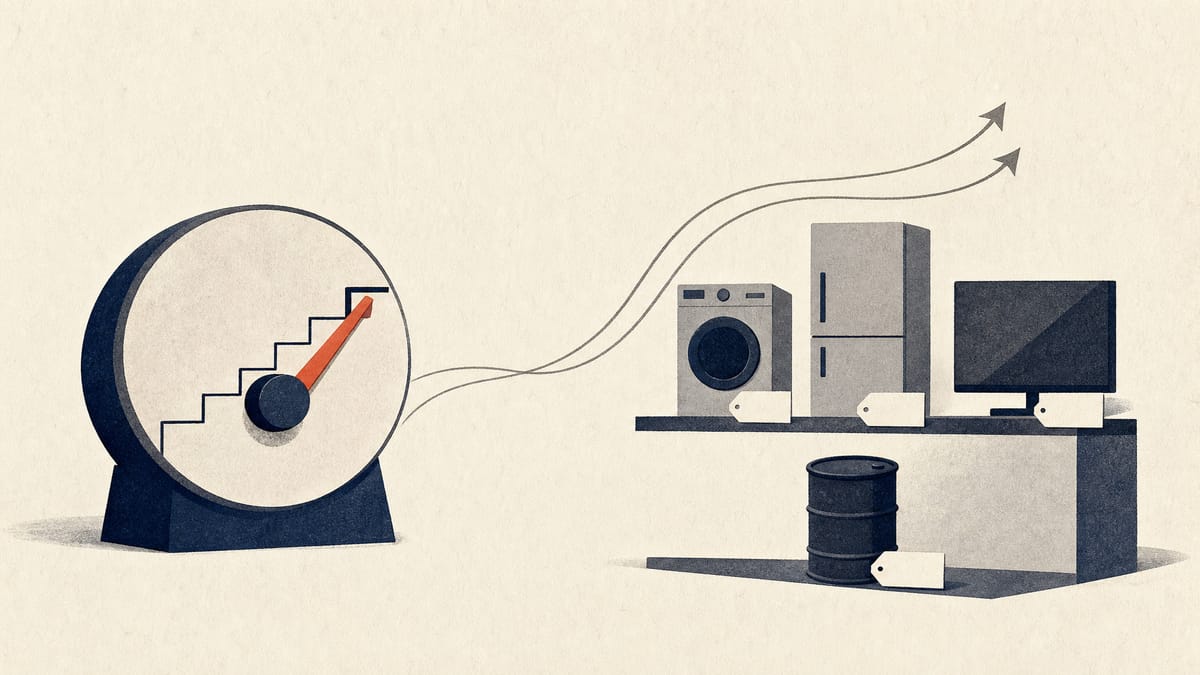
Consumer price inflation excluding fresh food has been rising moderately and has recently been at around 2%, even with government measures to reduce the household burden of higher energy prices. Ueda said the rate is likely to accelerate to a level clearly above 2%. He listed three drivers: continued pass-through of wage increases to selling prices, higher crude oil prices pushing up energy and goods prices, and higher semiconductor prices tied to global AI-related demand together with the yen's depreciation thus far, which are likely to lift durable-goods prices.
He described a strong sense of labor shortage, a mechanism in which wages and prices rise moderately together, and medium- to long-term inflation expectations at around 2%.
The risks it names
The bank names the situation in the Middle East, the expansion in AI-related demand and foreign exchange developments as factors to watch. Because firms are shifting toward raising wages and prices, Ueda said there is a risk that medium- to long-term inflation expectations rise and underlying inflation deviates upward above 2%. That is why, he said, stabilizing underlying inflation around 2% "becomes important": it is the way to keep the upward-deviation risk from materializing and hurting the economy afterward.
On the economy, Ueda said Japan has recovered moderately with some weakness in part, partly due to the Middle East situation. Exports have risen moderately on global AI-related demand, and growth is expected to continue at a decelerated rate. He also said the financial system has been stable on the whole and is likely to stay highly robust, because Japanese financial institutions have sufficient capital bases.