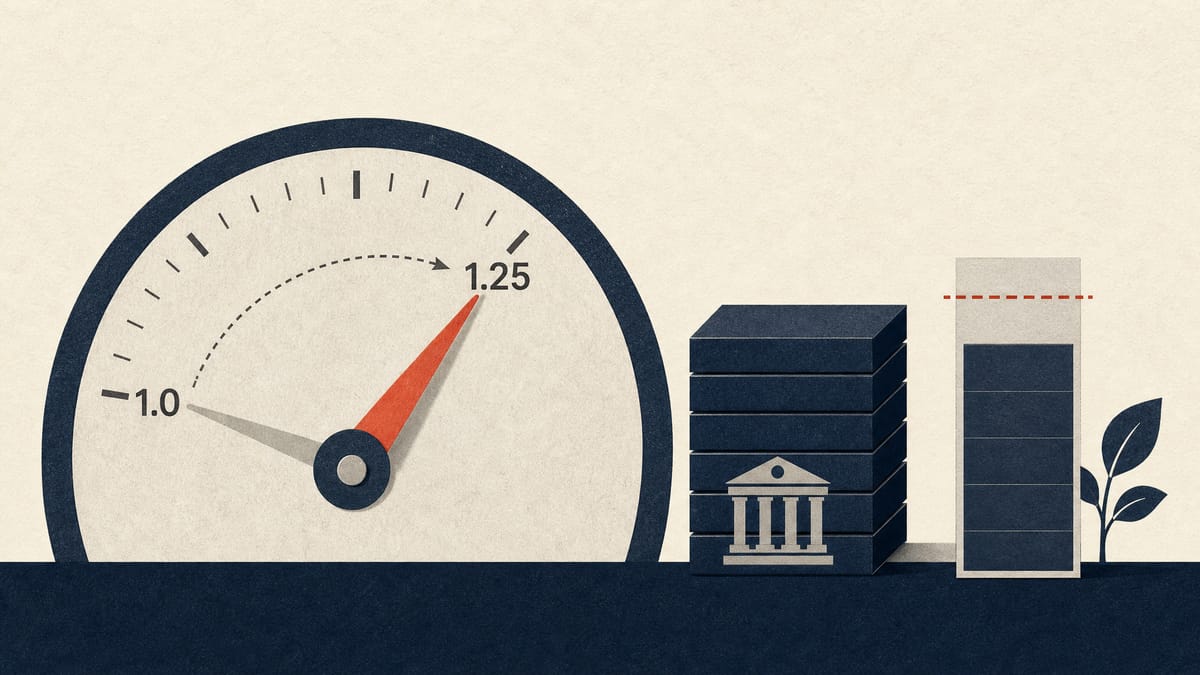
The Bank of Japan's Policy Board voted 7-2 on September 18 to raise its guideline for the uncollateralized overnight call rate to around 1.25%, up a quarter point from around 1.0%, with the change taking effect September 24. Governor Ueda Kazuo and six other members backed the increase; Asada Toichiro and Sato Ayano dissented. Asada argued that core consumer inflation, excluding fresh food, has recently run below 2%, so the economy was not clearly strong enough to justify tightening. Sato said price and activity trends had not accelerated enough to warrant a hike at this meeting.
The rate rise flows directly into two related benchmarks. The interest rate the Bank pays financial institutions on current-account balances at the BOJ, the complementary deposit facility rate, rises to 1.25% from 1.0%. The basic loan rate under the complementary lending facility, along with the basic discount rate, both move to 1.5%. All three changes take effect September 24.
| Rate measure | Previous level | New level |
|---|---|---|
| Uncollateralized overnight call rate guideline | around 1.0% | around 1.25% |
| Complementary deposit facility rate | 1.0% | 1.25% |
| Basic loan rate (complementary lending facility) | not disclosed in the release | 1.5% |
By unanimous vote, separate from the rate decision, the Board also rewrote the terms of its Funds-Supplying Operations to Support Financing for Climate Change Responses. The loan rate on this facility switches to a floating rate, set as the average complementary deposit facility rate over the period each loan is outstanding. The total lending ceiling is ¥50tn, and the amount each counterparty may borrow is now set equal to its own outstanding climate-related investment and loans with at least one year of remaining maturity, capped at ¥10tn per counterparty. Central organizations of financial cooperatives, the umbrella bodies for shinkin and other cooperative lenders, get a separate aggregate limit equal to the sum of what their member institutions would individually qualify for. The Bank made parallel changes to loan rates for its disaster-area support operation and its pooled-collateral funds-supplying operation, tying both to the same floating complementary deposit facility rate. Loans already disbursed under the prior terms keep those terms until they mature. Separately, the Bank will drop the Great East Japan Earthquake from the list of designated disasters eligible for that support facility once the next scheduled disbursement, in May 2027, is complete, citing factors including recent usage of the operation.
The Bank's stated case for tightening rests on its reading of prices and output rather than any single indicator. It judges that Japan's economy "has recovered moderately," despite some weakness tied to the Middle East situation, with growth underpinned by the government's various measures and rising global AI-related demand. Producer prices remain elevated on high crude-oil costs, a weaker yen, and AI-related demand; underlying consumer inflation is edging toward the 2% target as wage increases pass through to selling prices, and medium-to-long-term inflation expectations keep climbing. The Board flagged a risk that underlying inflation could overshoot the 2% target given how firms are behaving on wages and pricing.
On future policy, the Bank said accommodative financial conditions should persist even after this increase, and that it "will continue to raise the policy interest rate and adjust the degree of monetary accommodation," weighing the timing and pace against incoming data rather than committing to a schedule. Takata Hajime and Tamura Naoki, both part of the seven-member majority that approved the rate rise, separately objected to how the Board described the price outlook, arguing underlying inflation had already reached a level consistent with the 2% target. That internal disagreement over language, even among members who voted the same way on the rate itself, points to debate ahead over how fast the Bank moves next rather than whether it moves at all. The Bank's Summary of Opinions from the meeting is due October 1, with full minutes following November 5.