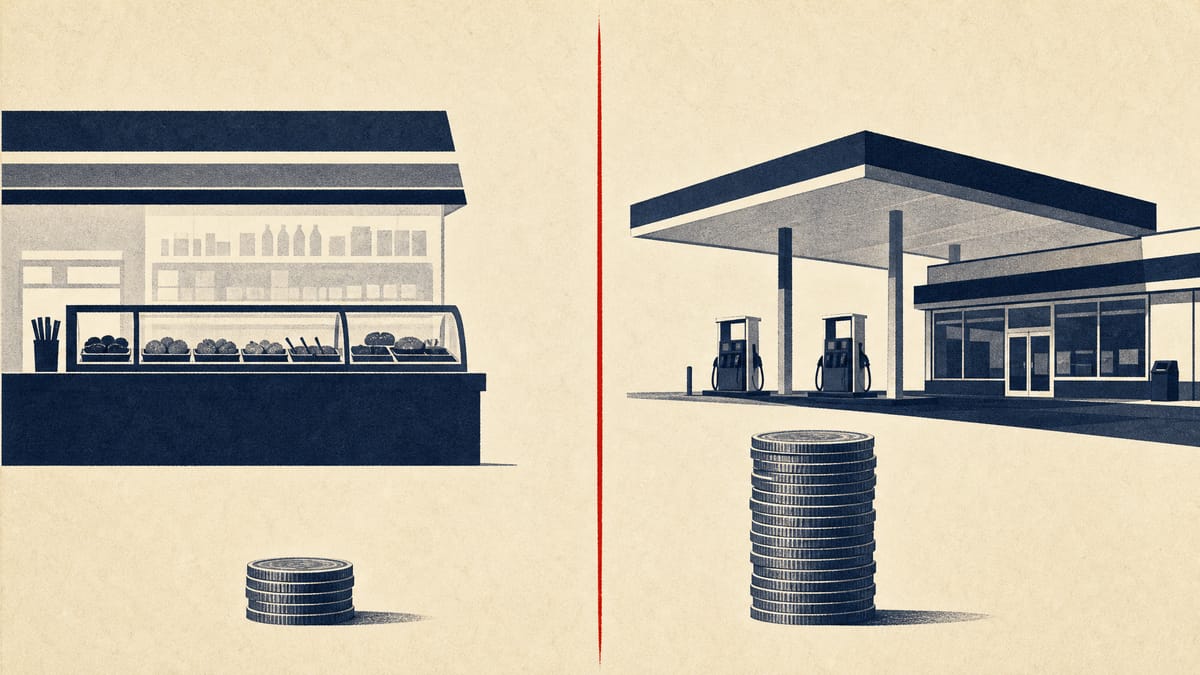
Seven & i Holdings' convenience stores outside Japan supplied the profit growth in the six months to August 2026, while the Japanese chain earned less. Reported operating revenue fell 2.8% to ¥5.46tn, yet operating profit rose 11.5% to ¥232.3bn and net profit attributable to owners of the parent rose 2.2% to ¥124.4bn, according to the company's interim earnings release.
Why revenue falls while profit rises
The revenue decline is largely a consolidation effect. Seven Bank and its subsidiaries left the group's consolidation on June 24, 2025, and York Holdings' subsidiaries on September 1, 2025. The prior-year interim period still counted them as consolidated subsidiaries; this year Seven Bank and BCJ-95 enter as equity-method affiliates. The "Others" segment shows it: revenue of ¥32.4bn was 3.4% of the prior-year figure.
The company also reports an adjusted basis that removes those units from the prior-year period, adds equity-method income at the post-exit stake and strips related special items. On that basis, the prior-year interim stood at revenue of ¥4.70tn and operating profit of ¥170.1bn, and this year's revenue is 116.3% of it, operating profit 136.6% and net profit 117.8%. Those are the company's own restated comparisons and do not match the statutory growth rates above. Currency also helped: the yen's move added ¥311.0bn to revenue and ¥9.4bn to operating profit.
| Segment | Year to date (2026) | Prior year (restated) | Versus prior year |
|---|---|---|---|
| Domestic convenience stores | ¥109.9bn | ¥121.8bn | 90.2% |
| Overseas convenience stores | ¥150.4bn | ¥80.1bn | 187.7% |
| Others | ¥2.7bn | ¥41.4bn | 6.6% |
Overseas earns more, Japan less
Overseas convenience-store revenue rose to ¥4.97tn (117.7% of the prior year) and operating profit to ¥150.4bn. At 7-Eleven, Inc., operating profit was $1,320mn, 145.8% of a year earlier, and ¥209.1bn before goodwill amortisation. The release cites higher U.S. same-store merchandise sales in dollars, a better gross margin from original products, and higher fuel income from market conditions. The company's profit bridge for 7-Eleven, Inc. shows fuel contributing $398mn to a $414mn rise. In the April-to-June quarter, however, U.S. same-store merchandise sales were slightly below the prior year, with customer traffic down.
Japan went the other way. Domestic convenience-store operating profit was ¥109.9bn, 90.2% of the prior year, on revenue of ¥467.3bn (101.0%). At Seven-Eleven Japan, same-store sales rose 1.1% and the merchandise gross margin was flat at 31.8%. Customer numbers fell 1.7% while spending per customer rose 2.8%. Costs outran sales: the company points to up-front investment in in-store cooking equipment and next-generation store systems, plus inflation. In the second quarter alone, operating profit was ¥57.8bn, 86.3% of the prior year, as soft drinks sold poorly and the gross margin slipped. The presentation says the system-cost increase runs through in the fourth quarter and that first-half selling and administrative costs were on plan.
Guidance unchanged, buyback booked
The company left its full-year forecast unchanged from the July 9 version: revenue of ¥10.43tn, operating profit of ¥425bn and net profit of ¥278bn. Interim operating profit was 99.3% of the company's revised plan, with the domestic business at 91.3% of plan and overseas at 103.0%. The interim dividend is ¥30, against ¥25 a year earlier, and the full-year forecast is ¥60.
On August 3 the company bought 189,663,300 of its own shares for ¥400.0bn at ¥2,109 each through ToSTNeT-3, part of it through an accelerated share repurchase with SMBC Nikko Securities. The final effective cost may differ, because a later adjustment transaction ties the price on that tranche to an average share price over a set period. Treasury shares fell to 53.2mn from 292.9mn after a cancellation and a third-party disposal.