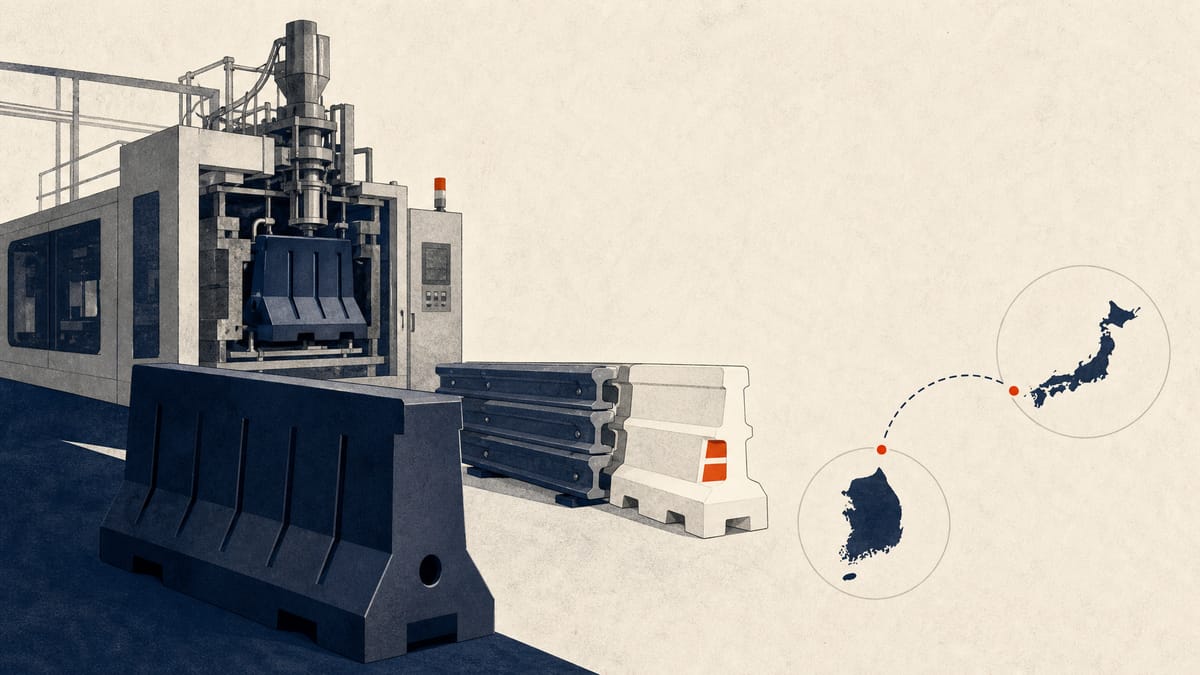
Sekisui Jushi (TSE Prime: 4212) completed its acquisition of control of Hi-Q Co., Ltd. on October 6, paying KRW58bn for a South Korean maker of road and construction safety products.
What it buys
Hi-Q, founded in 1987 and based in Hwaseong, Gyeonggi Province, develops, makes and sells road and construction safety products. Its wholly owned subsidiary HIQ VINA, set up in 2018 in Bac Ninh Province, Vietnam, makes and sells similar goods. Sekisui Jushi says the pair give it a development, manufacturing and sales base in Korea and a manufacturing site in Vietnam with enough capacity to serve the wider Asian region. It also cites Hi-Q's blow-moulding and large injection-moulding capabilities as a way to widen its product range.
The numbers
Hi-Q reported 2025 sales of KRW27.1bn and operating profit of KRW2.2bn, up from KRW1.2bn in 2024, with net assets of KRW30.3bn. HIQ VINA's 2025 sales were KRW5.5bn, against KRW3.2bn in 2023, with operating profit of KRW0.7bn. Hi-Q does not prepare consolidated accounts, so the figures are for each company separately. Other financial details are withheld at the counterparty's request, and the release does not state the size of the stake acquired.
Timing and earnings
Sekisui Jushi's board approved the deal and the contract was signed on June 29, 2026. Sekisui Jushi has a March year-end and Hi-Q and HIQ VINA have December year-ends. With a deemed acquisition date of October 31, the earnings effect should begin in the fourth quarter of the year to March 2027, and the company expects a minor effect on its current consolidated forecast.