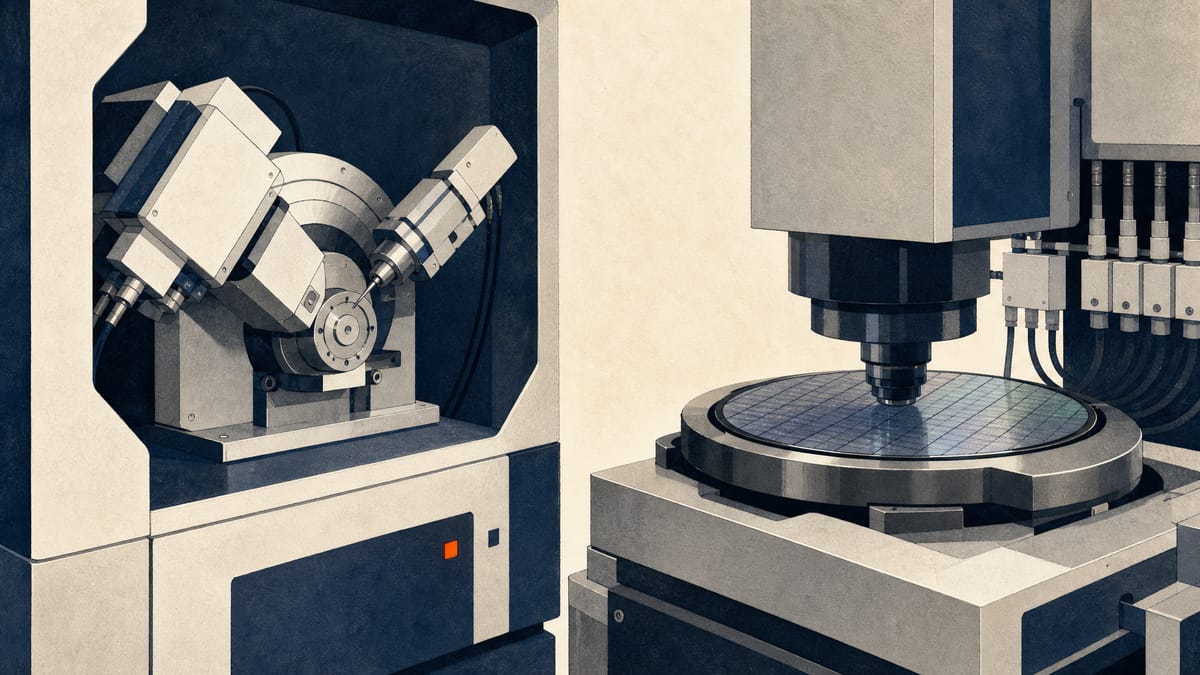
Rigaku Holdings, the Tokyo-listed maker of X-ray diffraction and fluorescence instruments, disclosed a rough first half in a semiannual securities report filed August 14, 2026: operating profit fell to ¥2.6bn from ¥5.7bn in the six months to June, even as revenue slipped only slightly, to ¥39.6bn from ¥40.8bn a year earlier. Net profit attributable to shareholders dropped to ¥1.6bn from ¥3.8bn.
| Metric | Six months to June 2025 | Six months to June 2026 |
|---|---|---|
| Revenue | ¥40.8bn | ¥39.6bn |
| Operating profit | ¥5.7bn | ¥2.6bn |
| Net profit attributable to owners | ¥3.8bn | ¥1.6bn |
The company traces the weakness to its multipurpose analytical-equipment business, where revenue fell 17.1% to ¥15.1bn. Rigaku attributes that decline to the continuing impact of US trade policy under the Trump administration and to energy-price swings tied to tensions in the Middle East, not to any single funding source. Separately, in its business-risk disclosure, Rigaku notes that US academic funding for research equipment has recently been cut, reducing purchases by the universities and public research institutes that buy its instruments. The filing presents that as an ongoing risk for future periods rather than the stated cause of this half's results.
The offset came from chipmaking tools. Revenue from Rigaku's semiconductor process-control equipment rose 18.2% to ¥12.8bn, which the company credits to strong memory and logic demand and steady progress on new product orders. Rigaku's risk disclosure notes that some of this equipment serves AI-chip production specifically, tying part of that growth to the pace of the AI buildout.
The bigger structural change sits outside the earnings line. Carlyle-backed Atom Investment, L.P. completed the sale of its 26.99% stake in Rigaku, 61,123,436 shares, to US semiconductor-metrology supplier Onto Innovation Inc. on August 10, 2026. Under the capital and business alliance, Onto Innovation gets the right to nominate one non-executive director to Rigaku's board, and has named its own chief executive, Michael Plisinski, as that nominee. The two companies plan to jointly develop hybrid metrology solutions for advanced AI chips.
For a company already exposed to swings in US research spending, the Onto tie-up pulls Rigaku further into the orbit of chip-tool demand just as its older analytical-instruments business cools. Rigaku's own filing warns that if Japanese or US subsidy programs for semiconductor manufacturing were scaled back, demand for its process-control equipment could fall too.