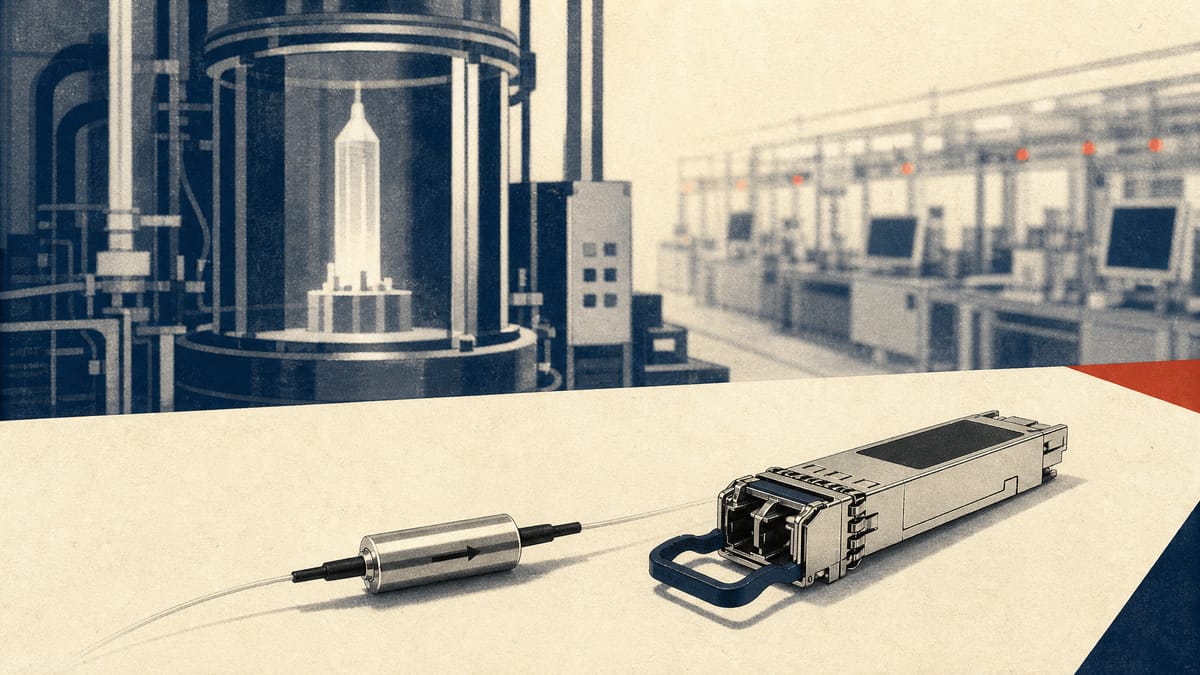
OXIDE Corporation, the crystal-growth specialist listed on the Tokyo Stock Exchange Growth market, told the exchange on August 19, 2026 that its executive committee had approved a ¥1.455bn capital investment to expand production of Faraday rotators. The equipment will be installed at OXIDE's planned No. 6 factory in Hokuto City, Yamanashi Prefecture, with operations due to start in the second half of the fiscal year ending February 2027.
| Item | Detail |
|---|---|
| Investment amount | ¥1.455bn (planned) |
| Facility | Production equipment for increased Faraday rotator output at the planned No. 6 factory, Hokuto City, Yamanashi Prefecture |
| Start of operations | Second half of the fiscal year ending February 2027 (planned) |
| Earnings impact | Described as minor for the year ending February 2027; no forecast revision as of August 19, 2026 |
Faraday rotators are the core component inside optical isolators, small devices mounted in optical transceivers that stop reflected light from bouncing back into laser sources and disrupting data-center circuits. By rotating light's polarization plane and pairing that rotation with a polarizing plate, the rotator protects the stability and reliability of high-speed optical links, OXIDE said in its filing. The company builds the parts using single-crystal growth technology it has developed over many years.
OXIDE points to expanding generative-AI workloads as the force behind faster, higher-capacity data-center connections, both within and between facilities. That growth has lifted demand for the optical transceivers carrying that traffic, and in turn for the Faraday rotators that keep those transceivers running without interference from reflected light, the company said.
The company was careful to bound near-term expectations. OXIDE said the investment's impact on its consolidated results for the year to February 2027 will be minor, and it has not revised the earnings forecast it published on April 14, 2026. Management said it will disclose any needed revision to that forecast promptly. The equipment itself will not even be running until the back half of the current fiscal year, leaving the capacity payoff, and any earnings effect from it, for later reporting periods.